
Cassava moves from farm to factory to table through a system that creates wealth at every stage. Knowing that system is the difference between farming cassava and building a business around it.
The cassava value chain is the complete journey of cassava from planting to consumption. It connects farmers, processors, traders, exporters, and end users through a structured system where each stage depends on the next.
When this chain works well, it reduces waste, improves product quality, and creates multiple entry points for income generation across food, industry, and trade. When it breaks down at any point, losses ripple through the entire system.
This guide covers every stage of that chain in detail: cultivation, harvesting, processing, distribution, consumption, and the business opportunities embedded at each level.
If you are new to cassava, start here: Cassava for beginners.
Table of Contents
I Have Been Inside This Value Chain My Entire Life
I grew up in Abia State, Eastern Nigeria, where cassava is not a development topic, it is what families farm, process, eat, and sell to survive and build wealth.
I have planted cassava stems, harvested roots, peeled and grated tubers, produced cassava starch from my own farm, and registered Cassava Pathway as a formal agribusiness to serve this market commercially.
The insights in this guide come from that lived experience, not from policy documents.
Every stage described here is one I have worked through with my own hands in a community where cassava farming is generational knowledge.
How the Cassava Value Chain Works
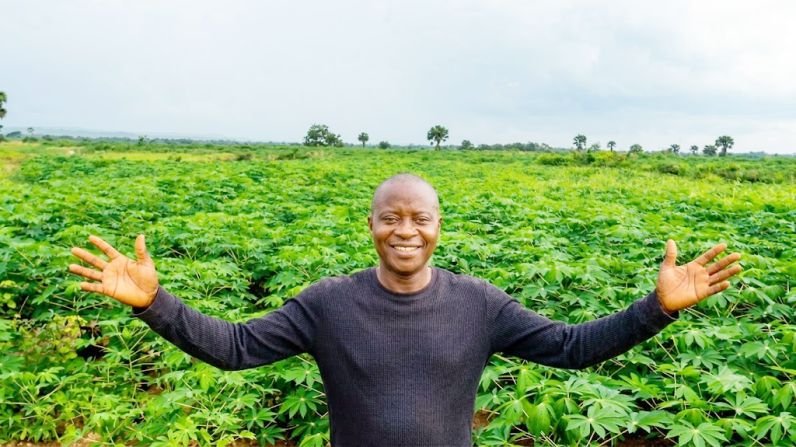
Cassava Farming and Production
Cassava cultivation is the foundation of the value chain. This hardy, drought-tolerant crop grows well in poor soils and marginal lands where other crops regularly fail.
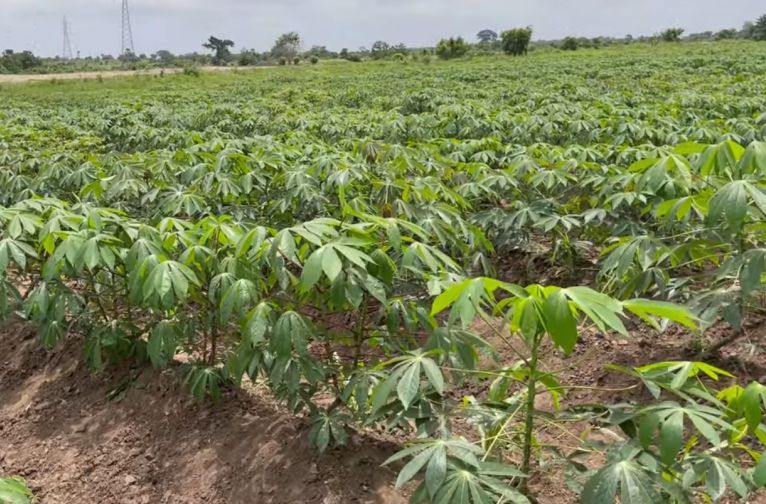
In Abia State where I farm, cassava goes into the ground as stem cuttings at the start of the rainy season and comes out 8 to 12 months later as heavy, starch-rich tubers.
The yield you get out depends entirely on the decisions you make going in, variety selection, land preparation, planting spacing, weed control, and pest management.
Success depends on selecting the right varieties, proper land preparation, sound planting techniques, and effective pest and disease management. Good agronomic practice at this stage directly determines yield and root quality for every stage that follows.
Explore the full cassava cultivation and farming guide.
Harvesting and Post-Harvest Handling
Harvesting is a critical stage in the cassava value chain. Proper timing and careful technique determine root quality, starch content, and market value.
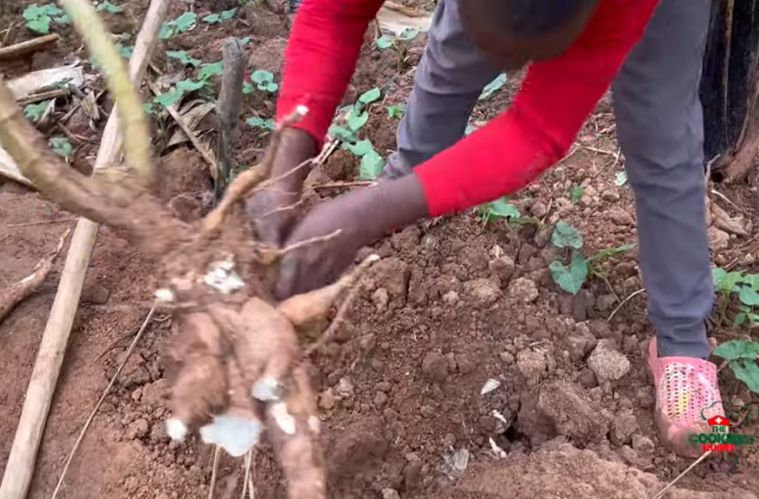
Most varieties mature between 8 and 12 months, signaled by yellowing leaves and visible root size.
Farmers must harvest cassava roots carefully to avoid bruising, then immediately wash, sort, and move the highly perishable roots.
Without quick action, cassava spoils within 2 to 3 days. In my community, this urgency is understood by every farmer; you do not leave harvested cassava in the field overnight if you can help it.
The losses that come from poor post-harvest handling are not abstract statistics. They are real income disappearing from real households.
Post-harvest handling, including proper storage or rapid transport to processing, plays a major role in reducing losses and preserving the value that cultivation created.
Read the full guide: Post-Harvest Handling of Cassava
Processing and Value Addition
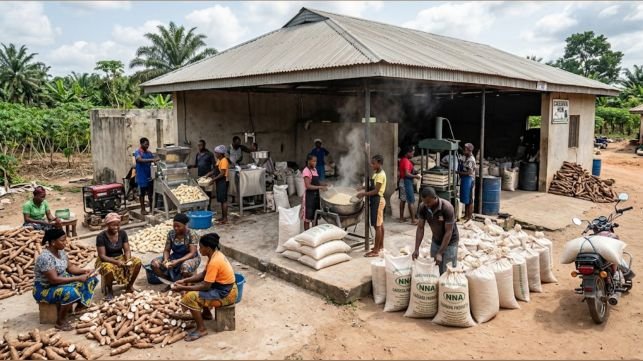
Processing is the heart of the cassava value chain. Fresh cassava roots spoil quickly, so processing preserves them and transforms them into products with dramatically higher market value and shelf life.

The process includes peeling, washing, grating, pressing, drying, and milling.
Participating in these processes is a routine everyone in my community learns from childhood.
While we use local equipment to get things done at the subsistence level, going commercial requires semi-modern or modern equipment for reasonable output.
Producing cassava starch from roots I grew myself, grating, sieving, drying, and milling the powder, gave me a direct understanding of where quality is gained and where it is lost in processing.
Processing transforms raw cassava into cassava flour, tapioca starch, tapioca pearls, cassava flakes or garri, cassava chips, fufu, pellets, ethanol, and industrial starch.
Each product serves different market needs, from household meals to large-scale manufacturing.
Visit the full cassava processing guide for detailed methods.
Distribution, Market, and Trade
The cassava value chain connects farmers, processors, and industries across local and global markets.
Cassava is a major staple crop in tropical regions, with top producers including Nigeria, Brazil, Thailand, and Indonesia.
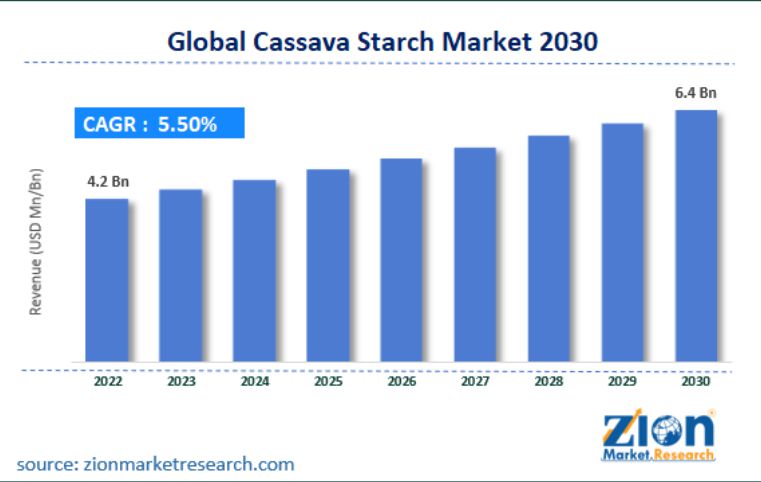
Demand is rising globally due to cassava’s role in food production and industries like starch processing, biofuels, and animal feed.
Locally, cassava feeds communities through garri, fufu, and flour.
Globally, the growing gluten-free market has opened new commercial opportunities for cassava-based products, while industries rely on cassava starch for food, textiles, and pharmaceuticals.
Prices fluctuate based on seasonal harvests, climate conditions, and trade policies.
Poor infrastructure and export restrictions limit market access for smallholder farmers across West Africa, a challenge I deal with directly in Abia State, where road conditions and logistics costs affect the price the market will actually deliver versus what it promises on paper.
Being aware of these factors helps businesses and farmers make informed decisions about where to enter the chain and how to protect their margins.
Read about the cassava market and trends here.
Cassava Foods and Cooking
In the cassava value chain, food is where most people first encounter cassava.
It is the most visible end of the chain and the one with the most direct cultural meaning in communities across West Africa, Latin America, and Southeast Asia.
While most local cassava farmers in Nigeria, like those in my community, rely solely on subsistence cassava farming for garri and fufu, there is a growing awareness of the need to add more value for more business opportunities.
Cassava works well in many meals, from traditional African and Latin American dishes to modern gluten-free baking.
Its mild taste and flexible texture make it suitable for both savory and sweet recipes.
Common uses include boiled cassava root, fried cassava, cassava flour breads, cakes, and pancakes.
It also appears in tapioca puddings, bubble tea pearls, garri, and fufu as everyday staples.
Each preparation method brings out different textures and flavors, making cassava a practical ingredient for home cooking and commercial food production.
See the full cassava foods and recipes guide.
Consumption in the Cassava Value Chain
Every time someone eats garri, fufu, cassava flour bread, or a tapioca-based product, they are participating in the cassava value chain. Industries do the same when they use cassava starch for sweeteners, ethanol, or animal feed.

Consumer demand drives what farmers plant, what processors produce, and what traders move.
The growing global interest in gluten-free alternatives has created new demand signals that were not part of cassava’s traditional market footprint.
That shift creates real income opportunities for farmers and processors who can meet the quality standards those markets require.
Benefits: Economic, Health, and More
Cassava delivers value beyond processing and sales. When properly processed, it provides genuine nutritional and health benefits for everyday diets.
It is naturally gluten-free, making it a strong option for gluten-sensitive consumers and alternative baking markets.
On the economic side, cassava supports farmers, processors, and traders through flour, garri, starch, and industrial products that create income across multiple levels of the chain.
In communities like mine in Abia State, cassava is not a supplementary crop; it is a primary economic driver that sustains households from planting through processing and sale.
Read more about cassava benefits.
Products in the Cassava Value Chain and Their Roles
Cassava moves through different stages of processing, turning raw roots into food, industrial materials, energy sources, and trade products that support farming and manufacturing systems.
| Product | Primary Use | Value Added |
|---|---|---|
| Fresh Cassava Tubers | Raw consumption, processing | Basic |
| Cassava Chips | Food, feed, raw material for starch and ethanol | Medium |
| Cassava Flour | Baking, thickening | High (gluten-free) |
| Garri | Daily staple food | Medium-High |
| Fufu | Traditional staple meal | Medium |
| Tapioca/Cassava Starch | Food, textile, paper, adhesive | Very High |
| Modified Cassava Starch | Industrial processing | Very High |
| Tapioca Pearls | Beverages, desserts | High |
| Animal Feed | Livestock feeding | Medium |
| Ethanol | Biofuel, industrial use | High |
| Cassava Pulp | Feed, biogas, compost | Medium |
| Cassava Peels | Feed, fertilizer, waste recovery | Medium |
| Cassava Syrup | Sweeteners in food and drinks | High |
| Cassava Beer | Traditional beverages | Medium |
| Cassava Pellets | Export feed, industrial starch supply | High |
| Cassava Leaves | Vegetable, a source of nutrition | Nutritional |
Explore the full list of cassava-based products.
Challenges in the Cassava Value Chain
The cassava value chain struggles with inefficiencies that hurt every player from farm to market.
These are not theoretical problems; they are realities that active farmers and processors deal with daily.
From the outside, people don’t understand until they become players in the value chain.
We farmers in Nigeria know the challenges we have to face: poor roads, the government paying a deaf ear, and more.
Below are some of the challenges we look out for along the value chain:
- Post-Harvest Losses: Cassava spoils within 2 to 3 days of harvest. Without adequate processing infrastructure close to farms, a large portion of every harvest is lost before it reaches any market.
- Poor Infrastructure: Bad roads, unreliable power supply, and limited cold storage drive up logistics costs and reduce the effective market radius for fresh cassava. In South Eastern Nigeria, road conditions between farming communities and processing centers remain one of the most consistent barriers to value chain efficiency.
- Traditional Methods and Low Technology Adoption: Many smallholder farmers still use hand tools and manual processing methods, limiting throughput and product consistency. Meeting industrial demand for quality cassava flour or starch requires mechanization that most small operations cannot yet afford.
- Market Access and Price Instability: Small-scale farmers frequently sell to the nearest buyer at whatever price is offered, with no visibility into what the market is actually paying downstream. This information gap is where most of the smallholder margin is lost.
- Pests and Diseases: Cassava mosaic disease, brown streak disease, mealybugs, and mites threaten yields across West Africa. Variety selection and early detection are the first line of defense.
See the full post on challenges facing the cassava value chain.
Lucrative Opportunities in the Cassava Value Chain
The cassava value chain holds real commercial opportunities at every stage for entrepreneurs who understand where value is created and where it is currently being lost.
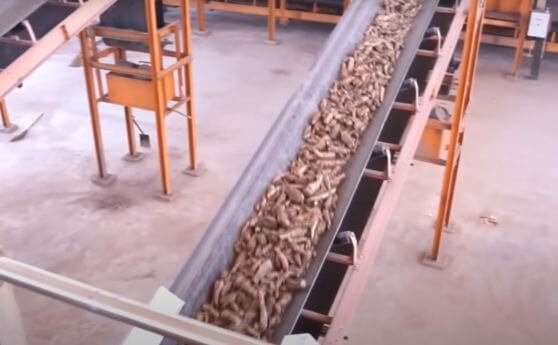
Processing and Value Addition: The gap between raw cassava root prices and processed product prices, like high-quality cassava flour prices, is where the most accessible profit sits. A farmer who can also process, even on a small scale, captures the margin that currently goes to intermediaries.
Gluten-Free Market: Growing global demand for gluten-free alternatives has opened export and premium domestic markets for cassava flour and starch that did not exist a decade ago.
Industrial Starch Supply: Demand for cassava starch in food, textile, pharmaceutical, and paper manufacturing is outpacing local supply in many markets. Quality-certified starch producers have a strong commercial position.
Mechanization Services: Providing processing services, grating, pressing, drying, and milling to smallholder farmers who cannot afford their own equipment is a viable and scalable business model in cassava-producing communities. More on cassava processing equipment.
Export and Aggregation: Aggregating cassava products from multiple smallholder processors and selling into export markets or to large domestic buyers is a margin opportunity that requires logistics capability and market relationships more than land.
Explore the full post on cassava business opportunities.
Factors That Guarantee Success in the Cassava Value Chain
- Access to Raw Materials: Reliable cassava supply through direct farming or outgrower arrangements with local farmer groups. Without consistent root supply, processing operations cannot run profitably.
- Strategic Location: Proximity to cassava-producing areas reduces transport costs. Proximity to markets reduces distribution costs. Where those two overlap is where processing operations belong.
- Cost-Efficient Production: Labor-saving equipment for peeling, grating, and pressing reduces the labor intensity that makes small-scale cassava processing difficult to scale. Equipment investment pays back in throughput and consistency.
- Quality Control: Sorting, moisture testing, microbial management, and consistent drying standards determine whether your product meets food industry specifications or gets rejected at the buyer’s gate.
- Market Development: Building relationships with buyers before scaling production prevents the common trap of producing inventory with no outlet. Know your buyer before you expand your capacity.
- Access to Finance: Bank loans, microfinance institutions, government agricultural funds, and impact investors all provide capital pathways. The right source depends on the scale and stage of your operation.
- Research and Partnerships: Collaboration with agricultural research institutes on variety selection, disease management, and processing technology gives small operators access to knowledge they could not develop independently.
Government’s Role in the Cassava Value Chain
Government policy influences the cassava value chain more than most farmers realize, and not always positively.
In Nigeria, cassava is a designated strategic crop with official programs supporting cultivation, processing, and export.
The policy intent is strong. The implementation gap between policy and what actually reaches farming communities in states like Abia is where most of the frustration lies.
Road infrastructure, rural electrification, input subsidy programs, and export facilitation all directly affect whether a smallholder cassava farmer can compete and profit or simply survive.
When roads are poor, transport costs eat into the margin. When power is unreliable, processing equipment sits idle.
When import duties and export restrictions shift without notice, market planning becomes guesswork.
The government interventions that make the most practical difference are the ones that reduce the cost of getting cassava from farm to processor and from processor to market.
Everything else- branding campaigns, international trade missions, innovation competition, matters far less than fixing the road between the farm and the mill.
Frequently Asked Questions
What is the cassava value chain?
It is the complete system of activities from cultivation to consumption, connecting farmers, processors, traders, and buyers through linked stages of production and commerce.
Who are the actors in the cassava value chain?
Farmers, processors, transporters, marketers, input suppliers, exporters, and consumers all play vital roles across the different stages of the cassava value chain.
What are the five stages of the cassava value chain?
Production, processing, distribution, marketing, and consumption form the five major segments, each with distinct activities, challenges, and income opportunities.
What are the value-added products of cassava?
Value-added cassava products include garri, fufu, cassava flour, ethanol, starch, chips, tapioca pearls, animal feed, cassava syrup, and modified starch for industrial use.
What are the key challenges in the cassava value chain?
Post-harvest losses, poor infrastructure, limited market access, low technology adoption, and pest and disease pressure are the primary challenges affecting chain efficiency and profitability.
How can the cassava value chain be improved?
Improvement requires better post-harvest handling, investment in processing technology, stronger market linkages, reliable infrastructure, and policy support that actually reaches farming communities.
What is cassava value addition in Nigeria?
It involves transforming raw cassava roots into products like garri, starch, flour, and ethanol for food, industrial, and export markets, capturing higher margins than raw root sales.
How do I profit from the cassava value chain?
Enter at the processing or aggregation stage, where the margin between raw material and finished product is largest, and build reliable supply and buyer relationships before scaling.
Conclusion
The cassava value chain is not complicated in principle. Raw roots go in at the farm and finished products come out at the market.
What makes it challenging is the gap between those two ends, the infrastructure failures, the processing bottlenecks, the market information asymmetries, and the capital constraints that prevent most participants from capturing the value the chain is capable of generating.
I have spent my life working inside that gap in Abia State, from planting and harvesting on my own farm to processing cassava starch and building Cassava Pathway as a registered agribusiness. The opportunity is real.
So is the work required to capture it. This site documents both honestly, from someone who has never watched this chain from the outside.
Chimeremeze Emeh
Chimeremeze Emeh is a tropical crop farmer and chemical engineer from Ntigha, Isiala Ngwa North LGA, Abia State, Eastern Nigeria, specializing in cassava and palm oil, with over 30 years of hands-on experience growing, harvesting, and processing cassava. He grows TMS series, TME 419, and local traditional varieties on his own farms and operates a small-scale cassava flour and starch production business through Cassava Pathway, which he founded as a CAMA-registered agribusiness in 2024. He is also the founder of Palm Oil Pathway, where he applies the same tropical farming expertise. His farms are located in Ntigha, Abia State.