Last updated on October 31st, 2026 at 03:23 pm
Every sheet of printing paper carries a hidden layer of starch that stops ink from bleeding into the fibers. Cassava starch for the paper industry competes for that job against maize, potato, and wheat, and research shows it holds its own.
Paper passes through my hands almost daily, because besides producing starch in Nigeria, I also print and bind jobs for clients.
A sheet that drinks ink or sheds fibers ruins a print run, and starch is one reason good paper behaves well.
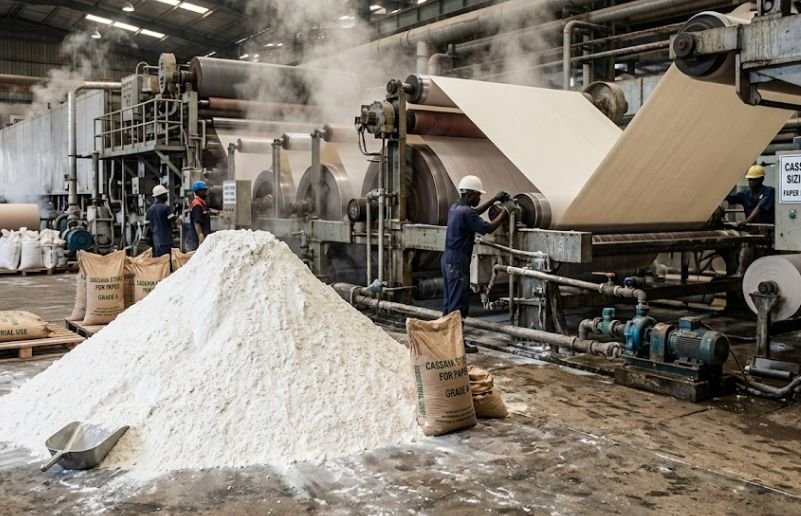
Mills add it at three points: inside the pulp, on the surface at the size press, and in pigment coatings.
Below, each use is explained with figures from paper researchers, alongside trials that tested cassava against other starches.
Nigeria’s idle paper mills, and the trillions of naira now spent on imports, close out the discussion.
Table of Contents
Three Places Starch Enters a Sheet
| Stage | Starch type usually chosen | Main purpose |
|---|---|---|
| Wet end, inside the pulp | Cationic starch | Holds fines and fillers, adds internal strength |
| Size press, on the surface | Oxidized or enzyme-converted starch | Seals the surface for writing and printing |
| Coating color | Low-viscosity starch binder | Binds pigment particles to the base sheet |
Strength is the main reason mills buy starch, a Bergh review for the Fundamental Research Committee states plainly.
That review found Europe’s paper industry consumed about 1.3 million tonnes of the region’s 2.8 million tonnes of starch in 1995.
Usage varies wildly by grade, from none at all in some papers to as much as 70 kilograms per tonne in others.
Surface Sizing Takes the Largest Share
Around 60 percent of all starch used by paper mills goes into surface sizing, according to Fraunhofer IAP.
At the size press, a thin starch solution soaks into both faces of the moving web before drying.
That layer adds strength, stiffness, and dimensional stability, while also improving printability, the Fraunhofer researchers note.
A 2021 overview in Paper and Biomaterials adds that surface sizing raises water and abrasion resistance.
Oxidized starch forms a continuous film that pins loose fibers down, which helps both handwriting and press work.
Viscosity decides where the starch ends up, Bergh explains, with thin solutions penetrating deeper and thicker ones staying near the surface.
Starch near the face reduces linting and dusting, the fluff that clogs printing blankets and spoils fine detail.
Cationic Starch at the Wet End
Wood fibers and mineral fillers carry a negative charge, so positively charged starch clings to them readily.
Cationic starches act as retention aids and strongly influence paper strength, Fraunhofer reports.
Closed water loops and heavier use of recycled fiber now push mills toward cationic grades with carefully tuned structures.
The Paper and Biomaterials overview credits cationic starch with high adsorption on fiber and good water-holding capacity.
Charge, oxidation, and enzyme treatments are explained with diagrams in modified tapioca starch production.
Where Cassava Stands Against Maize and Potato
Potato, maize, and wheat remain the main starch sources in European papermaking, with tapioca used only in small quantities, Bergh notes.
Geography explains much of that, because Europe grows potatoes and wheat while cassava belongs to the tropics.
Tapioca starch contains hardly any protein or lipid, so its cooked solutions stay clear in sizing baths.
Malaysian researchers tested carboxymethyl cassava starch blended with polyurethane as a surface size, Chemical Engineering Transactions reported in 2017.
Water contact angle rose to 73 degrees with the blend, against 62 for plain carboxymethyl starch and 40 for unsized paper.
A higher contact angle means water beads up instead of soaking in, the property writers and printers want.
Starch from the same root can also become glue for paperboard and cartons, a use described on the cassava starch adhesives page.
Paperboard Glue From Ghanaian Cassava
Researchers at the Forestry Research Institute of Ghana studied local cassava flour as a replacement for wheat flour in paperboard adhesive.
Their 2003 project report, led by Sekyere, Darkwa, and Jetuah, compared starch from several Ghanaian varieties.
They chose the Abasafitaa variety, whose starch dissolved readily and resisted the strong absorbent pull of paper better than the others.
A small clay addition of 2 grams further improved gluing in their formulation.
That Ghanaian work shows cassava starch for the paper industry can come from West African roots, not only Asian factories.
Variety matters in Nigeria too, and improved lines like TME 419 differ from local types, as my notes on cassava types grown in Ntigha show.
Nigeria’s Paper Mills Stand Idle
Nigeria spent about ₦1.63 trillion importing paper and allied products over five years to 2022, BusinessDay reported in 2023.
The 2022 bill alone reached ₦412 billion, up 25 percent on the previous year.
Jebba’s mill once made about 65,000 tonnes a year of kraft, liner, and sack paper by 1985.
Iwopin produced fine writing and printing paper, while Oku-Iboku was built for newsprint, yet all three are now described as distressed.
With no large mills running, there is almost no local paper industry buying Nigerian cassava starch today.
Factories that could buy domestic starch, if they reopened, are profiled among starch buyers across twelve industries.
Supplying Cassava Starch for the Paper Industry
- Steady viscosity: size press recipes depend on starch that behaves the same from one delivery to the next.
- Low impurities: sand, fiber, and peel fragments cause spots and holes in finished paper.
- Large, reliable volume: a paper machine runs around the clock and cannot pause for a late truck.
- Modified grades: most mills buy cationic or oxidized starch rather than the native powder small units make.
Starch from my small Ntigha unit suits cooks and bakers, not a paper machine running nonstop.
Thai suppliers dominate export starch for exactly these reasons, as figures on the Thai tapioca export trade make clear.
Yarn sizing, a close cousin of surface sizing, appears in textile uses of cassava starch.
Extraction from the root itself, step by step, is shown in my starch and flour method.
Conclusion
Mills use starch in three places: cationic grades inside the pulp, film-forming grades at the size press, and binders in coatings.
Surface sizing alone absorbs about 60 percent of paper starch, sealing sheets against ink and water.
Cassava starch for the paper industry remains a minor source in Europe, yet trials show modified grades sizing paper well.
Nigeria imported ₦1.63 trillion of paper products in five years while its own mills sat idle.
Printers, packagers, or researchers curious about starch from Ntigha can ask Cassava Pathway about starch orders or technical questions on WhatsApp.
Frequently Asked Questions
Why do paper mills add starch?
Starch adds strength, stiffness, and a sealed surface that accepts ink cleanly.
Mills add it inside the pulp, at the size press, and within pigment coatings.
What is cationic starch in papermaking?
It is starch given a positive charge so it clings to negatively charged fibers and fillers.
That grip improves retention of fine particles and raises internal paper strength.
Is tapioca starch common in paper mills?
In Europe, mills mainly use potato, maize, and wheat starch, with tapioca in small amounts.
Cassava-growing regions in Asia use more, particularly in modified surface sizing grades.
Does Nigeria produce its own paper?
Very little, because the large Jebba, Iwopin, and Oku-Iboku mills are all reported as distressed.
Paper and allied product imports cost the country about ₦412 billion in 2022 alone.

Chimeremeze Emeh is a tropical crop farmer and chemical engineer from Ntigha, Isiala Ngwa North LGA, Abia State, Eastern Nigeria, specializing in cassava and palm oil, with over 30 years of hands-on experience growing, harvesting, and processing cassava. He grows TMS series, TME 419, and local traditional varieties on his own farms and operates a small-scale cassava flour and starch production business through Cassava Pathway, which he founded as a CAMA-registered agribusiness in 2024. He is also the founder of Palm Oil Pathway, where he applies the same tropical farming expertise. His farms are located in Ntigha, Abia State.