Cassava, known as yuca or manioc, quietly powers kitchens and farms across the tropics. This tough root crop delivers steady energy, flexible uses, and real opportunities for those who grow and process it. Discover its basic story here.
This crop ranks among the world’s most important root crops.
It thrives in harsh conditions and supports millions of people across Africa, Asia, and Latin America. See cassava as a staple food.
Beyond its humble roots lies immense potential: this super crop is food, income, and industry all in one.
In this cassava basics guide, you will learn its botanical identity, physical features, types and varieties, safety information, value chain, and its place in human history.
Whether you are a home cook, farmer, or entrepreneur, you will build a clear foundational knowledge.
What Decades of Farming This Crop Actually Teaches You
There is a version of cassava knowledge that comes from research, and a version that comes from spending your life growing, harvesting, and processing the crop commercially.
This guide draws on the second kind. The author, Chimeremeze, has been on the cassava farm since childhood and has witnessed decades of cassava cycles, produced cassava starch and flour, and built Cassava Pathway as a registered agribusiness around this crop.
The basics covered here are things I have worked through with my hands, not just my reading.
Table of Contents
What is Cassava, the Yuca Plant, aka Manioc?
Cassava is a tropical root crop scientifically known as Manihot esculenta. It produces starchy underground tubers that serve as a major food source for millions.
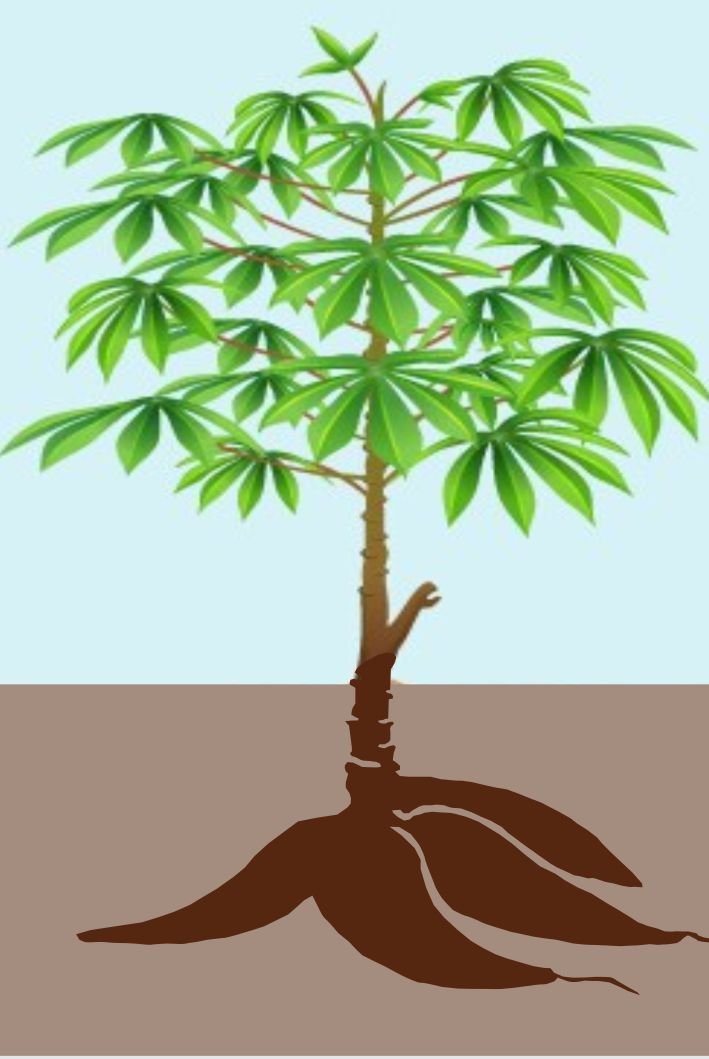
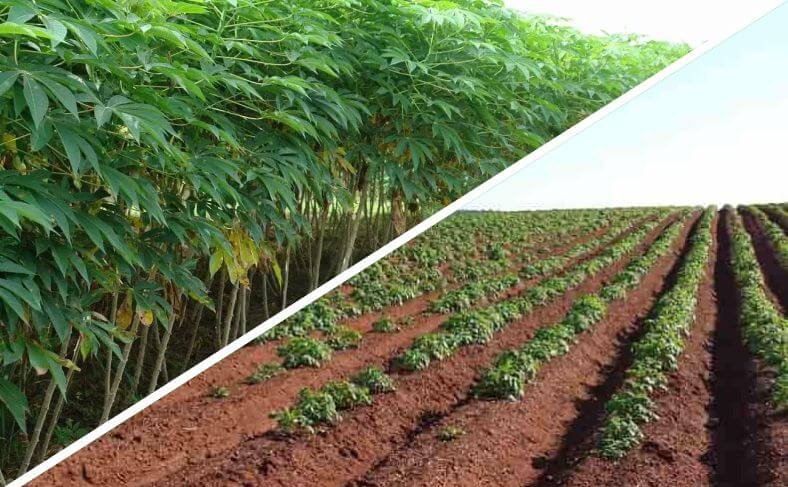
Yuca features woody stems, palm-shaped leaves, and clusters of elongated roots.
It grows widely across Africa, Asia, and Latin America due to its ability to survive in poor soils and dry conditions.
Botanical Description and Taxonomy
Yuca, scientifically known as Manihot esculenta, belongs to the plant family Euphorbiaceae, which includes other well-known species like the castor oil plant (Ricinus communis), poinsettia (Euphorbia pulcherrima), croton (Codiaeum variegatum), leafy spurge (Euphorbia esula), and Chinese tallow tree (Triadica sebifera).
Quick Facts about Cassava
| Scientific name | Manihot esculenta Crantz |
| Family | Euphorbiaceae |
| Other names | Yuca, manioc, mandioca, garri plant, singkong, kamoteng kahoy |
| Native to | Amazon basin, South America |
| Edible part | Starchy root (tuber); young leaves also eaten |
| Time to harvest | 8–12 months from planting |
| Climate | Tropical, 25–30°C, 1,000–2,000mm rainfall/year |
| Major producers | Nigeria, DR Congo, Thailand, Indonesia, Brazil, Ghana |
| Toxicity | Contains cyanogenic glycosides — never eaten raw |
| Global ranking | One of the world’s most-consumed root crops; a primary calorie source across the tropics² |
How Cassava is Known Around the World
Known by many names across regions, this root crop reflects its global significance and cultural reach.
In South America, it is known as mandioca or manioc, while in Spanish-speaking countries, it’s referred to as yuca.
Across Africa, names like garri plant, agbeli, or mogo are commonly used, depending on local dialects.
In Asia, particularly in Indonesia and the Philippines, it goes by singkong or kamoteng kahoy.
Each name represents the plant’s integration into regional diets and traditions.
To see a full list of local names and their origins, visit the detailed page on cassava names around the world for more insights.
| Region | Common name(s) |
|---|---|
| Spanish-speaking Americas | Yuca |
| Brazil / Portuguese-speaking S. America | Mandioca, manioc |
| Nigeria, Ghana, West Africa | Cassava, garri plant, agbeli |
| East Africa | Mogo |
| Indonesia | Singkong |
| Philippines | Kamoteng kahoy |
Where Cassava Grows Best
Manioc grows best in warm tropical climates with temperatures between 25 and 30 degrees Celsius.
It prefers well-drained sandy or loamy soil and does not like waterlogged areas.
The plant needs moderate rainfall of 1000 to 2000 millimetres per year and can survive short dry spells once established.
You will find it thriving across Nigeria, Ghana, Thailand, Brazil, Indonesia, and many other parts of Africa and Asia where these conditions exist.
See a comprehensive post on the ideal climate conditions for cassava growth.
Types and Varieties
Cassava comes in different types and varieties that affect how they are used.
People confuse types and varieties. There are mainly two types and a wide variety.
Types of Cassava
The two main types are the sweet and the bitter cassava.
The sweet type contains lower levels of natural toxins and tastes milder. You can cook and eat it after simple peeling and boiling.
As the name suggests, the bitter type has a bitter taste and contains higher cyanide compounds and needs careful processing before consumption.
Farmers grow both types depending on local needs and market demand for fresh roots or processed products.
See the comprehensive discussion on types of cassava.
Common Varieties
Farmers in Africa grow improved varieties such as TMS 30572, TMS 419, and NR 8082 developed by research institutes.
These types give good yields and resist common diseases.
Local landraces also remain popular in many communities because they adapt well to specific soils and climates across Nigeria, Ghana, Uganda, and other cassava-growing regions.
Improved hybrid varieties developed by institutions like IITA combine traits from both sweet and bitter types, often offering higher yields, disease resistance, or better starch content.
See a dedicated post for cassava varieties.
Parts of the Cassava Plant
The yuca plant shows three clear parts that help you recognise it easily in any farm or garden.
These features make the plant simple to identify and grow successfully.
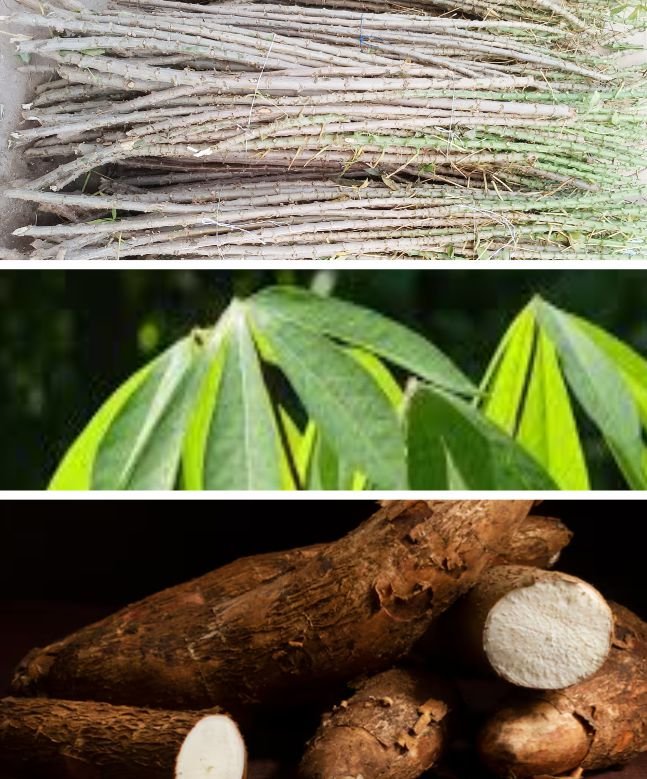
- Stems: The stem is the grow straight and woody with a light brown or grey colour. They are a part of the plant used for propagation with nodes along their length. These nodes allow easy propagation when you cut and plant them in suitable soil. Explore the cassava stem dedicated post.
- Leaves: The leaves are the shoots of the plant, spread out like open hands with three to nine lobes. Many farmers cook the young leaves as a nutritious vegetable after proper preparation. Visit this page for an exhaustive cassava leaves discussion.
- Roots or Tubers: The roots are the edible tubers, which are long, cylindrical, and grow in clusters underground. Each tuber has thin brown skin and white or yellow starchy flesh inside. Here is a comprehensive discussion on the cassava root tuber.
| Part | Key feature | Primary use |
|---|---|---|
| Stem | Woody, light brown/grey, with nodes along its length | Propagation — cut and replanted to grow new plants |
| Leaves | Palm-shaped, 3–9 lobes | Eaten as a cooked vegetable in many regions |
| Roots (tubers) | Long, cylindrical, thin brown skin, white or yellow starchy flesh | The primary food product — eaten fresh or processed |
Cassava Growth and Production
The plant grows from stem cuttings and follows a straightforward cycle that takes eight to twelve months from planting to harvest.
This section shows you the basic stages, so you understand how the plant develops from start to finish.
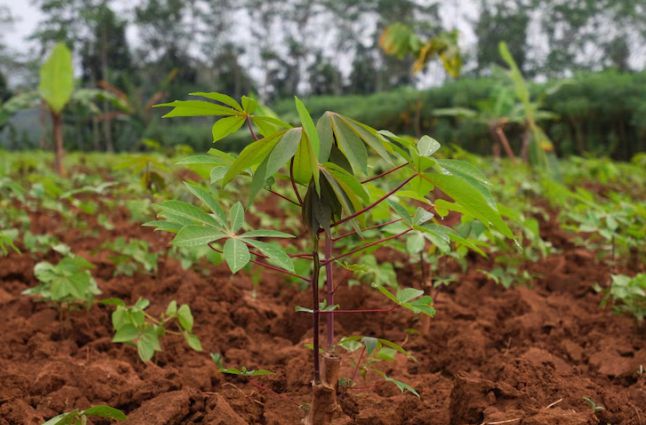
1. Planting: Farmers plant mature stem cuttings 20 to 30 centimetres long in prepared soil at the start of the rainy season. Place them at an angle or upright with at least two nodes buried. This method gives fast and uniform sprouting in warm tropical conditions.
2. Growth Stage: The plant sprouts leaves and branches within the first few weeks. It forms a bushy structure as the stems grow taller. During this period, you need to keep the field free of weeds so the young plants get enough sunlight and nutrients. Learn more about Cassava growth stages and adaptability.
3. Root Development: After two to four months, the tubers start forming underground. The roots swell and store starch as the plant matures. Good rainfall and well-drained soil help the tubers grow bigger and healthier during this main bulking phase.
4. Harvesting: The roots are harvested when the leaves begin to yellow (how to know cassava is ready for harvesting), and the tubers reach full size, usually between eight and twelve months. Dig carefully around each plant to pull out the roots without damage. Harvest only what you need since the tubers store well in the ground for some time. See how to harvest cassava.
How to Transform Cassava into Products
Cassava transformation follows a few core paths depending on the end product.
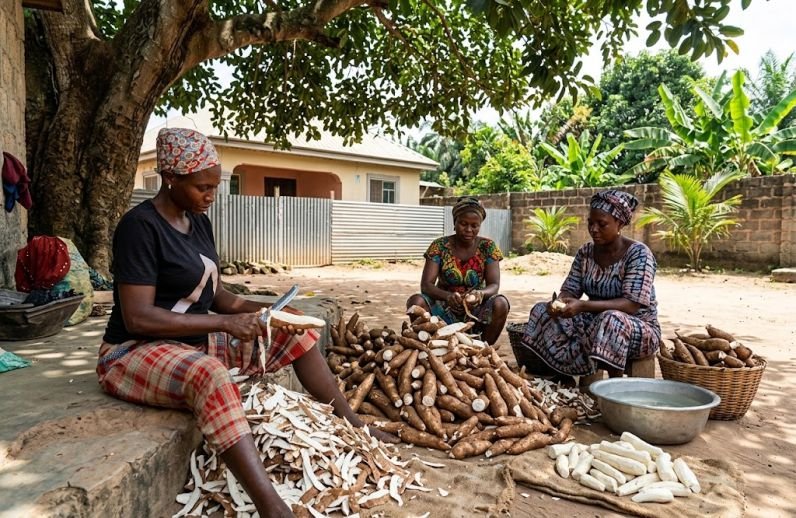
For garri and fufu, roots are peeled, grated or pounded, then fermented to neutralize natural toxins before frying or moulding into dough.
For flour, peeled roots are sliced, dried, and milled directly into powder, often skipping fermentation.
Starch and tapioca pearls take a different route: roots are pulped, washed repeatedly to separate pure starch from fiber, then either dried into powder or formed into pearls.
Pellets, used mainly for animal feed and export, come from drying and compressing chipped roots.
Traditional methods rely on manual peeling, sun-drying, and fermentation; modern processing uses mechanical graters, presses, and dryers to scale the same steps.
Each path trades speed for control over texture, shelf life, and safety.
Here is a full breakdown to learn more about Cassava Processing
Added Values to Cassava
A root crop only becomes valuable once it moves, from farm to fork, or from farm to factory.
The value chain describes that full path: cultivation and harvest, then primary processing (peeling, grating, fermenting) that turns raw tubers into mash or chips, followed by secondary processing into flour, starch, garri, or pellets.
From there, aggregators, transporters, and equipment suppliers move the product toward food manufacturers, industrial buyers, and exporters, each stage adding value and income along the way.
Smallholder farmers, processors, and entrepreneurs all sit somewhere on this chain, which is why understanding it matters as much as understanding the plant itself, it’s the difference between growing yuca and building a business around it.
→ Full breakdown: The Cassava Value Chain Explained
Common Cassava Products and Derivatives
Manioc turns into several everyday products that you see in markets and kitchens across Africa and beyond.
Here are the most common ones and how people use them.
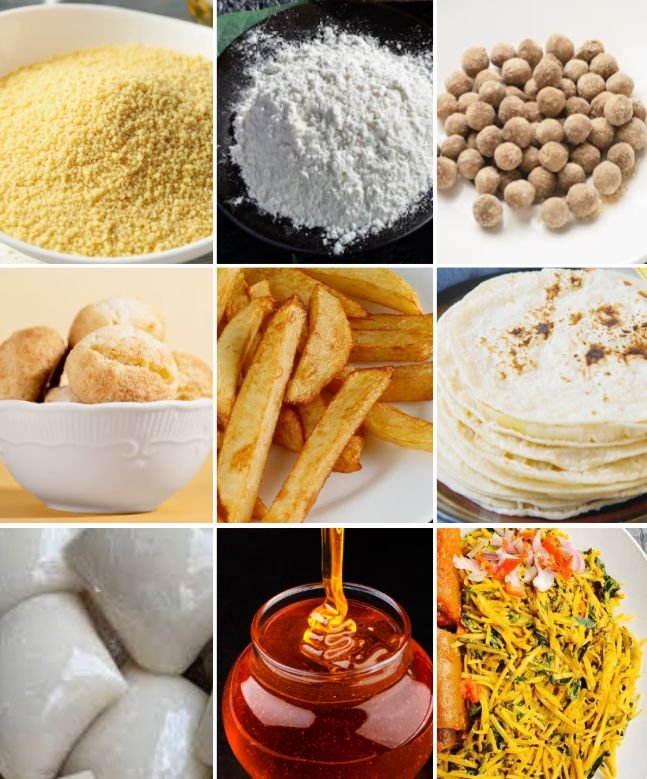
- Garri: Garri, or cassava flakes, is a popular granular flour made from cassava. You use it to prepare eba or soak it in water with sugar or groundnuts for a quick meal.
- Fufu: Fufu is a smooth, stretchy dough made by pounding or fermenting cassava. It serves as a staple swallow that pairs well with soups and stews.
- Cassava Flour: The flour is a fine powder ground from dried cassava roots. You use it for baking bread, pancakes, and other gluten-free recipes.
- Tapioca Pearls: Tapioca pearls come as small white pearls or flakes from cassava starch. You cook it into puddings, desserts, or bubble tea.
- Starch: The starch, also called tapioca, acts as a thickener in soups, sauces, and gravies. Many industries also use it in paper, textiles, and food production.
Visit this page for a comprehensive discussion on the numerous cassava products.
| Product | What it is | Common use |
|---|---|---|
| Garri | Fermented, fried cassava flakes/granules | Eaten as eba, or soaked with sugar/groundnuts |
| Fufu | Pounded or fermented cassava dough | Swallow food eaten with soups and stews |
| Cassava flour | Fine powder from dried roots | Gluten-free baking |
| Tapioca pearls | Small starch pearls/flakes | Puddings, desserts, bubble tea |
| Cassava starch (tapioca starch) | Extracted root starch | Food thickener; also used in paper, textiles |
Cassava Foods and Recipes
The crop’s adaptability is most clearly seen in the kitchen, where the same root becomes wildly different dishes depending on region and preparation.
In West Africa, boiled or pounded root becomes fufu and eba, eaten with soups and stews; fermented and fried, it becomes garri.
In Latin America, yuca is boiled, fried into chips, or mashed much like potatoes.
The flour shows up in gluten-free breads, pancakes, and flatbreads, while tapioca starch thickens puddings, pies, and bubble tea pearls.
The leaves, cooked thoroughly, appear as a vegetable side dish in several African cuisines.
Across all of these, one rule holds: proper peeling, soaking, fermenting, or cooking comes first; the recipe only starts once the root is safe to eat.
→ Full recipes: Cassava Recipes
Why Cassava is Important
This supercrop plays a major role in the lives of millions of people. This section shows you exactly why this root crop matters so much for food, income, and everyday needs.
It feeds more than 800 million people worldwide and ranks as the fourth most important staple crop after rice, wheat, and maize.
In Africa, it provides up to 50 per cent of daily calories for many families.
- Food Security: It stays in the ground for months and acts as a natural food bank. When other crops fail, you can still harvest it to feed your family.
- Drought Tolerance: The plant survives long dry periods with very little water or fertilizer. This makes it reliable in regions with unpredictable rainfall.
- Income Source: Smallholder farmers sell fresh roots and processed products like gari and flour. This brings steady cash for school fees, healthcare, and household needs. See how to start commercial cassava farming.
- Industrial Uses: Factories turn cassava into starch for food, paper, textiles, and ethanol. This creates jobs and connects farmers to larger markets. Learn more about the industrial applications of cassava.
Learn more about the benefits of yuca.
Cassava Health and Nutrition
Yuca is primarily an energy food: a carbohydrate-dense root low in protein and fat, with modest vitamin C, potassium, and magnesium. Learn more about its nutritional information.
It’s naturally gluten-free, making it a safe staple for people with celiac disease or gluten sensitivity.
Its glycemic index is high (roughly 70–80), so it raises blood sugar quickly when eaten alone; people managing diabetes should pair it with protein, fat, or fiber to slow that response. Learn more about cassava glycemic index.
During pregnancy, well-prepared cassava (peeled, soaked, and thoroughly cooked) is generally considered safe as part of a balanced diet, though excessive reliance on it without diverse protein sources isn’t ideal for either parent or child.
Read more about cassava and pregnancy.
The real health risk isn’t the root itself but improper preparation: raw or undercooked roots contain cyanogenic compounds that can cause poisoning.
Properly processed, cassava is a safe, reliable, gluten-free energy source best eaten alongside protein-rich foods.
Learn more about how cassava benefits health.
Cassava Safety Basics
The root contains natural compounds that can be harmful if you eat it the wrong way.
This section gives you simple safety rules so you can enjoy it without worry.
- Some Cassava Varieties Require Proper Processing: Sweet varieties need only peeling and cooking. Bitter varieties contain higher toxin levels and always require extra steps like soaking or fermenting before you eat them.
- Improper Preparation May Be Unsafe: Eating raw or poorly prepared cassava can cause stomach upset or worse problems. Always peel the outer skin and cook the root thoroughly.
- Traditional Processing Improves Safety: Methods like peeling, washing, soaking, boiling, or fermenting remove most toxins. These age-old techniques make the root safe and ready for your meals. See how to remove cyanide from cassava.
| Variety | Toxin level | Required prep |
|---|---|---|
| Sweet | Lower | Peel + cook (boiling is usually sufficient) |
| Bitter | Higher | Peel, grate/soak, ferment, and cook before eating |
These steps are not cautionary notes for experienced cassava farmers; they are automatic habits developed over years of processing. Knowing when fermentation has gone far enough, how the smell changes, how the texture shifts before and after soaking, that practical sensory knowledge is what makes safe cassava preparation second nature rather than a checklist to follow.
Cassava in Human History and Culture
The root crop has a long story connected to people across continents.
This section shows you how the crop moved around the world and why it became so important in daily life and traditions.
Origin and Spread of Cassava Globally
The crop first grew in the Amazon basin of South America more than 10,000 years ago.
Indigenous people cultivated and used it as a main food source long before Europeans arrived.
In the 1500s, Portuguese traders brought cassava to Africa, Asia, and other tropical regions.
The plant spread rapidly because it grew easily and produced food in new environments.
Today, you can find it grown in over 100 countries across the globe.
Why it Became a Staple Food in Tropical Regions
This crop became a staple food in tropical regions because it survives difficult conditions where other crops struggle.
It grows in poor soils, needs little fertilizer, and tolerates dry spells once established. Farmers get high yields from small plots with minimal work.
These advantages helped millions of people in hot, humid areas rely on cassava when maize or rice failed due to bad weather.
See a dedicated post on how cassava is a staple food.
Cultural Importance in African Diets
In Africa, yuca holds deep cultural importance beyond just filling plates.
You see it in everyday family meals and festive dishes like Nigerian eba, Ghanaian fufu, and Ugandan kwon.
Many communities pass down special recipes and preparation methods through generations.
That passing down is rarely formal. You learn by watching someone peel a root the right way, by being in the kitchen when garri is being fried, by understanding through repetition rather than instruction. That kind of knowledge does not appear in academic papers, but it is what separates someone who has lived with cassava from someone who has only written about it.
The crop supports social gatherings, traditional ceremonies, and local economies.
For countless households across Nigeria, Ghana, and other countries, cassava represents both daily sustenance and part of their cultural identity.
See a dedicated post on the history of cassava.
Conclusion
Cassava is one of those crops that rewards the people who take it seriously.
As a farmer, processor, and entrepreneur who has worked with this crop across its full cycle, from planting stems to selling finished products, I can say that what most people know about cassava barely scratches the surface of what it is capable of delivering.
The plant parts, varieties, growth stages, processing methods, safety rules, and cultural history covered in this guide are a starting point.
What makes cassava genuinely valuable is what happens when you move from understanding it to building something around it, a farm, a processing operation, a product, or a business.
Cassava Pathway exists to support that progression, and the guides linked throughout this page are the deeper resources that take you there.
Frequently Asked Questions
What is cassava?
Yuca is a tropical root crop known as yuca or manioc. It produces starchy tubers that millions of people eat fresh or processed daily. (24 words)
Is cassava safe to eat raw?
No, you should never eat yuca roots raw. It contains natural toxins that proper peeling, soaking, and cooking remove for safe consumption. (24 words)
What are the main uses of cassava?
Manioc is used for food products like flour, starch, and tapioca, as well as in biofuel, textiles, and animal feed industries.
What is the difference between sweet and bitter cassava?
Sweet yuca has lower toxins and needs simple cooking. Bitter cassava contains higher cyanide levels and requires extra processing before eating.
How long does cassava take to mature?
Cassava usually takes eight to twelve months from planting to harvest. The exact time depends on the variety and growing conditions.
Chimeremeze Emeh
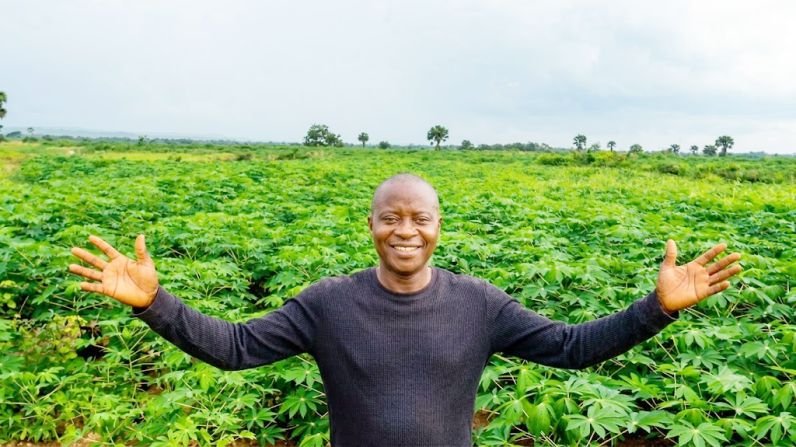
Chimeremeze Emeh is a tropical crop farmer and chemical engineer from Ntigha, Isiala Ngwa North LGA, Abia State, Eastern Nigeria, specializing in cassava and palm oil, with over 30 years of hands-on experience growing, harvesting, and processing cassava. He grows TMS series, TME 419, and local traditional varieties on his own farms and operates a small-scale cassava flour and starch production business through Cassava Pathway, which he founded as a CAMA-registered agribusiness in 2024. He is also the founder of Palm Oil Pathway, where he applies the same tropical farming expertise. His farms are located in Ntigha, Abia State.


References
- Cassava: The Heartbeat of Local Farming
- ResearchGate: Studies on cassava plant micropropagation
- PMC: Cassava (Manihot esculenta Crantz): A Systematic Review for the Pharmacological Activities, Traditional Uses, Nutritional Values, and Phytochemistry
- Ripe: Research shows how to grow more cassava, one of the world’s key food crops
- ScienceDirect: Cassava in focus: A comprehensive literature review, its production, processing landscape, and multi-dimensional benefits to society
- The Applied Ecologist: Research into Cassava, a promising crop under climate change
- How Cassava Feeds Millions and Powers Industries
- Cassava: The Lifeline for Millions