Cassava Pathway bridges the gap between cassava research and rural farmers, disseminating improved varieties, collecting field data, and building toward formal institutional collaboration in Nigeria.
Agricultural research on cassava has produced significant advances over the past three decades: higher-yielding varieties, disease-resistant strains, improved processing methods, and better agronomic practices.
The problem is not the research. The problem is the distance between where that research happens and where the farming happens.
Most smallholder cassava farmers in Nigeria have never heard of the improved varieties sitting in research station trial plots.
They plant what their neighbours plant, buy stems from whoever has them available, and manage pests and diseases with whatever knowledge was passed down to them.
The gap between what research knows and what farmers do is where most of the yield potential in Nigeria’s cassava sector is being lost.
Closing that gap between research institutions and rural farming communities is what Cassava Pathway’s R&D collaboration work is about.
We are not a research institution. We are the link between what research produces and what farmers can actually use.
Table of Contents
What We Currently Do
Improved Variety Dissemination
One of the most direct contributions Cassava Pathway makes to the R&D space is helping farmers understand and access improved cassava varieties.
Research institutions like IITA and NRCRI Umudike have developed high-yielding, disease-resistant, early-maturing varieties that significantly outperform the unimproved planting material most smallholder farmers currently use.
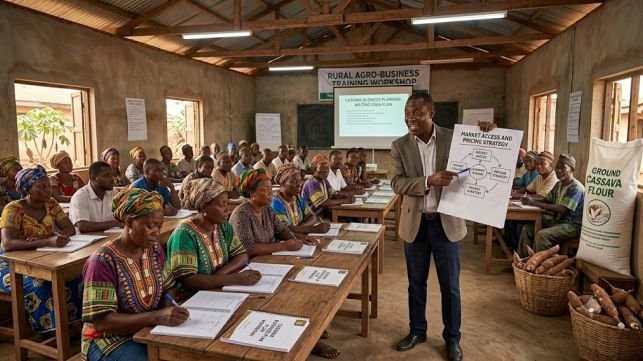
Through our training programmes, we educate farmers on which varieties exist, what their characteristics are, why variety selection matters more than almost any other farming decision, and where to source certified planting material.
Getting a farmer to switch from unimproved stems to a certified high-yielding variety is one of the highest-impact interventions available, and it requires no new land, no major equipment, and no large capital investment.
Field Data Collection and Feedback
In 2023, Cassava Pathway conducted a community observation exercise in Ntigha, Isiala Ngwa North LGA, Abia State, gathering field-level information on cassava farming practices, yield outcomes, pest and disease patterns, and post-harvest handling methods from fifteen farming households in the community.
That data, collected from real farms, from real farmers, in a specific agro-ecological context, is exactly what research institutions need to calibrate their work to actual smallholder realities rather than controlled trial conditions.
We channelled that data back to relevant research contacts to inform ongoing work on variety performance and farming system recommendations.
This kind of ground-level data collection is something Cassava Pathway is positioned to do in ways that formal research institutions often cannot.
We have the community relationships, the local knowledge, and the trust that make farmers willing to share honest information about what is and is not working on their land.
Pest and Disease Information Dissemination
Cassava pests and diseases, including cassava mosaic disease, brown streak disease, mealybugs, and bacterial blight, are a consistent yield threat across South Eastern Nigeria.
Research institutions invest significantly in developing resistant varieties and management protocols.
Cassava Pathway translates that research into practical farm-level guidance delivered through training and advisory sessions.
Farmers learn to identify early signs of infection, understand which varieties carry resistance to the most common local threats, and apply management practices that limit spread without unnecessary input costs.
This dissemination role, taking research outputs and making them usable at the farm level, is where we add the most immediate value in the R&D space.
Agronomic Best Practice Adoption
Research on cassava agronomy, including optimal planting spacing, intercropping systems, soil fertility management, and weed control timing, produces consistent recommendations that most smallholder farmers never receive.
Cassava Pathway incorporates current agronomic research into training content, ensuring that farmers are applying evidence-based practices rather than inherited habits that may be outdated or suboptimal for the varieties and markets they are working with today.
What We Are Building Toward
Formal Institutional Collaboration
Cassava Pathway is actively working toward formal collaboration with the International Institute of Tropical Agriculture and other agricultural research institutions in Nigeria. The primary goals of that collaboration are:
- Access to certified improved stem varieties for distribution to farmers in our training network
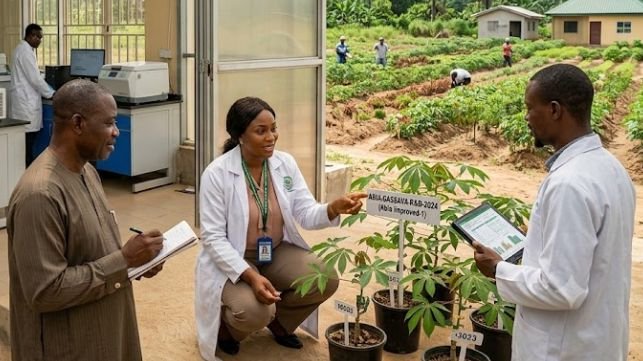
- Joint on-farm trial programmes where research-backed varieties and agronomic practices are tested under real smallholder conditions in South Eastern Nigeria
- Structured data sharing arrangements where field observations from the Cassava Pathway’s farmer network inform research priorities
That collaboration is in the relationship-building stage.
When it is formalised, it will significantly strengthen what we can offer farmers in terms of variety access and technical support.
On-Farm Demonstration Plots
Rather than asking farmers to adopt new varieties and practices based on training alone, on-farm demonstration plots allow farmers to see innovations performing under local conditions before committing their own land.
We are working toward establishing demonstration plots in our primary operating communities, starting in Ntigha and expanding from there, where improved varieties, spacing trials, and new processing techniques can be observed and evaluated by local farmers directly.
Processing Innovation Trials
On the processing side, Cassava Pathway plans to work with research partners to trial improved processing technologies, including better fermentation management systems, more efficient drying methods, and small-scale starch extraction improvements at the community level.
The goal is to identify which processing innovations are genuinely adoptable by smallholder processors given their current resources, and to build the evidence base that encourages wider adoption.
Why This Work Matters
Nigeria is the world’s largest cassava producer but captures a fraction of the value that production should generate.
The gap between current average yields and what is agronomically possible with improved varieties and better practices is substantial.
Closing that gap does not require a large infrastructure investment.
It requires knowledge transfer, varied access, and the kind of ground-level data collection and feedback that connects research to reality.
That is the work the Cassava Pathway is positioned to do, is already doing in part, and is building the institutional relationships to do at a greater scale.
Every farmer we train on improved varieties, every data point we collect from the field, and every research finding we translate into practical farm guidance is a contribution to a cassava sector that works better for the people who grow the crop.
Who We Want to Work With
We are actively looking to collaborate with:
- Agricultural research institutions, including IITA, NRCRI, and state agricultural development programmes seeking farm-level partners for variety dissemination and field data collection
- Agronomists and extension officers working in South Eastern Nigeria who want to reach more farmers through the Cassava Pathway’s training network
- Development organisations and NGOs working on cassava productivity, food security, or smallholder income in Nigeria
- Academic researchers studying cassava farming systems, post-harvest losses, or value chain dynamics who need field access and community relationships
If any of those descriptions fit your work, contact us here. We are open to conversations about what collaboration could look like and what each party brings to it.
Conclusion
Cassava Pathway’s role in research and development is not to conduct research. It is to make research useful.
The improved varieties, agronomic practices, pest management protocols, and processing innovations that institutions like IITA and NRCRI develop belong in the hands of the farmers who can apply them.
Getting them there requires community presence, farmer trust, and the kind of practical translation that formal research channels often cannot provide.
That is what we do now. The formal institutional partnerships, demonstration plots, and processing trials we are building toward will expand the scale of that work.
But the core function, connecting research to the farm level, is already active and already making a difference in the communities we work with.
Chimeremeze Emeh
Chimeremeze Emeh is a tropical crop farmer and chemical engineer from Ntigha, Isiala Ngwa North LGA, Abia State, Eastern Nigeria, specializing in cassava and palm oil, with over 30 years of hands-on experience growing, harvesting, and processing cassava. He grows TMS series, TME 419, and local traditional varieties on his own farms and operates a small-scale cassava flour and starch production business through Cassava Pathway, which he founded as a CAMA-registered agribusiness in 2024. He is also the founder of Palm Oil Pathway, where he applies the same tropical farming expertise. His farms are located in Ntigha, Abia State.