Last updated on July 14th, 2026 at 01:07 pm
Decades of cassava research have produced better varieties, stronger disease resistance, and improved processing methods, yet most of it never reached the farmers it was built for. That gap is the most important story in cassava R&D.
The cassava plant ranks among the top sources of carbohydrates across the tropics, and it remains the primary food security crop for hundreds of millions of people in Africa, Asia, and Latin America.
For decades, disease, low yields, weak post-harvest handling, and limited processing infrastructure have held back its full potential benefits.
Cassava research and development exists to close those gaps, improving the plant itself, the practices that surround it, and the systems that connect it to markets.
This article covers where that research began, what it has produced, and where the distance between institutional research and farm-level reality remains the most important problem still to solve.
Table of Contents
What Cassava R&D Looks Like From the Farm Side
Most reporting on cassava research and development describes it from the top down, through institutional press releases and journal abstracts.
This article draws on both the published research record and my own ground-level experience as a cassava farmer in Ntigha, Isiala Ngwa North LGA, Abia State, where I have watched what happens when research reaches farming communities and what happens when it does not.
In 2023, Cassava Pathway conducted a field observation across fifteen farming households in Ntigha.
These farmers had received improved cassava stems through a government program, yet they harvested only a fraction of the expected yield because no agronomic support followed the stems into the ground.
That gap between what research produces and what farmers actually receive is the context that shapes everything covered in this article.
What Is Cassava Research and Development?
Cassava research and development is the organized study of the cassava plant, covering its genetics, agronomy, nutrition, processing, and market integration, all aimed at improving yield, quality, disease resistance, and economic value across the cassava industry.
This work spans several disciplines at once. Plant breeders develop improved cassava varieties, agronomists refine cultivation practices, food scientists advance processing technology, and economists work on market linkages and policy.
The strongest cassava R&D programs bring these disciplines together in ways that eventually reach smallholder farmers in Nigeria, who produce over 90 percent of the country’s total cassava output.
Why Cassava Research and Development Matters
Yields Remain Far Below Their Potential
The average Nigerian smallholder cassava farmer harvests between 6 and 10 tonnes per hectare.
Research trials on improved varieties consistently demonstrate potential yields of 30 to 45 tonnes per hectare under good agronomic management.
That gap between roughly 8 tonnes and 40 tonnes, on the same land, is not primarily a farming failure.
It reflects a research delivery failure instead, because the improved varieties already exist, and so does the agronomic knowledge needed to use them well.
The remaining challenge is getting both to the farmer who actually needs them.
In Ntigha in 2023, five farmers who received government-supplied improved stems still harvested only 15 to 20 bags per plot against an expected 30 to 40 bags.
The varieties were not the problem. No agronomic guidance accompanied the planting material, and that single gap is a microcosm of the national problem.
Disease Threatens Every Investment a Farmer Makes
Cassava mosaic disease and other cassava pests and diseases together represent the biggest yield threat cassava farmers face.
A farmer who clears land, buys inputs, plants, and manages weeds for five months can still lose a serious share of the harvest to disease pressure that research has already developed solutions.
Developing and distributing resistant varieties remains one of the clearest cases where R&D investment translates directly into protecting farmers’ income.
Research from the International Institute of Tropical Agriculture (IITA) identified a dominant resistance gene known as CMD2 among West African cassava landraces, and that discovery now underpins the marker-assisted breeding programs working to prevent cassava mosaic virus on large-scale farms across the region.
Processing Technology Determines Market Access
Raw cassava roots spoil within 48 to 72 hours of harvest. Without accessible processing technology, farmers are forced into post-harvest losses and forced sales at whatever price the market offers, often during glut periods when prices sit at their lowest.
Research into affordable, small-scale processing equipment directly determines whether a smallholder farmer can turn perishable roots into shelf-stable garri, cassava flour, chips, or starch, products that can be stored, transported, and sold later at better prices.
Nutritional Improvement Serves Food Security and Market Development Together
Cassava’s biggest nutritional limitation is its low protein content and its narrow micronutrient profile.
Research into biofortified varieties, particularly high-carotene cassava that delivers provitamin A, addresses food security needs in communities where micronutrient deficiency is common, while also opening market opportunities in nutrition-focused food manufacturing.
HarvestPlus, working with NRCRI and IITA, has released nine vitamin A biofortified cassava varieties in Nigeria to date.
By the end of 2020, an estimated 1.76 million smallholder farming families were already growing them, one of the more visible successes in translating cassava research directly into household nutrition.
Historical Background of Cassava Research and Development
Early Breeding and Cultivation Research
Cassava has been cultivated for thousands of years, tracing back to the Amazon basin of South America.
Organized research and development began in earnest during the twentieth century, as the crop’s importance to tropical food security gained wider international recognition.
The Central Tuber Crop Research Institute in India, established in 1963, built one of the earliest significant cassava germplasm collections and began research aimed at improving production.
In 1969, the International Center for Tropical Agriculture began assembling its own cassava germplasm collection, and by 1972 it had established a dedicated Cassava Program, bringing together a multidisciplinary research team.
Conventional breeding techniques, including full-sib and half-sib progeny production and mass selection, served as the primary tools for variety development throughout this period, including the breeding work behind today’s hybrid cassava varieties.
These methods produced real improvements in yield and disease tolerance, but they operated on long timelines, limited by cassava’s complex genetic structure and its extended breeding cycles.
That same breeding foundation extends beyond food crops too, informing research into cassava’s role in livestock feed as an affordable, high-energy input.
Institutional Development in Nigeria
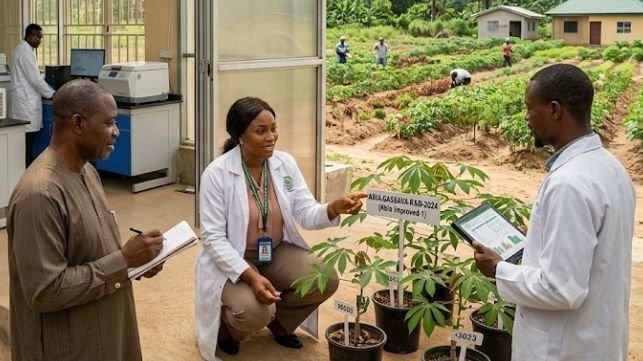
In Nigeria, the National Root Crops Research Institute (NRCRI) at Umudike in Abia State has served as the country’s primary institution driving cassava research since its founding.
According to NRCRI, the institute has released 46 improved cassava varieties to date, including six beta-carotene, or pro-vitamin A, varieties that improved both nutritional value and disease resistance at once.
NRCRI’s location in Umudike, within the same Abia State where Cassava Pathway operates, makes it a directly relevant research partner for the farming communities this site serves.
Advances in Biotechnology and Genetic Engineering
The limits of conventional cassava breeding, long generation times, complex polyploidy, and the difficulty of combining multiple desirable traits at once pushed researchers toward molecular and biotechnology approaches that have picked up the pace of variety improvement considerably.
Marker-Assisted Selection
Marker-assisted selection uses genetic markers linked to desirable traits, allowing breeders to identify promising lines earlier and more reliably than conventional field evaluation allows.
In cassava breeding, this approach has been applied to select for resistance to cassava mosaic disease and cassava brown streak disease, along with tolerance to whitefly, the three biggest disease and pest threats across Sub-Saharan African cassava production.
This technology has shortened breeding cycles and made resistance traits more consistent in released varieties.
Delayed Post-Harvest Deterioration
One of the more commercially valuable research advances in cassava has been the development of varieties with delayed post-harvest physiological deterioration.
Fresh cassava roots begin deteriorating within 24 to 72 hours of harvest, a biological process that shrinks market access windows and forces distress sales at low prices.
Research using low-cost molecular markers to combine genes associated with delayed deterioration has produced varieties that stay marketable for meaningfully longer periods after harvest, directly improving the economics of fresh root marketing for smallholder farmers.
Genetic Engineering for Nutritional Improvement
Genetic engineering has been applied to raise cassava’s protein content and to lower cyanogenic glucoside levels, the natural compounds responsible for cassava’s toxicity in its unprocessed state.
Research programs have also produced high-carotene varieties that meaningfully improve provitamin A delivery for communities that depend on cassava as a daily staple.
These rank among the most nutritionally important crop improvement achievements in Sub-Saharan African food science.
Recent Developments in Cassava Research
Disease-Resistant Variety Development
The release of varieties resistant to cassava mosaic disease, bacterial blight, and anthracnose has been one of the most consistent achievements of recent cassava R&D.
Researchers develop these varieties through both conventional breeding and marker-assisted selection, combining resistance traits with high yield potential and acceptable taste and processing qualities.
The practical value of disease-resistant varieties shows up clearly at the farm level.
During the 2023 Ntigha field observation, farmers planting government-supplied improved varieties reported visibly healthier plants and lower cassava mosaic disease incidence than neighboring plots using local, unimproved stems, even though overall yields stayed below potential due to the missing agronomic support.
The disease resistance held up on its own. The support system around it did not.
Processing Technology Innovation
Cassava processing technology has drawn real research attention in recent years.
Advances include more efficient mechanical graters, improved hydraulic presses that reduce moisture content more consistently, flash dryers that cut energy use in garri production, and small-scale starch extraction systems built specifically for smallholder and cooperative-scale operations.
Research has also targeted the labor intensity of traditional processing, one of the biggest barriers to scaling cassava processing in communities where female farmers and processors carry most of the manual workload.
Equipment that reduces processing time and physical strain directly affects whether commercial cassava farming and processing remain a viable livelihood at a small scale.
Nutritional Enhancement
Recent research has produced cassava varieties with meaningfully higher beta-carotene content, delivering provitamin A in staple food form to populations where vitamin A deficiency remains a documented public health concern.
NRCRI’s six released beta-carotene varieties represent the practical output of this work in Nigeria, while ongoing research on protein enhancement through genetic engineering targets cassava’s biggest remaining nutritional gap: its low protein content relative to its calorie density.
Opportunities for Further Cassava Research and Development
Closing the Research-to-Farm Gap
The most important opportunity in cassava R&D right now is not producing more research. It is delivering existing research more effectively to the farmers who need it.
Improved varieties, agronomic best practices, processing innovations, and market linkage strategies are already part of institutional knowledge bases.
The real challenge is the last mile, getting that knowledge from research stations to a farmer who planted local stems in the same local government area as an NRCRI research institute, without ever receiving guidance on what improved alternatives were available.
Extension systems, farmer training programs, and organizations like Cassava Pathway that operate at the community level serve as the delivery mechanisms that keep this research from being institutionally contained.
Expanding Cassava’s Geographic Range
Expanding Cassava’s Geographic Range
Expanding cassava cultivation beyond its current tropical range depends on further research into hardier varieties.
Semi-arid regions of Africa and parts of South Asia, where food insecurity is highest, need varieties that can tolerate drought, cooler temperatures, and soil conditions unlike those in which current commercial varieties were bred.
That work pairs naturally with a clearer understanding of the environmental impact of cassava farming at scale, since expansion into new regions carries its own ecological tradeoffs.
Collaboration Between Researchers, Farmers, and Policymakers
The Cassava Community of Practice and Partnership has shown what structured collaboration between researchers and farmers can achieve.
That collaboration works once knowledge and technology transfer becomes a core program objective, not an afterthought.
Scaling that model in Nigeria, where the research infrastructure already exists, ranks among the highest-return investments available in cassava R&D.
Processing Infrastructure Investment
Research into processing technology only delivers value if the infrastructure exists to put it to use.
Small-scale processing equipment research needs pairing with financing mechanisms and cooperative formation support.
It also needs market linkage programs that make equipment reachable for farming communities, not only for commercial processors.
In southeastern Nigeria, the absence of industrial cassava processing capacity within reach of farming communities remains the single biggest barrier to smallholder income improvement.
Research alone cannot fix that gap, but research-informed policy investment can close it.
Conclusion
Cassava research and development have made real, measurable progress, with NRCRI alone releasing 46 improved varieties to Nigerian farmers.
Disease resistance gains show up visibly at the farm level, and processing innovations now reduce labor while improving product quality.
Biotechnology applications keep shortening breeding cycles that were once measured in decades of work.
What remains is not a laboratory problem, but the distance between the laboratories and the farms.
That distance shows up in improved stems distributed without agronomic support, processing innovations that never reach smallholder communities, and market infrastructure that lags behind production capacity.
Cassava Pathway’s work sits inside that gap: training farmers on improved agronomic practices, sharing research-backed variety information, and collecting field data from real farms in Ntigha.
Closing the distance between what research knows and what farmers receive is what makes cassava R&D genuinely transformative, rather than only institutionally impressive. Follow along as Cassava Pathway documents that work, one field observation at a time.
Frequently Asked Questions
What are the main objectives of cassava research and development?
The goals include improving cassava yield, disease resistance, nutritional value, and processing efficiency, so gains reach the farmers who grow most of the world’s cassava.
How do genetic modifications contribute to cassava research and development?
Genetic modification speeds up breeding by enabling disease resistance, delayed post-harvest deterioration, and higher provitamin A content, cutting years off timelines conventional methods alone would need.
What role do national agricultural research systems play in cassava research?
Institutions like NRCRI and IITA supply technical expertise and run breeding programs, functioning as knowledge hubs that feed local development and farmer extension systems.
How does cassava R&D contribute to food security and economic growth?
Better yields, fewer losses, improved nutrition, and stronger processing methods together raise income and food security for the households that produce most of the world’s cassava.

Chimeremeze Emeh is a tropical crop farmer and chemical engineer from Ntigha, Isiala Ngwa North LGA, Abia State, Eastern Nigeria, specializing in cassava and palm oil, with over 30 years of hands-on experience growing, harvesting, and processing cassava. He grows TMS series, TME 419, and local traditional varieties on his own farms and operates a small-scale cassava flour and starch production business through Cassava Pathway, which he founded as a CAMA-registered agribusiness in 2024. He is also the founder of Palm Oil Pathway, where he applies the same tropical farming expertise. His farms are located in Ntigha, Abia State.