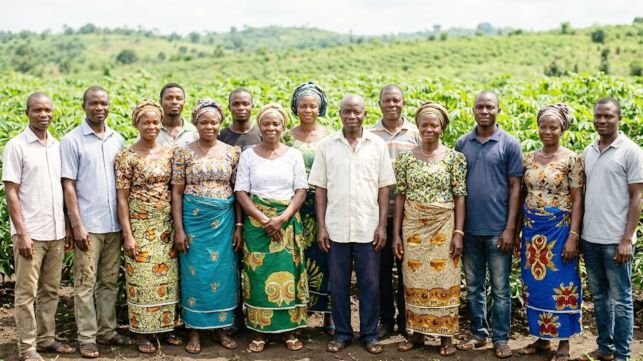
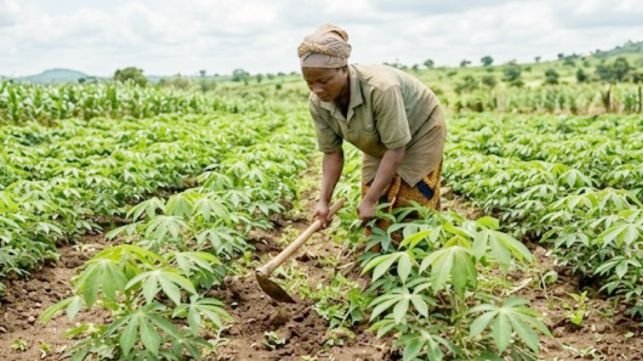
They planted. They tended. They harvested. Then they were told to take their cassava to Lagos, Benue or Ogun or sell at a ridiculously low cost. This is what cassava farming actually looks like in Ntigha, Isiala Ngwa North LGA, Abia State.
In September 2023, Cassava Pathway visited fifteen smallholder cassava farming households in Ntigha, Isiala Ngwa North LGA, Abia State, to document what was actually happening on the ground.
Not what policy documents said should be happening.
Not what research station trials predicted. What fifteen real farmers, on their own land, with their own resources, were experiencing at the end of a full cassava farming season.
What we found was not surprising to anyone who farms in South Eastern Nigeria.
But it was specific, documented, and important enough to put on record, because the gap between national cassava production statistics and what smallholder farmers in communities like Ntigha actually experience is wider than most people outside these communities understand.
I am Chimeremeze Emeh. I farm cassava on my own land in Ntigha.
These are my neighbours, my community members, and in some cases, people I have known my entire life.
That proximity is what made honest conversation possible.
An honest conversation is what produced the observations in this report.
The Farmers
The fifteen households visited in September 2023 were a mix of male and female farmers, all smallholders farming cassava as a primary or significant secondary source of household income.
Their names are recorded here with their knowledge and consent as participants in the observation exercise:
Theresa Onyenso, Uzoma Njoku, Ogadimma Onyeukwu, Ikechi Onyeike, Akuamia Chinegbo, Okechukwu Madugba, Adamma Onyenkwere, Chiedo Akubiro, Uzondu Nwachukwu, Anyanwu Chidiebere, Uruch Uruchi, Enyichi Ihesiaba, Udochi Onyenso, Chidimma Anyanwu, and Charity Orji.
Each was farming a plot of approximately 100 by 100 metres. None was operating at a commercial scale.
All were investing their own capital, labour, and land in a crop that the Nigerian government designates as a strategic agricultural priority.
What They Planted
Of the fifteen farmers, ten were planting local unimproved cassava varieties, stems sourced from their own previous harvests or from neighbours, the same material their families have planted for generations.
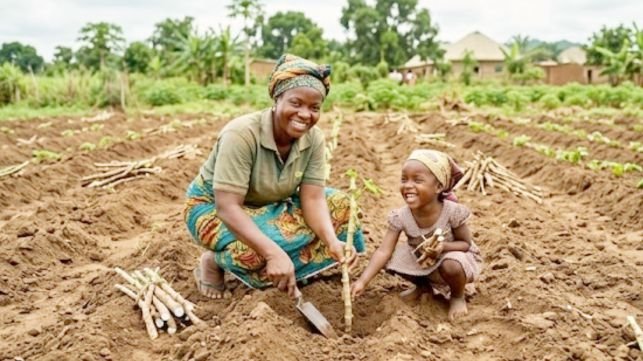
Five had accessed improved cassava stems through a government supply programme and were farming certified improved varieties.
That split, ten local, five improved, reflects a pattern that research across South Eastern Nigeria consistently documents.
Improved stems are available through government programmes but do not reach most farmers.
When they do reach farmers, they arrive without the agronomic support package that determines whether the variety performs anywhere near its potential.
What They Harvested
The yield gap between what these farmers harvested and what was possible is the first significant finding of this observation.
| Farmer Group | Variety Type | Actual Yield per Plot | Expected Yield per Plot | Gap |
|---|---|---|---|---|
| 10 farmers | Local unimproved | 10 bags | 10-15 bags | Minimal |
| 5 farmers | Government-supplied improved | 15-20 bags | 30-40 bags | 10-25 bags below potential |
| Community average | Mixed | 10-15 bags | 30-40 bags | Up to 75% below potential |
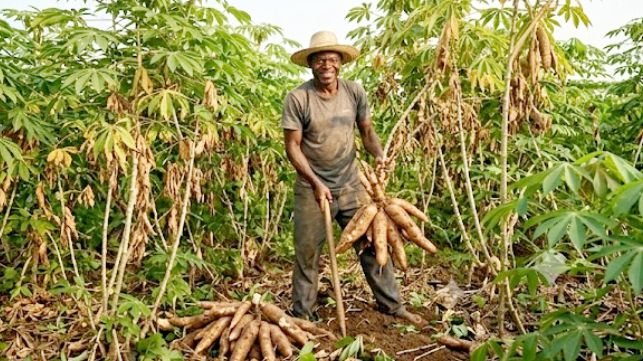
The five farmers who planted improved varieties did better than their neighbours.
They noticed healthier plants, stronger stems, and a significantly reduced incidence of Cassava Mosaic Disease compared to local variety plots.
Their yields of 15 to 20 bags per plot were 50 to 100 per cent higher than the community average of 10 bags.
But 15 to 20 bags is still half of what those varieties should produce under good agronomic management.
The improved stems performed better than local varieties.
They did not perform anywhere near their documented potential.
The reason is straightforward: improved varieties require better soil preparation, correct planting spacing, targeted fertilisation, and timely weed management to deliver their yield potential.
None of the five farmers received any guidance on those adjustments after receiving their stems.
They planted improved material using the same methods they had always used. The variety improved. The agronomy did not.
What Cassava Mosaic Did to Their Crops
Cassava Mosaic Disease was the most commonly reported pest and disease challenge across all fifteen households.
It is the most widespread cassava disease in West Africa and one of the most yield-reducing threats smallholder farmers face.
Among the ten farmers planting local unimproved varieties, Cassava Mosaic was visibly present and significantly impacted both plant health and root development.
Among the five farmers planting improved varieties, the disease was notably reduced, a direct result of the CMD resistance bred into certified improved varieties by IITA and NRCRI.
This observation alone makes a strong practical case for improved variety adoption.
Even without optimal agronomic management, the disease resistance built into certified stems protected yield in ways that local varieties could not. The farmers who noticed the difference said so directly.
The cleaner plants, the stronger stems, the better-looking roots at harvest, these were observable differences that required no measurement to appreciate.
What They Sold Their Produce
All fifteen farmers processed and sold their cassava during the 2023 cassava glut season.
A cassava glut occurs when harvest volumes across producing regions peak simultaneously, supply exceeds local processing and market capacity, and prices collapse.
| Financial Metric | Figure |
|---|---|
| Cost of farming one plot (bush clearing, stems, fertilizer, weeding, hired labour) | Approximately N20,000 |
| Bags harvested per plot (community average) | 10 bags |
| Price received per bag during the 2023 glut | Less than N1,000 |
| Maximum income at 10 bags x N1,000 | Approximately N10,000 |
| Net loss per farmer | Approximately N10,000 on a N20,000 investment |
| Return on investment | Negative — farmers lost approximately 50% of their capital |
Every single one of the fifteen farming households surveyed lost money on their 2023 cassava crop.
Not because they farmed badly. Not because the crop failed. Because the market was not there to receive what they produced at a price that covered their costs.
The Market Collapse: No Buyers in the South East
This is the most important finding from the September 2023 observation and the one that national cassava statistics do not capture.
When the 2023 glut hit and local market prices collapsed, the logical next step for farmers with unsold cassava was to find industrial buyers, starch processors, flour millers, sorbitol manufacturers, who could absorb supply at volumes and prices that made production viable.
The problem was straightforward and devastating: there are no cassava processing companies of significant scale in South Eastern Nigeria.
The farmers were directed to processors in Lagos, Benue, and Ogun States.
| Barrier | Reality for Ntigha Farmers |
|---|---|
| Distance to the nearest processor | Hundreds of kilometres to Lagos, Benue, or Ogun |
| Road conditions | Poor road infrastructure between Ntigha and major processing centres |
| Spoilage risk | Fresh cassava tubers begin deteriorating within 24-72 hours of harvest |
| Transport cost | Cost of transport to processors exceeded value of cassava at glut prices |
| Practical outcome | Transport was financially and logistically impossible for smallholder farmers |
The result was not a choice between good options and bad options. It was a forced outcome.
Farmers sold locally at whatever price they could get, less than N1,000 per bag, because the alternative was watching their harvest rot.
Theresa Onyenso, one of the fifteen farmers, had invested in her plot expecting to recover her costs and make a modest profit.
Like every other farmer in the exercise, she sold at a loss.
The frustration in that community in September 2023 was not the frustration of bad luck.
It was the frustration of a structural failure, a community producing a crop that a government policy designates as strategic, with no processing infrastructure within viable reach to give that crop commercial value.
What the Farmers Said
When asked directly about their outlook on cassava farming, the majority of the fifteen households expressed serious consideration of abandoning cassava as a crop.
The reasons were consistent across all fifteen conversations:
Primary reason: No market. The absence of processing companies in South Eastern Nigeria means that during glut seasons, which are predictable and recurring, there is nowhere to sell at viable prices. Farmers are producing for a market that does not exist near enough to reach.
Secondary reason: Infrastructure Bad roads, long distances, and the perishability of cassava tubers combine to make any option beyond the local market practically inaccessible. The knowledge that better prices exist in Lagos means nothing if getting there costs more than the cassava is worth.
Compounding factor: Investment loss Losing N10,000 on a N20,000 investment is not an abstract financial setback for a smallholder farming household. It is half a season’s capital gone. For many of these farmers, that money was borrowed, saved across months, or diverted from other household needs. The loss compounds across seasons and erodes both the financial and psychological capacity to keep farming.
The sentiment expressed most consistently across the fifteen households was not anger but exhaustion.
These were not farmers who had farmed carelessly. They had invested, managed their plots, and harvested a reasonable crop.
The system around them had failed to provide the one thing that makes farming commercially viable, a buyer.
What This Tells Us
The fifteen households in Ntigha are not an anomaly. They are a representative sample of what smallholder cassava farming looks like across South Eastern Nigeria in a glut season, and glut seasons are not exceptional events.
They are a structural feature of a value chain where production capacity has grown faster than processing infrastructure.
The findings from this observation point to four specific gaps that, if addressed, would change the outlook for communities like Ntigha fundamentally:
Gap 1 — Agronomic support after improved stem distribution. Distributing improved stems without accompanying agronomic training delivers a fraction of the yield potential that those varieties are capable of. The five farmers who planted improved stems in Ntigha got better results than their neighbours. They did not get the results the varieties were bred to produce. Extension support that follows the stem, not just precedes it, is what closes that gap.
Gap 2 — Processing infrastructure in South Eastern Nigeria. The single most impactful intervention for cassava farming communities across Abia, Imo, Anambra, Enugu, and Cross River States is the establishment of cassava processing capacity within a viable distance of farming communities. Not in Lagos. Not in Benue. In the South East, where the farmers are.
Gap 3 — Market information and glut early warning. Farmers planting cassava in January have no reliable way to know whether the market in September will absorb their harvest. A simple early warning system, coordinated through farmer groups, cooperatives, or platforms like Cassava Pathway — that signals likely glut conditions before planting would allow farmers to adjust variety, volume, or timing decisions before the damage is done.
Gap 4 — Post-harvest handling and processing training All fifteen farmers processed their cassava manually. None had access to mechanical processing equipment. Speed of processing is one of the most direct defenses against post-harvest loss in a glut season — getting roots into a shelf-stable form quickly removes the spoilage pressure that forces distress sales. Training and equipment access that enables faster processing gives farmers more time to find better buyers rather than accepting whatever the local market offers on day two after harvest.
What Cassava Pathway Is Doing About It
This observation exercise was not conducted to produce a report that sits in a file. It was conducted because understanding what is actually happening in our own community is the foundation of everything Cassava Pathway does.
The training programmes we run address gaps 1 and 4 directly, agronomic best practices for improved variety management and processing training that reduces losses and improves product quality.
The market access work we do addresses gap 3 partially.
Gap 2 — processing infrastructure in the South East — is the structural challenge that requires investment at a scale beyond what Cassava Pathway currently operates at, but it is the gap we are most actively working to draw attention to through this site, through our community work, and through the institutional relationships we are building.
The farmers of Ntigha deserve better than being told their crop has a market in Lagos.
Every observation in this report points toward the same conclusion: the cassava value chain in South Eastern Nigeria needs processing infrastructure, and it needs it close to where the farmers are.
Conclusion
Fifteen farming households. One community. One season. A crop that should have been profitable was not because of anything these farmers did wrong, but because the system around them was not built to support them when it mattered most.
Theresa Onyenso, Uzoma Njoku, Ogadimma Onyeukwu, Ikechi Onyeike, Akuamia Chinegbo, Okechukwu Madugba, Adamma Onyenkwere, Chiedo Akubiro, Uzondu Nwachukwu, Anyanwu Chidiebere, Uruch Uruchi, Enyichi Ihesiaba, Udochi Onyenso, Chidimma Anyanwu, and Charity Orji planted cassava in Ntigha in 2023, expecting a return on their investment.
They did not get one. Their experience is not unique. It is representative.
Cassava Pathway exists because these gaps are real, these farmers are real, and the distance between what Nigeria’s cassava sector is capable of producing and what smallholder farmers in communities like Ntigha are actually able to earn from it is a gap that someone has to take seriously enough to document, discuss, and work to close.

Chimeremeze Emeh is a tropical crop farmer and chemical engineer from Ntigha, Isiala Ngwa North LGA, Abia State, Eastern Nigeria, specializing in cassava and palm oil, with over 30 years of hands-on experience growing, harvesting, and processing cassava. He grows TMS series, TME 419, and local traditional varieties on his own farms and operates a small-scale cassava flour and starch production business through Cassava Pathway, which he founded as a CAMA-registered agribusiness in 2024. He is also the founder of Palm Oil Pathway, where he applies the same tropical farming expertise. His farms are located in Ntigha, Abia State.