Last updated on July 29th, 2026 at 08:45 pm
My community in Abia State has depended on cassava since before my ancestors were born. Nearly a billion people across 105 countries now rely on this root crop, and after thirty years farming it, I understand exactly why that is.
Cassava is the staple food of nearly a billion people across 105 countries, according to the Food and Agriculture Organization.
In sub-Saharan Africa, it supplies more than 500 kilocalories a day per person, and Congolese families depend on it for over 1,000 daily calories.
There is hardly a family in my part of Abia State without a cassava farm running at any time.
We grow it for subsistence, the way my ancestors did, since it survives droughts and poor soils that ruin other staples.
This guide looks at why cassava matters for food security, and how it compares to rice and maize.
Table of Contents
Why Cassava Became a Major Staple Food
Cassava earned its place through raw dependability rather than any single standout trait.
A factsheet from the Food and Agriculture Organization confirms cassava now feeds close to a billion people across 105 countries.
Researchers estimate the crop serves as the main calorie source for roughly 800 million people worldwide, based on findings published on PMC.
Roots stay edible underground well past maturity, so farmers can delay harvest instead of rushing to process or sell everything at once.
This flexibility matters most during a poor season, when other crops demand immediate harvest regardless of market conditions or storage capacity.
Choosing resilient, well-suited cassava varieties from the start makes this flexibility even more dependable.
- Dependable supply: roots keep producing food through poor harvests and seasonal shortages that would devastate grain crops.
- Harsh-condition tolerance: cassava grows in depleted soils and irregular rainfall that few staple crops can handle.
- Flexible harvesting: mature roots can stay in the ground for months, easing pressure on storage and processing.
- High yield per plot: small farms can produce large root harvests, supporting steady household consumption.
Cassava as a Daily Food Across Africa
Cassava is Africa’s second most important food staple by per capita calories consumed, behind only maize.
It provides a meaningful share of daily calories for roughly two out of every five Africans, according to an FAO report on the cassava transformation.
In the Congo, families regularly eat cassava at breakfast, lunch, and dinner, and the crop contributes more than 1,000 calories per person daily there.
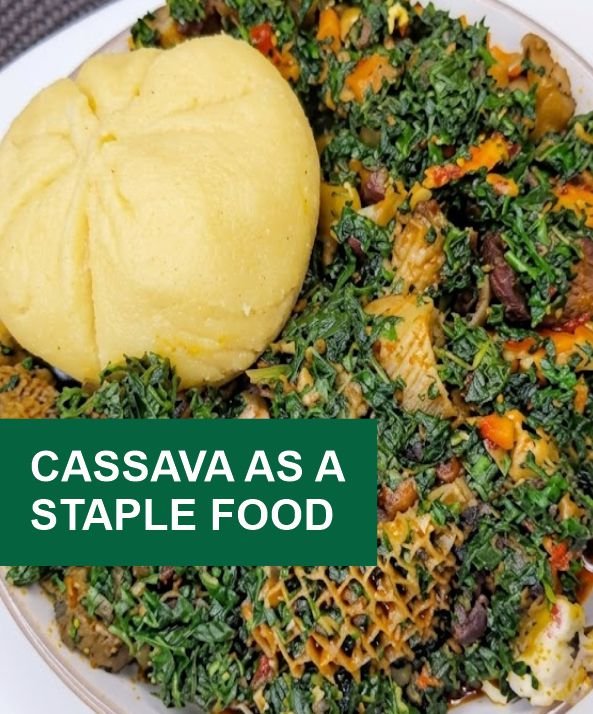
My own community follows a similar pattern, built around garri, fufu, and cassava flour rather than rice or wheat.
In West Africa, garri, fufu, lafun, and cassava flour anchor daily meals across Nigeria, Ghana, and neighboring countries.
Nigeria alone harvests more than 59 million tonnes of fresh cassava roots each year, making it the continent’s largest producer, according to research published on PMC.
Families in Congo and Central Africa rely on both cassava roots and leaves, especially during food shortages and poor harvest seasons.
Cassava consumption in Uganda and Tanzania climbs during drought years, when maize and other staples fail from poor rainfall.
Our post on smallholder cassava farmers in Nigeria looks at how this dependence plays out at the household level.
Cassava and Food Security
Cassava’s deep root system draws water from lower soil layers, letting it keep producing through dry spells that ruin shallow-rooted staples.
This resilience matters most during drought years, when maize, rice, and yam harvests decline sharply from poor seasonal rainfall.
Rural households lean on cassava for regular feeding since the roots deliver filling meals and a steady calorie supply through hard seasons.
Because mature roots can stay underground until needed, farming families gain real flexibility in when they harvest and how they plan meals.
This reduces seasonal food gaps and supports household food planning across an unpredictable farming calendar.
Why Rural Families Keep Depending on Cassava
Smallholder farming conditions favor cassava over crops with heavier input demands, since it needs less fertilizer and simpler management, which matters for resource-limited farmers.
Poor soils and irregular rainfall, conditions that would cripple other staples, rarely stop a cassava harvest outright.
Roots staying underground after maturity give households real flexibility for daily meal support when other food supplies run thin.
Intercropping cassava alongside maize, vegetables, and legumes also helps rural farmers get more value from limited land.
The guide on ideal climate conditions for cassava farming breaks down exactly how much rainfall and heat the crop can tolerate.
Cassava Compared to Other Staple Crops
Cassava holds up well against the other major staples grown across the same regions.
- Cassava vs Maize: Cassava keeps producing roots through drought conditions that stall maize outright. Maize must be harvested immediately at maturity for grain quality, while cassava roots can stay in the soil for months.
- Cassava vs Rice: Rice needs flooded fields, heavy water supply, and far more inputs than cassava requires. Cassava adapts easily to upland areas, which matters where irrigation infrastructure is limited or unreliable.
- Cassava vs Yam: Yam demands more labor, staking systems, and fertile soil than cassava’s simpler cultivation process needs. Cassava also scales more easily across larger plots, giving farmers higher output per unit of labor invested.
Challenges Affecting Cassava as a Staple Food
A few recurring pressures threaten cassava’s role in food security across the continent.
- Crop diseases: cassava mosaic disease and brown streak disease reduce root harvests and can devastate an unprotected field. Our guide on preventing cassava mosaic virus on large-scale farms covers early warning signs.
- Climate pressure: drought and irregular rainfall reduce cassava growth and raise farming risk even for this resilient crop.
- Population growth: rising demand for cassava-based foods keeps stretching existing production systems across rural regions.
- Limited resources: many smallholders face restricted access to land, inputs, and quality planting material, which caps productivity. Our post on challenges facing the cassava value chain covers these constraints in more depth.
What This Looks Like on My Own Farm
Farming cassava for subsistence in Ntigha means planning around the seasons rather than the market.
I keep at least one plot planted specifically as a food reserve, harvested gradually as the household needs it rather than all at once.
This mirrors what I have documented in our post on cassava farming data from Ntigha, Abia State, where subsistence and market plots are tracked separately.
Disease resistance matters as much as yield when a crop failure could mean real hunger for a household, not just lost income.
Conclusion
Cassava earns its place as Africa’s food security backbone through resilience rather than glamour.
It survives droughts, poor soils, and erratic rainfall that would wipe out rice or maize.
My community in Abia State has leaned on it for generations, and that dependence has only grown as climate pressures increase.
Improved disease-resistant varieties and better processing methods keep expanding what cassava offers beyond the farm gate.
If you farm cassava for subsistence or market, protecting your harvest from disease and drought should stay a priority.
Check our guide on sustainable cassava farming practices to strengthen your farm’s resilience this season.
Frequently Asked Questions
Why is cassava considered a staple food?
Cassava is a staple because it delivers dependable calories, survives poor soils and drought, and supports daily meals for nearly a billion people worldwide.
Why do millions depend on cassava?
Millions rely on cassava because it is affordable, filling, tolerant of drought and poor soil, and available year-round even when other crops fail.
Which African countries consume the most cassava?
Nigeria, DR Congo, Ghana, Uganda, and Tanzania consume the most cassava daily, with Nigeria alone harvesting more than 59 million tonnes of roots yearly.
Can cassava survive drought better than maize?
Yes, cassava’s deep root system draws water from lower soil layers, letting it keep producing through dry spells that would devastate a maize crop.

Chimeremeze Emeh is a tropical crop farmer and chemical engineer from Ntigha, Isiala Ngwa North LGA, Abia State, Eastern Nigeria, specializing in cassava and palm oil, with over 30 years of hands-on experience growing, harvesting, and processing cassava. He grows TMS series, TME 419, and local traditional varieties on his own farms and operates a small-scale cassava flour and starch production business through Cassava Pathway, which he founded as a CAMA-registered agribusiness in 2024. He is also the founder of Palm Oil Pathway, where he applies the same tropical farming expertise. His farms are located in Ntigha, Abia State.