Last updated on July 19th, 2026 at 04:05 pm
My mother planted corn beside our cassava mounds while my father planted yam a meter away, and every harvest came out well. Here is what makes an intercropping system work, backed by both that family tradition and current agronomic research.
In our family cassava farms, intercropping has always been part of the farming system.
My mother handled corn planted close to the cassava mounds, and yams were also in the picture, and the farm produced well, season after season.
That space kept each crop from competing too hard for the same nutrients.
This guide covers which crops pair well with cassava, including maize, legumes, sweet potato, and yam.
It also covers what the research says about the trade-offs involved and how to manage spacing and timing so your own intercropped farm thrives.
If you are new here, here is a good place to start on the cassava plant.
Table of Contents
My Family’s Intercropping System
Growing up in Ntigha, my family never planted cassava alone, and my mother took charge of corn, planting it beside the cassava mounds so both crops shared the same rows.
My father handled yam separately, keeping each stand about a meter from the cassava.
That distance was not guesswork passed down without reason, since corn draws heavily on the same nutrients cassava needs early on, so keeping it close meant closer attention to fertility.
Yam competes with cassava less aggressively, so it could sit farther out without either crop suffering.
Every season, both the corn and the yam came in before the cassava did, and the farm still produced a full cassava harvest afterward.
That instinct matches published research, since a review of cassava intercropping trials found that yam interferes with cassava growth less than maize does.
That may explain why wider spacing for yam still produced full harvests without anything being measured with precision.
Crops that Can Be Planted (Intercropped) with Cassava
Maize: A Productive Partner for Cassava
Maize is the most common crop paired with cassava, especially in southern Nigeria.
More than 60 percent of cassava farmland there is intercropped rather than planted alone, according to research coordinated with the International Institute of Tropical Agriculture.
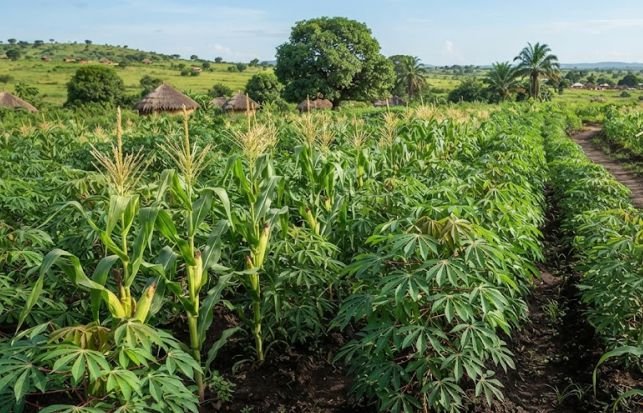
Maize matures in three to four months, so farmers collect income and food from it long before the cassava is ready, which was also true on our farm.
Maize and cassava do draw on different soil layers, with maize rooting shallower and cassava reaching deeper, but this does not eliminate competition entirely.
A meta-analysis of cassava intercropping trials found that maize yields can drop by about 10 percent alongside cassava, mainly from competition for light and nutrients early on.
Careful spacing, timely fertilizer, and higher planting density for both crops can offset most of that loss, based on multi-year field trials conducted across southern Nigeria.
Beans: Enriching the Soil and Your Yield
Beans, particularly bush varieties or shorter climbing types, pair well with cassava because they fix nitrogen in the soil through their root nodules, reducing the need for synthetic fertilizer.
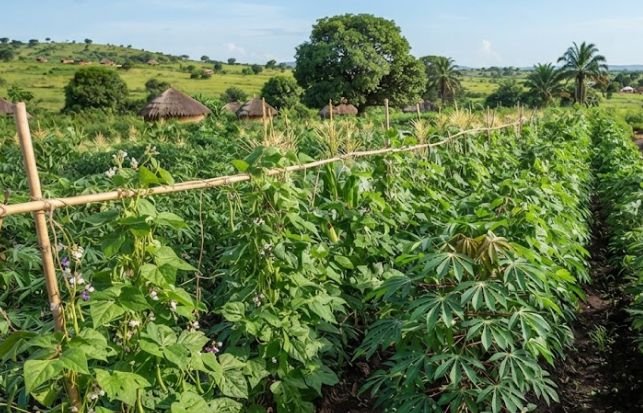
Beans also mature quickly, giving farmers an early harvest of food or income before cassava is ready.
The same meta-analysis of cassava-legume intercropping trials found that this pairing works best on low-input farms with limited fertilizer, since adding more inputs narrows the yield advantage over sole cropping.
With proper spacing, beans can grow alongside cassava without competing heavily for sunlight.
Dwarf Pigeon Pea: A Resilient Ally
Dwarf pigeon pea is a hardy legume commonly intercropped with cassava for weed control and soil fertility.
Its dense ground cover blocks sunlight from reaching weed seedlings, reducing the need for herbicides, a benefit confirmed in a review of non-chemical weed management strategies for cassava farms.
Pigeon pea also fixes nitrogen, enriching the soil for the cassava planted alongside it.
That said, research on cassava-pigeon pea systems found that pigeon pea yield can drop when nitrogen fertilizer is applied heavily, since vigorous cassava cultivars outcompete it for the added nutrients.
Farmers who intercrop pigeon pea with cassava should watch fertilizer rates carefully rather than assuming that more nitrogen benefits both crops equally.
Sweet Potatoes: Maximizing Land Efficiency
Pairing sweet potatoes with cassava is a common way to make fuller use of the same plot.
Sweet potato vines spread across the surface, while cassava’s roots grow deep underground, so the two crops draw water and nutrients from different zones.
Sweet potatoes mature within a few months, giving farmers an earlier harvest while the cassava keeps growing.
Their vines also help cover bare soil, which can reduce erosion and moisture loss between cassava rows.
Cowpeas: A Versatile Choice
Cowpeas are a widely intercropped legume in cassava systems, valued for their ability to fix atmospheric nitrogen and enrich the soil naturally.
Cowpeas mature faster than cassava, giving farmers an additional income source early in the growing season.
They also sell well fresh or dried, which adds to their appeal for smallholder farmers managing multiple income streams.
As with other legumes, cowpeas planted alongside cassava should be spaced carefully so farmers can plan planting distances that let both crops grow harmoniously without competing for the same nutrients.
Groundnuts: A Dual-Purpose Companion
Groundnuts, also called peanuts, are a practical intercrop for cassava with real research behind the pairing.
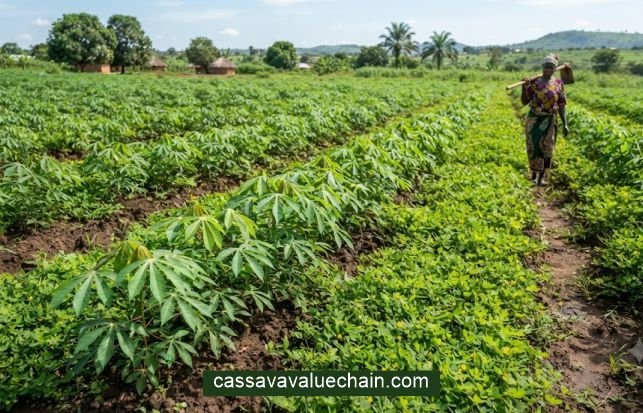
A study on cassava-peanut intercropping found the system improves available soil nitrogen by increasing beneficial microbial activity around the roots of both crops.
Groundnuts also have a shorter growth cycle than cassava, so farmers harvest them earlier and gain an additional income stream.
Combined with their strong market demand, groundnuts remain one of the more reliable legumes to plant alongside cassava.
Yam
Yam is another crop we grew alongside cassava on our family farm, and research backs up why it worked without heavy management.
The same review of cassava intercropping systems found that yam interferes with cassava growth less than maize does, since yam’s root structure overlaps less with cassava’s root zone.
On our farm, the planting space between the yam and cassava mounds gave both crops enough room to develop without direct competition.
Yam also matures on a longer timeline than crops like maize or beans, so it fits naturally into a system where cassava is already the slowest crop in the ground.
Farmers considering yam as an intercrop should still watch spacing and soil fertility, since research on yam-cassava-legume systems shows that combining all three can further reduce weeds and pest pressure.
Managing Competition and Trade-Offs
Every intercropping pairing involves some trade-off, even when the overall result favors the farmer.
Competition for sunlight, water, and nutrients is real, and multiple field trials show it can lower the yield of one or both crops without careful management.
The stress-gradient pattern found across several studies suggests intercropping benefits shrink once a farm adds heavy fertilizer or irrigation, since better-resourced soil reduces the advantage of pairing crops.
Labor is another factor, since managing two or three crops on the same plot takes more time than tending a single crop.
Intercropping can also draw a wider mix of pests and diseases, so integrated pest management becomes more important, not less, when multiple crops share a field.
Conclusion
Intercropping cassava with maize, legumes, sweet potato, or yam is not just theory; it is common practice across Nigeria and is backed by real field research.
My own family’s farm proved it works, corn close to the mounds, yam a meter out, and cassava still thriving underneath both.
The trade-offs are real, too, so plan spacing, fertilizer, and labor before choosing a combination.
Start with one pairing that fits your soil and market, watch how the crops interact for a season, and adjust from there.
Frequently Asked Questions
Which crop is easiest to intercrop with cassava for a beginner?
Maize is usually the easiest starting point, since it is already common practice in Nigeria, matures quickly, and gives farmers experience managing spacing before trying legumes or yam.
Does intercropping reduce cassava’s overall yield?
It can, especially in the early months when crops compete for light and nutrients, but careful spacing, correct fertilizer timing, and crop selection reduce that risk quite considerably.
Can I intercrop cassava with yam and maize together?
Yes, this is a traditional combination in parts of Nigeria, with maize harvested first, yam harvested next, and cassava left to mature last in the same shared plot.
Do legumes really improve soil fertility for cassava?
Yes, legumes like beans, cowpeas, groundnuts, and pigeon peas fix nitrogen through their roots, and research shows this benefit is strongest on low-input farms without heavy fertilizer use.


Chimeremeze Emeh is a tropical crop farmer and chemical engineer from Ntigha, Isiala Ngwa North LGA, Abia State, Eastern Nigeria, specializing in cassava and palm oil, with over 30 years of hands-on experience growing, harvesting, and processing cassava. He grows TMS series, TME 419, and local traditional varieties on his own farms and operates a small-scale cassava flour and starch production business through Cassava Pathway, which he founded as a CAMA-registered agribusiness in 2024. He is also the founder of Palm Oil Pathway, where he applies the same tropical farming expertise. His farms are located in Ntigha, Abia State.