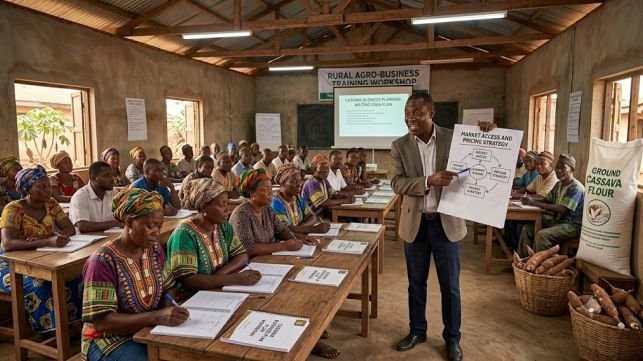
Business Development is a key function of the Cassava Pathway, designed to help smallholder farmers move beyond subsistence farming into structured, profitable agribusiness.
Most cassava farmers in Nigeria are skilled at growing the crop. The gap is rarely in production knowledge; it is in business thinking.
How to calculate real costs. How to price for profit rather than just for sale. How to decide whether to sell raw roots, process them into garri, or invest in flour production.
How to plan a season financially rather than react to whatever the market offers on harvest day.
That gap between farming skill and business skill is what this service exists to close.
Cassava Pathway does not provide loans or financial products.
What we provide is the knowledge, guidance, and practical support that help farmers develop into structured agribusiness operators, people who make deliberate decisions about their operations rather than hoping each season works out.
Table of Contents
What Business Development Support Means at Cassava Pathway
Commercial Mindset Training
The first shift is mental. Growing cassava as a livelihood and cassava farming as a business require fundamentally different thinking.
A subsistence farmer asks: Did we have enough to eat and enough left to sell?
A business operator asks: what did it cost to produce, what did it sell for, what was the margin, and how do we improve it next season?
We work with farmers to make that shift, not through abstract lectures but through practical exercises tied to their own farms, their own costs, and their own market realities.
Farmers who go through this process start seeing their land, labour, and inputs differently. That is the value chain thinking.
That change in perspective is where commercial growth begins.
Budgeting, Cost Tracking, and Record Keeping
Most smallholder farmers operate without written records.
They know roughly what they spent and roughly what they earned, but cannot tell you their cost per kilogram of garri or their net margin per hectare.
Without those numbers, every business decision is a guess.
We train farmers on simple, practical record keeping, what to track, how to track it, and how to use those records to make better planting, processing, and selling decisions.
The goal is not accounting software. It is a notebook habit that turns farming from an activity into a business with measurable outcomes.
Value Chain Entry Point Analysis
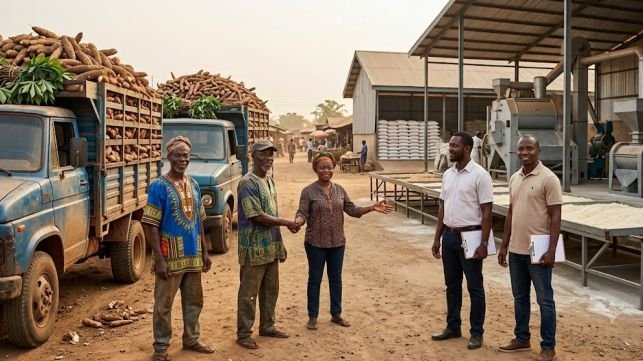
One of the most valuable things Cassava Pathway helps farmers understand is where in the cassava value chain they should be operating.
Selling raw roots at the farm gate is the lowest-margin option.
Processing into garri or chips captures more value.
Producing high-quality cassava flour or starch captures significantly more.
But each step up requires capital, equipment, skills, and market access that not every farmer has today.
We help farmers assess their current resources honestly and identify the most realistic next step, not the most ambitious one.
A farmer who moves from raw root sales to garri processing the roots with the right market connection is making a more sustainable business decision than one who overextends into starch production without the infrastructure to support it.
Pricing Strategy and Market Positioning
Many farmers price their products reactively; whatever the buyer offers, they take.
We train farmers on how to understand their actual cost of production and set a price floor below which selling makes no commercial sense.
We also help farmers understand product differentiation and why consistent quality, proper packaging, and reliable delivery create the conditions for better pricing and repeat buyers.
This is not theoretical. It is the same thinking I have applied to Cassava Pathway’s own commercial operations, understanding what it costs to produce, what the market will pay, and where the gap between those two numbers needs to close.
Business Planning for Agripreneurs
For farmers ready to scale, whether into processing, aggregation, or direct market supply, we provide guidance on building a simple, practical business plan.
Not a document for a bank manager but a working plan that maps out what the business does, what it needs to operate, what it will cost, and what it needs to earn to be viable.
This planning process often reveals gaps in:
…that needs to be addressed before scaling.
Identifying those gaps early saves farmers from investing in expansion that the market or the infrastructure cannot yet support.
Read the post about business planning for cassava businesses.
What We Are Building Toward
The business development support Cassava Pathway currently provides is knowledge-based.
As the organisation grows, the plan is to extend this into facilitated financial linkages, connecting farmers who have demonstrated business readiness to microfinance institutions, agribusiness investors, and cooperative financing structures.
That work requires farmers who already have the records, the plans, and the commercial discipline that makes them creditworthy.
The business development training we deliver today is preparation for that next stage.
Farmers who go through our programmes are building the foundation that financial partners will eventually need to see before extending support.
We are also working toward supporting cooperative formation, helping farmer groups pool resources, access larger market opportunities, and operate as collective enterprises with stronger bargaining power than individual smallholders can achieve alone.
Who This Is For
- Cassava farmers who want to move beyond subsistence and build a commercial operation
- Processors who want to understand their margins and price their products correctly
- Young agripreneurs entering the cassava value chain who need business fundamentals alongside farming knowledge
- Farmer groups looking to formalize and operate more strategically as a collective
Get Involved
If you are a cassava farmer or processor in Nigeria ready to approach your operation more deliberately, contact Cassava Pathway here.
Tell us where you are in the value chain and what business challenge you are trying to solve. We will tell you honestly what we can help with right now and what we are building toward.
Chimeremeze Emeh
Chimeremeze Emeh is a tropical crop farmer and chemical engineer from Ntigha, Isiala Ngwa North LGA, Abia State, Eastern Nigeria, specializing in cassava and palm oil, with over 30 years of hands-on experience growing, harvesting, and processing cassava. He grows TMS series, TME 419, and local traditional varieties on his own farms and operates a small-scale cassava flour and starch production business through Cassava Pathway, which he founded as a CAMA-registered agribusiness in 2024. He is also the founder of Palm Oil Pathway, where he applies the same tropical farming expertise. His farms are located in Ntigha, Abia State.