Last updated on July 11th, 2026 at 03:53 pm
Most cassava produced worldwide is consumed in its lowest-value form, boiled or dried root, when the same crop could become flour, starch, or sweetener worth many times more, and that gap is where the real business opportunity lives.
Cassava is one of the world’s most widely grown crops, yet the vast majority of what is harvested reaches consumers in its most basic form.
The entrepreneurs and investors capturing the most value are the ones building inside the gap between raw production and higher-value processing.
This guide ranks fourteen real entry points by capital required and barrier to entry, rather than treating them as equally accessible, since they are not.
It is written from the perspective of someone who farms, processes, and sells cassava commercially in Abia State, Nigeria, and who has trained over 100 rural farmers in community-level cassava entrepreneurship since 2020.
Table of Contents
Why This Guide Is Different
As someone who has processed, sold, and run a registered cassava business through Cassava Pathway, I have watched what happens when market infrastructure fails farming communities.
In a 2023 study Cassava Pathway conducted, fifteen farmers in my community harvested cassava during a glut and had no processing buyers within reach.
They were forced to sell the roots at a loss. The nearest industrial processors were hundreds of kilometres away, and that gap between harvest and buyer is as relevant to this guide as any global figure.
The opportunities described here are real, and so are the barriers that keep most producers locked out of the higher-value end of this chain.
The Global Market in Brief
Global cassava production reached roughly 341 million tonnes in 2024, with Africa contributing about 65 percent of that total, according to FAOSTAT.
Nigeria, the Democratic Republic of the Congo, Thailand, and Ghana are the four largest producers, in that order, based on the same FAOSTAT data.
Asia holds a disproportionate share of global processing capacity relative to its production volume.
Africa grows most of the crops but processes far fewer of them domestically.
That imbalance, Africa grows it, Asia processes more of it, is the defining structural reality behind most of the opportunities in this guide.
For the fuller regional and trade picture, see our complete guide to the global cassava market, which this guide deliberately does not repeat.
Cassava Business and Investment Opportunities, Ranked by Capital Required
Not every cassava business needs the same starting capital, and treating all fourteen opportunities as equally accessible does new entrepreneurs a disservice.
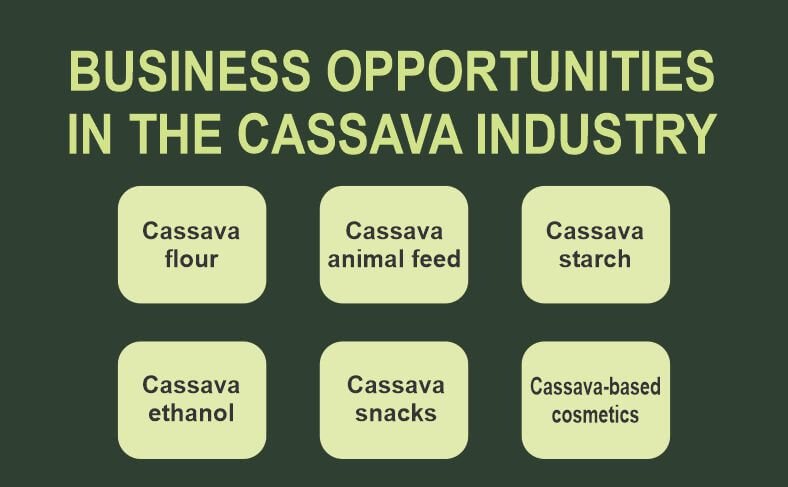
Grouping them by what they actually require, low capital, moderate capital, and high capital, gives a clearer picture of where to realistically start.
- Low capital, low barrier business entry points
- Moderate capital entry points
- Moderate capital entry points
- High capital entry points
Low Capital, Low Barrier Entry Points
Cassava Seed Entrepreneurship
Cassava seed entrepreneurship is a business opportunity that involves multiplying and selling certified, disease-resistant planting material to neighbouring farmers, requiring no processing equipment and minimal capital.
In communities where most farmers still plant unimproved local varieties, the yield gap this closes is substantial, something I saw firsthand in Ntigha in 2023.
See our guide to cassava variety selection for the agronomic details behind which varieties are worth multiplying.
Community-Scale Processing
Community-scale processing is a business in the industry that converts raw cassava into garri, fufu, chips, or flour within a day or two of harvest, solving post-harvest loss and market access at once.
This is the business model Cassava Pathway itself is built around, and the margins are real even at a modest scale.
See our guides to traditional and modern cassava processing methods for the technical details.
Cassava Leaves Business
Cassava leaves are a nutritional resource that most producing communities either underuse or discard, despite being high in protein relative to the root itself.
As plant-based food markets grow, cassava leaf businesses are emerging in packaged foods and nutrition products, an early opportunity for producers willing to invest in food safety.
Our guide to cassava leaves covers the nutritional and processing basics behind this opportunity.
Digital Supply Chain
Digital supply chain and aggregation services is a business in the cassava industry that tracks farmer deliveries and aggregates smallholder supply for larger processors are a business in themselves, requiring relationship management more than capital.
Entrepreneurs who can maintain farmer relationships and deliver consistent-quality raw material solve one of processing’s most persistent structural problems, without owning any processing equipment themselves.
Moderate Capital Entry Points
Cassava Chips for Export
Cassava chips for export are another cassava business that serves China’s ethanol, animal feed, and industrial markets, with clear technical requirements around moisture content and size consistency.
Thailand currently dominates this trade, but producers across Southeast Asia, Africa, and Latin America are increasingly positioned to supply it too.
See our guide to international cassava chip pricing for the trade details behind this opportunity.
Cassava for Animal Feed
Cassava for animal feed, chips, pellets, and dried roots is a cassava business opportunity that serves poultry, swine, and aquaculture formulations as a cost-effective substitute for corn and other grains.
For producers in cassava-growing regions with drying infrastructure already in place, this is one of the more accessible export commodity markets available.
Our full guide to cassava in animal feeds covers this market in more depth.
Cassava Snacks and Consumer Products
Cassava snacks and consumer products are another moderate cassava business opportunity.
It includes packaged snacks, garri, home-baking flour, and tapioca pearls for beverages, which carry meaningfully higher margins than bulk commodity sales.
This segment is growing across both domestic markets in producing regions and diaspora communities abroad, driven partly by bubble tea’s global reach.
Commercial Cassava Farming for Supply
Commercial cassava farming for supply, built around a confirmed buyer relationship rather than speculative planting, is the foundational moderate-capital entry point across every producing region.
Our step-by-step guide to starting commercial cassava farming covers exactly how to sequence this properly.
High Capital Entry Points
Cassava Starch Production
Cassava starch production is the cornerstone product of industrial processing, serving food manufacturing, pharmaceutical, textile, paper, and adhesive industries at real scale.
Asia’s current dominance in starch processing reflects infrastructure investment that other regions have not yet made, not any inherent limitation in cassava quality elsewhere.
High-Quality Cassava Flour
High-quality cassava flour is riding genuine gluten-free demand growth, substituting for wheat flour in bakery, beverage, and pharmaceutical applications across multiple markets.
Producers in Africa and Latin America who can meet quality and certification standards have a real export opportunity here, not just a domestic one.
See our guides to the cassava flour production business and how to process cassava flour for practical details.
Cassava Biofuel Business
Cassava biofuel is the umbrella category, and bioethanol is its most developed form today, offering a renewable alternative to fossil fuels.
The crop’s high starch content makes it efficient feedstock where sugarcane or corn is costly.
This is capital-intensive to enter but sits among the highest long-term value opportunities in the entire chain, worth serious study before commitment.
Our full guide to cassava biofuel covers the broader category. Our ethanol production guide covers that specific process in depth
Cassava-Based Sweeteners
Cassava-based sweeteners, glucose syrup and sorbitol, offer a genuinely cost-competitive alternative to corn-derived versions in toothpaste, pharmaceutical syrups, and confectionery.
This is an advanced processing entry point requiring real capital, but it delivers premium margins for producers who can meet industrial quality standards.
See our guide to cassava sweeteners for more on this specific opportunity.
Cassava-Based Bioplastics and Biodegradables
Cassava-based bioplastics and biodegradable packaging businesses are gaining real traction as regulation and consumer pressure push manufacturers away from petroleum-based materials.
This is one of the more capital-intensive, forward-looking entry points, worth watching closely rather than entering without industry partnerships already in place.
Our guide to cassava starch in eco-friendly bioplastics covers the technical and market details.
Modified Cassava Starch
Modified cassava starch, processed to alter its functional properties for specific industrial uses, commands premium prices over native starch from food, pharmaceutical, and paper manufacturers.
This is the highest-value starch opportunity and the one closest to the frontier of cassava processing innovation, requiring real technical capability to enter.
See our guide to modified starch production for the process behind it.
What Makes a Cassava Business Succeed
The pattern behind every cassava business that has scaled successfully looks remarkably consistent across regions and product categories.
Raw material security comes first, built through direct farming, out-grower schemes, or aggregator partnerships, before processing capacity is added.
Partnerships between farmers, processors, and buyers genuinely reduce risk, and no cassava business scales without building these deliberately rather than hoping they form on their own.
Our guides to profiting from the cassava value chain and starting commercial cassava farming cover the storage, quality, and buyer-timing factors that determine success in far more depth than fits here.
And also check out this guide on cassava marketing strategies for entrepreneurs.
Developing a Cassava Business Plan
Every cassava entrepreneurship journey benefits from a written plan, even a simple one, before capital gets committed to land or equipment.
Identify your buyer before deciding what to produce, since the market should drive the product decision, not the other way around.
A processor with an offtake agreement in hand before equipment investment takes meaningfully less risk than one building capacity first and searching for buyers after.
Choose the entry point that matches your actual resources, farming, processing, aggregation, seed multiplication, and trading, all of which demand different capital and relationships.
See our full cassava business plan example for a detailed framework to build from.
Accessing Support and Partnerships
Research institutions, including IITA and CIAT, provide agronomic guidance and technical support to cassava entrepreneurs across producing regions.
Development organizations, including the World Bank, the African Development Bank, IFAD, and the Gates Foundation, remain active investors in cassava value chain development.
Cassava Pathway’s own training and processing support services are available to entrepreneurs building in the cassava space in South Eastern Nigeria.
Conclusion
The cassava value chain spans six continents, and the entrepreneurs who capture the most from it will not be the ones waiting for conditions to improve.
They will be the ones building supply chains, securing buyers, and producing consistent quality, starting at the capital tier their resources allow.
I built Cassava Pathway inside these exact problems in Abia State, and the opportunities here are ones I have evaluated from that position, not from a market research desk.
The market is global. The entry points are local. Start where your resources allow, and find your buyer before you scale.
Frequently Asked Questions
How do I start a cassava business?
Identify your target product and buyer first, build raw material supply through farming or aggregation, secure processing capability, and start at a scale your capital can sustain.
What are the most profitable cassava products?
Cassava starch, modified starch, high-quality flour, sorbitol, and bioethanol offer the highest margins, while garri, fufu, and tapioca remain accessible, high-volume opportunities.
What are the biggest challenges in starting a cassava business?
Inconsistent raw material supply, post-harvest losses from poor infrastructure, price volatility, and limited access to financing are the most common obstacles new entrants face.
Which cassava entrepreneurship opportunities need the least starting capital?
Seed multiplication, community-scale processing, and supply aggregation all require relationships and skill more than large capital, making them realistic starting points for most entrepreneurs.

Chimeremeze Emeh is a tropical crop farmer and chemical engineer from Ntigha, Isiala Ngwa North LGA, Abia State, Eastern Nigeria, specializing in cassava and palm oil, with over 30 years of hands-on experience growing, harvesting, and processing cassava. He grows TMS series, TME 419, and local traditional varieties on his own farms and operates a small-scale cassava flour and starch production business through Cassava Pathway, which he founded as a CAMA-registered agribusiness in 2024. He is also the founder of Palm Oil Pathway, where he applies the same tropical farming expertise. His farms are located in Ntigha, Abia State.