Last updated on October 30th, 2026 at 09:36 am
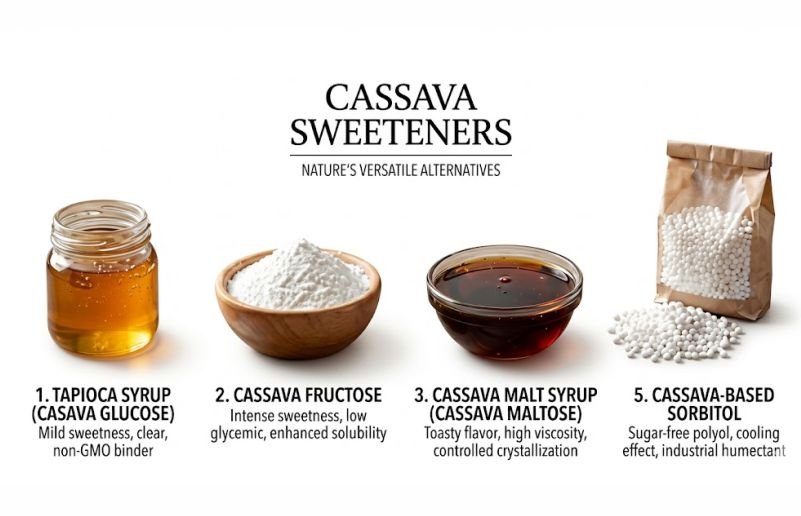
Cassava sweeteners are syrups and powders made by carefully breaking cassava starch into smaller sugars. Glucose syrup, dextrose, maltodextrin, and sorbitol all start from the same plain white starch, yet each behaves differently in food, medicine, brewing, and heavy industry.
Wet starch settling at the bottom of a basin is a familiar sight in my small processing room in Ntigha, Abia State.
That starch is the raw material for every sweetener in this article, and sorbitol is one product I hope to make myself someday.
This guide follows the enzymes that turn starch into syrups and powders, then sets out what separates each type.
It covers the legal definitions buyers use, how these ingredients compare with cane sugar and corn syrup, and their nutrition.
A selection table at the end matches each sweetener to bakery, beverage, confectionery, and pharmaceutical needs.
Table of Contents
What Are Cassava Sweeteners?
Cassava sweeteners are carbohydrate ingredients produced by splitting the long starch chains of cassava into shorter sugars.
Depending on how far the splitting goes, the result can be a thick syrup, a fine powder, or crystals.
Producers describe the degree of breakdown as dextrose equivalent, or DE, where pure starch scores 0 and pure glucose scores 100.
Low-DE products taste mild and feel thick, while high-DE products taste sweeter and ferment more readily.
The starch itself comes from grated roots, as the walkthrough on making tapioca starch and flour shows.
How Cassava Starch Becomes a Sweetener
Commercial production follows the same broad stages, though plants adjust enzymes, temperatures, and times to the product they want.
- Starch extraction: roots are washed, grated, and sieved, then the starch settles out of the water and is dried.
- Gelatinization: starch mixed with water is heated so the granules swell and open to enzymes.
- Liquefaction: a heat-stable alpha-amylase cuts the starch into shorter chains, producing maltodextrins below DE 20.
- Saccharification: glucoamylase, sometimes with pullulanase, breaks those chains further into glucose and maltose.
- Refining: the liquid is filtered, decolorized, and concentrated into syrup, or crystallized into dextrose.
- Hydrogenation (sorbitol only): glucose reacts with hydrogen under pressure to form the sugar alcohol sorbitol.
A 2014 study in Chemical Engineering Transactions liquefied cassava mash at 90°C and saccharified it at 60°C and pH 5.4.
After four hours of saccharification, the researchers reached a DE of 92.3 in the laboratory and 98.1 at small scale.
The first stage is the same work I do at home, grating, sieving, settling, and drying starch before it ever meets an enzyme.
Types of Cassava Sweeteners
| Type | Composition or DE | Form | Typical uses |
|---|---|---|---|
| Maltodextrin | Below DE 20 | Powder | Sports drinks, soups, bulking and thickening |
| Tapioca syrup | Partly hydrolyzed starch | Thick liquid | Snack bars, cereals, sauces, home baking |
| Glucose syrup | DE 20 or above | Thick liquid | Confectionery, bakery, brewing, fermentation |
| High-maltose syrup | Mostly maltose | Thick liquid | Hard candy, brewing, frozen desserts |
| Dextrose | At least 99.5 percent D-glucose | Crystal powder | Tablets, sports nutrition, fermentation media |
| Sorbitol | Sugar alcohol from glucose | Liquid or powder | Toothpaste, syrups, sugar-free sweets |
Tapioca Syrup
Tapioca syrup is the name most shoppers know, sold as a corn syrup alternative for granola, cereal bars, and candy.
Its properties, labeling, and grades are covered in the dedicated guide to tapioca syrup uses and properties.
Dried versions appear on labels as syrup solids, which the article on tapioca syrup solids explains.
Small batches can be made in a home kitchen with enzymes or acid, following the homemade tapioca syrup method.
Glucose Syrup and High-Maltose Syrup
Glucose syrup is the workhorse of candy and bakery plants, because it controls crystals and keeps products soft.
High-maltose syrup tastes less sweet and browns more slowly, so brewers and hard-candy makers favor it.
Dextrose
Dextrose is purified, crystallized glucose, and it dissolves quickly with a clean, simple sweetness.
Drug makers use it in tablets and oral solutions, while fermentation plants feed it to yeasts and bacteria.
Sorbitol
Sorbitol tastes about half as sweet as sugar and resists tooth decay bacteria, so toothpaste and sugar-free gum rely on it.
Psaltry International commissioned a 25-ton-per-day cassava sorbitol plant at Iseyin, Oyo State, in August 2022, according to the Lagos Business School cassava accelerator.
Legal Definitions Buyers Should Know
Specifications protect buyers, and European law sets clear minimums for glucose products, as Council Directive 2001/111/EC shows.
| Product | Minimum dry matter | Key requirement |
|---|---|---|
| Glucose syrup | 70 percent | DE of at least 20, expressed as D-glucose |
| Dried glucose syrup | 93 percent | Same DE requirement as glucose syrup |
| Dextrose monohydrate | 90 percent | At least 99.5 percent D-glucose in dry matter |
| Dextrose anhydrous | 98 percent | Crystallized without water of crystallization |
Industrial buyers also check color, conductivity, and microbial counts, so request a full specification sheet before signing a supply contract.
How Cassava Syrups Compare With Other Sweeteners
| Compared with | Main difference | Detailed comparison |
|---|---|---|
| Cane sugar | Less sweet, resists crystallizing, holds moisture better | Covered in this guide’s choice table below |
| Corn syrup | Functionally almost identical, differs mainly in source crop and price | Tapioca syrup versus corn syrup |
| Honey | Neutral taste and consistent composition, without floral notes | Tapioca syrup versus honey |
| Agave syrup | Mostly glucose rather than fructose, with a milder flavor | Tapioca syrup versus agave |
Where corn must be imported, cassava syrups usually win on cost, which is why tropical producers favor them.
What These Sweeteners Do in Food
- Moisture retention: low-DE syrups bind water, keeping cakes and cookies soft for longer after baking.
- Crystal control: glucose blocks sucrose crystals, giving smooth caramels, fondants, and hard candies.
- Browning: free glucose joins the Maillard reaction, helping crusts turn golden in the oven.
- Fermentation: high-DE syrups feed yeast quickly during proofing, brewing, and ethanol production.
- Body and gloss: syrups add thickness and shine to sauces, glazes, and fruit fillings.
- Freezing control: dissolved sugars lower the freezing point, so ice creams stay scoopable.
Industrial Uses in Brief
Outside food, cassava glucose feeds fermentation plants making ethanol, organic acids, amino acids, and enzymes.
Pharmaceutical plants rely on high-purity dextrose and sorbitol, which must meet strict purity and microbial standards.
Sector-by-sector detail, from brewing to drug making, lives in the article on sweetener uses across industries.
Fuel-grade fermentation is explained step by step in the cassava ethanol production guide.
Nutrition and Health
They are almost pure carbohydrate, supplying about 4 calories per gram of dry solids, like other sugars.
Refining removes nearly all fiber, protein, vitamins, and minerals from the original root.
Glucose is the reference food for the glycemic index, so glucose-rich syrups raise blood sugar quickly.
Cassava contains no gluten, and Stanford Children’s Health lists it among gluten-free foods for celiac patients.
Digestive tolerance is a separate question, examined in the post asking is tapioca syrup low FODMAP.
Nigeria’s Opportunity in Starch-Based Sweeteners
Nigeria grows more cassava than any country yet still imports many of the sweeteners its factories use.
The Central Bank of Nigeria put yearly imports of cassava derivatives, including glucose and sorbitol, near $600 million, Channels TV reported in 2019.
Local plants like Psaltry show the demand is real, but steady root supply and reliable power decide which projects survive.
The costs facing small processors are laid out in my account of running a cassava flour production business.
How to Choose the Right Cassava Sweetener
| Your need | Best choice | Why |
|---|---|---|
| Soft bakery products | Low-DE glucose syrup | Holds moisture and slows staling |
| Smooth candy and caramel | Glucose syrup | Prevents sugar crystals from forming |
| Hard candy and brewing | High-maltose syrup | Less browning and steady fermentation |
| Beverages | Glucose syrup around DE 40 to 65 | Dissolves easily with a neutral taste |
| Tablets and oral solutions | Pharmaceutical-grade dextrose | High purity and precise dosing |
| Sugar-free and dental products | Sorbitol | Sweet without feeding decay bacteria |
| Home candy and granola | Tapioca syrup | Replaces light corn syrup cup for cup |
Ask suppliers for DE, dry solids, color, and microbial data, and test a small batch before changing any production formula.
Conclusion
Cassava sweeteners all begin as starch, then enzymes decide if the result becomes maltodextrin, syrup, dextrose, or, after hydrogenation, sorbitol.
DE explains most of the differences, from thick, mild syrups to sweet, fast-fermenting powders.
Buyers should check legal definitions and full specification sheets before committing to any supplier.
Nutritionally, treat every type as added sugar, because each carries near-zero vitamins, minerals, or fiber.
For Nigeria, local production could replace costly imports if root supply and power improve.
To discuss cassava starch supply, contact Cassava Pathway through this website or WhatsApp.
Frequently Asked Questions
What sweeteners can be made from cassava?
Cassava starch yields maltodextrin, tapioca syrup, glucose syrup, high-maltose syrup, dextrose, and sorbitol.
Each type depends on how far enzymes break down the starch and on later refining.
Is tapioca syrup the same as glucose syrup?
Not exactly, because tapioca syrup is usually less broken down, with a lower DE.
Glucose syrup must reach at least DE 20 under European rules and tastes sweeter.
Are cassava syrups healthier than sugar?
No, they are mostly simple carbohydrates with almost no vitamins, minerals, or fiber.
Glucose-rich types raise blood sugar quickly, so use them sparingly, just like any added sugar.
Can cassava syrup replace corn syrup?
Yes, in recipes and formulas, because both come from starch broken down by similar enzymes.
Tapioca syrup replaces light corn syrup almost cup for cup in home cooking.

Chimeremeze Emeh is a tropical crop farmer and chemical engineer from Ntigha, Isiala Ngwa North LGA, Abia State, Eastern Nigeria, specializing in cassava and palm oil, with over 30 years of hands-on experience growing, harvesting, and processing cassava. He grows TMS series, TME 419, and local traditional varieties on his own farms and operates a small-scale cassava flour and starch production business through Cassava Pathway, which he founded as a CAMA-registered agribusiness in 2024. He is also the founder of Palm Oil Pathway, where he applies the same tropical farming expertise. His farms are located in Ntigha, Abia State.