Last updated on September 22nd, 2026 at 05:26 pm
Most guides to commercial cassava farming start with equipment lists, but successful farmers start with a buyer, since equipment means nothing if you have nowhere reliable to sell what you grow.
Commercial cassava farming is not subsistence farming scaled up; it runs on a different logic entirely.
A subsistence farmer, like in my cassava farming community in Nigeria, plants what the household needs and sells whatever is left over.
A commercial farmer plants against a market, with costs, buyers, and yield targets decided before the first stem goes into the ground.
I built Cassava Pathway around that shift myself, from farming for household consumption to farming for supply contracts, and the sequence that follows is the one I actually used, not a theoretical checklist.
Each step links to a deeper guide where one already exists on this site.
Table of Contents
What Makes Cassava Farming “Commercial”
Commercial cassava farming means growing cassava specifically to sell into structured markets, not just to feed your own household.
That distinction changes almost every decision you make, from how much land you commit to which variety you plant first.
A subsistence farmer can absorb a bad season by eating less of the harvest. A commercial farmer has contracts and cash flow riding on it.
Step 1: Choose and Test Your Land
Start with land that is fertile, well-drained, and realistically sized for what you can manage in your first season.
Test the soil before you commit to a plot, since correcting pH or nutrient gaps later is far more expensive than fixing them upfront.
Our guide to introduction to cassava farming covers soil testing and land preparation in full depth.
Step 2: Select Your Variety and Source Certified Stems
Choose a high-yield, disease-resistant variety suited to your target buyer, since garri, starch, and export markets each reward different traits.
Improved varieties can yield more than 40 tonnes per hectare under strong management, compared to under 10 tonnes per hectare for local varieties, according to IITA.
See our full guide to cassava variety selection and how to source quality cassava stems for the details.
Step 3: Budget for Your Scale
Startup capital for commercial cassava farming varies enormously by scale, and most online cost estimates you will find are not trustworthy.
A hand-tool operation on a few hectares can start with hoes, machetes, and manual labor, keeping upfront costs low but limiting your output per person.
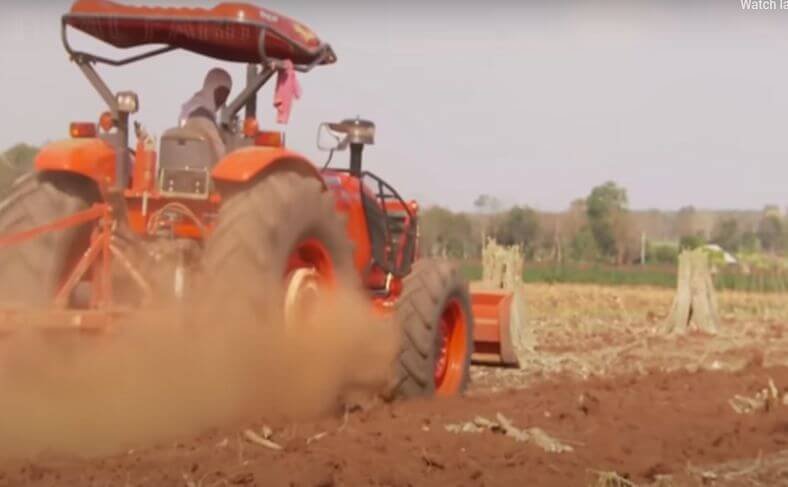
A semi-mechanized operation adds a tractor for land preparation and possibly a planter, trading a higher upfront cost for a far greater area covered per season.
Full mechanization, including harvesters and irrigation systems, only makes financial sense once you have secured buyers who can absorb that volume reliably.
Get a real quote for your specific region and scale before committing capital, since published cost estimates for cassava farming vary so widely across sources that quoting a single figure here would do you a disservice.
Match your equipment tier to your confirmed buyers, not to your ambitions, since idle machinery is the fastest way to sink a new commercial farm.
Step 4: Get the Land Ready
Getting the land ready for planting follows the same fundamentals as any cassava farm, just at a scale that rewards efficiency. Read more on land preparation for cassava farming.
Also read about planting techniques, spacing, and timing in full detail.
Step 5: Manage the Farm Through the Season
Weed control, fertilization, and pest management follow the same principles at a commercial scale as on any cassava farm, just with less room for error.
Missing a critical weeding window on ten hectares costs far more than missing it on one, since the lost yield scales with your entire operation.
Build a simple record-keeping system from day one, tracking input costs, labor, and yield by field, since this becomes critical once you scale further.
Our full cultivation guide covers weed management, nutrient management, and pest control in depth, all directly applicable at a commercial scale.
Step 6: Plan Your Harvest and Handling
Harvest timing affects both root quality and your ability to meet delivery commitments to buyers, so plan around your contracts, not just plant maturity.
Decide early if you are selling fresh roots or investing in basic processing to sell garri, chips, or flour at a higher margin.
See our guides on harvesting cassava properly and post-harvest handling for the technical details behind this step.
Step 7: Line Up Buyers and Financing Before You Scale
The single biggest difference between commercial farmers who succeed and those who struggle is when they find their buyer.
Secure at least one serious buyer conversation, ideally a letter of intent or informal agreement, before you commit capital to land or equipment.
Food processors, starch manufacturers, and animal feed companies all buy differently, so match your variety and scale decisions to your actual target buyer.
Our guide to writing a cassava business plan and our post on cassava marketing strategies both go deeper into structuring this relationship properly.
New Commercial Farmers Should Beware of These Mistakes
- Scaling land before securing buyers is the most common mistake, leaving farmers with a harvest and no reliable place to sell it.
- Underestimating labor costs at a commercial scale catches many first-time farmers off guard, since weeding and harvesting both scale directly with the hectares planted.
- Buying equipment before land tenure is secure risks stranding capital on machinery you cannot use if the land arrangement falls through.
- Skipping soil testing to save time upfront regularly costs far more later, once poor yields reveal a problem that a simple test would have caught.
- Treating your first season as a full commercial launch, rather than a smaller pilot, removes your margin for the mistakes every new farmer makes.
Conclusion
Commercial cassava farming rewards sequence as much as effort.
Land and soil testing come first, variety and stem sourcing come next, and equipment decisions should follow your confirmed scale, not precede it.
Securing a buyer before you plant protects you from the single most common failure point in this business.
None of this removes the real risk of farming at scale, but it replaces guesswork with a sequence that has actually worked.
Start smaller than your ambition, prove the model on a modest plot, and scale once your buyer relationship and your yields both hold up.
Frequently Asked Questions
How many hectares do I need to start commercial cassava farming?
There is no fixed minimum, some farmers start commercial operations on two to five hectares, scaling up only once buyer relationships and yields are proven.
How much does it cost to start a commercial cassava farm?
Costs vary enormously by scale and mechanization level, from a few hundred dollars for hand tools to large sums for tractors and irrigation systems.
What is the biggest mistake new commercial cassava farmers make?
Scaling land or planting before securing a reliable buyer is the most common and costly mistake, leaving farmers with harvests they cannot profitably sell.
Should I start with fresh root sales or invest in processing?
Start with fresh root sales to prove your farming operation, then consider basic processing like garri or chips once you have consistent, reliable yields.

Chimeremeze Emeh is a tropical crop farmer and chemical engineer from Ntigha, Isiala Ngwa North LGA, Abia State, Eastern Nigeria, specializing in cassava and palm oil, with over 30 years of hands-on experience growing, harvesting, and processing cassava. He grows TMS series, TME 419, and local traditional varieties on his own farms and operates a small-scale cassava flour and starch production business through Cassava Pathway, which he founded as a CAMA-registered agribusiness in 2024. He is also the founder of Palm Oil Pathway, where he applies the same tropical farming expertise. His farms are located in Ntigha, Abia State.