Last updated on July 20th, 2026 at 08:01 am
Most cassava planting guides list five methods and stop there, as if choosing one were the hard part. The harder part is that some of these methods are becoming obsolete while a lab technique most farmers have never heard of quietly reshapes cassava propagation across Africa.
I have been planting cassava using traditional stem cuttings on my farm, and it remains the right choice for a smallholder operation like mine.
Larger and better-resourced farms increasingly have real alternatives, from mechanized planting to lab-grown seedlings that multiply far faster than any cutting ever could.
This guide covers all five established methods, what actually determines which one fits your farm, and a genuinely emerging propagation technology most planting guides never mention.
You will also find the real research behind claims that usually go unsourced elsewhere.
Table of Contents
The Five Ways to Plant Cassava
Each method below suits different farm sizes, budgets, and goals, and no single one is correct for every situation.
1. Traditional Stem Cuttings
Planting mature stem cuttings, typically one to two years old, remains the oldest and most widely used method worldwide.
Our guide on cutting cassava stems the right way covers selecting healthy, viable cuttings.
This method is affordable and keeps a plant’s genetic traits fully consistent with its parent.
Its real drawbacks are labor intensity and disease risk if cuttings come from an infected plant.
That said, it is exactly the method I still rely on for my own crop.
2. Whole Stem Planting
Planting entire stems instead of cutting them into pieces encourages multiple shoots to sprout from each stem, regularly producing faster growth.
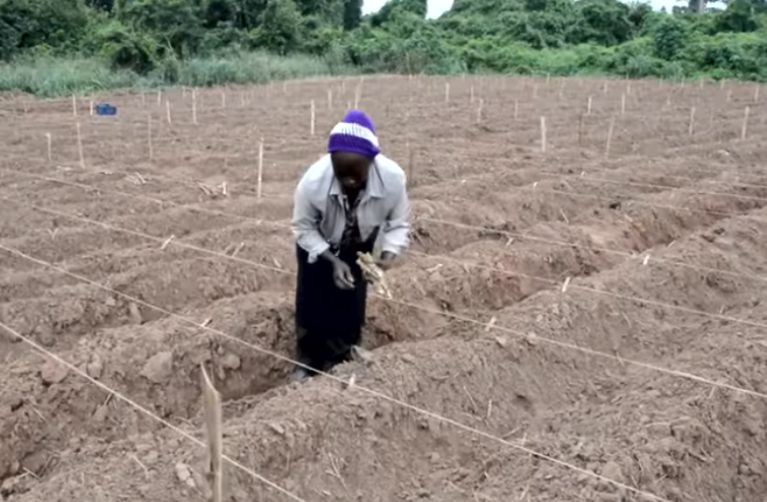
The stem’s added length also supports stronger root establishment, helping plants resist drought and pest pressure better than shorter cuttings.
Our separate guide on planting cassava cuttings covers the planting process itself.
The tradeoff is space, since whole stems need wider spacing than cut pieces to avoid overcrowding.
Read the guide on cassava spacing, which covers exact distances for this and other planting styles.
3. Mechanized Planting
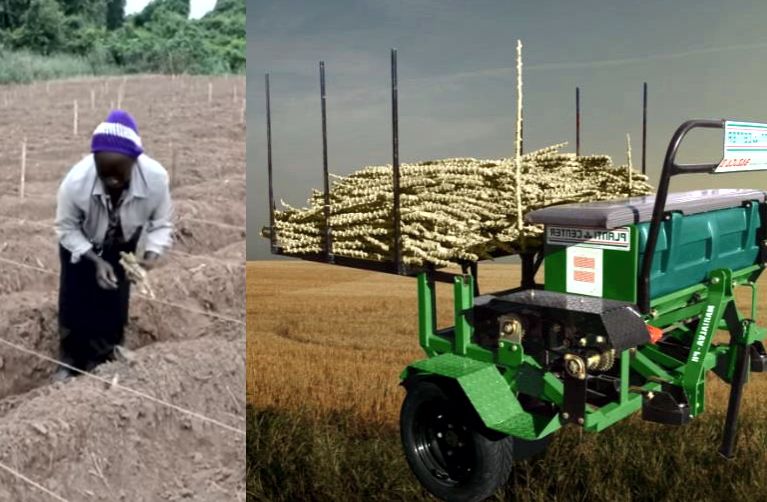
Mechanized planting uses precision planters and seeders to place stem cuttings at consistent depth and spacing across large commercial fields.

This cuts labor costs and speeds up planting considerably, but it demands real upfront investment in machinery and the infrastructure to move it through a field.
Smallholder farms rarely find mechanization worthwhile given the equipment cost relative to farm size.
This guide on cassava weed management strategies covers how mechanized weeding fits into a larger commercial operation.
4. Direct Seedling Method
Growing cassava from true seed rather than stem cuttings remains uncommon, but it solves a real problem in regions where planting material is scarce or diseased.
Vegetative cuttings carry cassava mosaic virus from one planting cycle to the next, a risk true seed avoids entirely.
Researchers have studied True Cassava Seed as a production alternative for exactly this reason, according to research on true cassava seed.
A related Nigeria-focused seed system initiative is working on similar disease-free planting material at scale.
This method demands careful management of vulnerable young seedlings and works best with a variety suited to your specific local conditions.
5. Nursery and Transplanting, Now Being Reinvented by Lab Propagation
Traditional nursery and transplanting give seedlings a controlled start before they move to the field, reducing early pest and disease pressure.
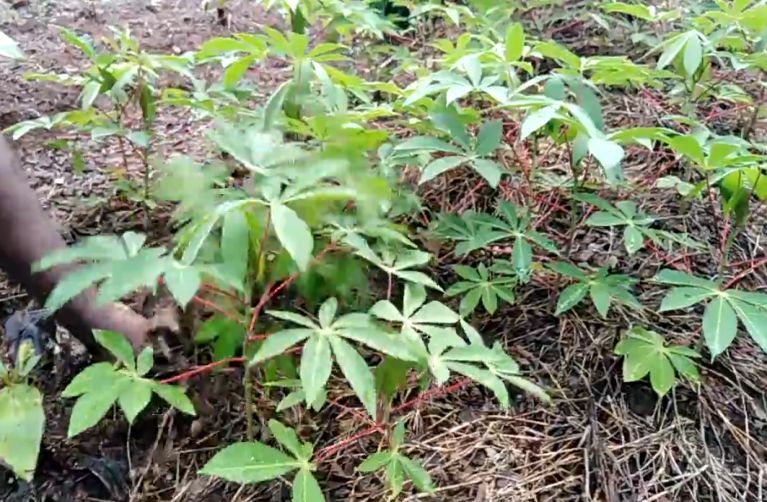
A newer lab technique called semi-autotrophic hydroponics is now multiplying cassava planting material at a pace no traditional nursery can match.
In Rwanda, this specific propagation method achieved a 90 percent plantlet survival rate in field trials.
Twenty-five starting plantlets multiplied to 156 within six weeks, according to IITA’s reporting on the technology.
Rwanda adopted this approach after a 2014 shortage forced the government to import millions of stem cuttings from Uganda just to keep processing plants running.
Research on simplifying cassava propagation at scale shows that similar rapid multiplication techniques are now spreading across Tanzania and the Democratic Republic of Congo.
Choosing the Right Method for Your Farm
Four factors decide which method actually makes sense for your specific operation.
- Farm size: Mechanized and lab-propagation methods reward scale, while smallholder farms usually get better returns from traditional cuttings or whole-stem planting.
- Climate and soil: Our guide to ideal climate conditions for cassava farming covers rainfall and temperature needs. A separate guide to soil requirements for cassava covers what your plot needs before any method will succeed.
- Access to planting material: If clean cuttings are scarce or diseased in your area, direct seeding or lab-propagated seedlings solve a problem stem cuttings cannot.
- Labor and budget: Cheaper methods generally demand more labor, while faster, less labor-intensive methods generally cost more upfront.
Our guide to the best time to plant cassava matters just as much as method choice.
Even the right method fails if timed poorly against the rainy season.
Frequently Asked Questions
What is the best method to plant cassava for high yields?
The best method depends on farm size, soil type, and available resources, since mechanized and lab-propagated methods boost yield mainly on larger farms.
Can I plant cassava directly from seeds instead of stem cuttings?
Yes, though direct seeding remains uncommon and requires careful management, since young seedlings are more vulnerable than established stem cuttings.
Why is mechanized cassava planting not suitable for all farms?
It requires a large upfront investment and infrastructure that most smallholder farms cannot justify given their scale and available budget.
What is replacing traditional nursery methods on larger cassava operations?
Semi-autotrophic hydroponics, a lab propagation technique, now multiplies clean planting material far faster than traditional nurseries, with survival rates above 90 percent in field trials.
Conclusion
Choosing a cassava planting method comes down to matching your farm’s size, budget, and access to clean planting material against what each method actually demands.
I still use traditional stem cuttings on my own farm in Ntigha, and that remains the right call for an operation my size.
Larger farms now have real alternatives beyond simple mechanization, including lab propagation methods multiplying planting material faster than any nursery could a decade ago.
Match the method to your actual farm, not the one that sounds most modern, and revisit that choice as your operation grows.

Chimeremeze Emeh is a tropical crop farmer and chemical engineer from Ntigha, Isiala Ngwa North LGA, Abia State, Eastern Nigeria, specializing in cassava and palm oil, with over 30 years of hands-on experience growing, harvesting, and processing cassava. He grows TMS series, TME 419, and local traditional varieties on his own farms and operates a small-scale cassava flour and starch production business through Cassava Pathway, which he founded as a CAMA-registered agribusiness in 2024. He is also the founder of Palm Oil Pathway, where he applies the same tropical farming expertise. His farms are located in Ntigha, Abia State.