Last updated on July 20th, 2026 at 07:13 am
The first rain of the season can be a trap. Many farmers plant the moment early rain falls in April, only to watch the rain disappear for weeks afterward, rotting cuttings that never had a chance to establish roots.
In my farming community in Abia State, we wait for rain between March and May before planting cassava, though it usually arrives in April and sometimes slips as late as May.
Nearly every year, an early false-start rain tempts overzealous farmers into planting too soon, only for the rain to disappear for weeks afterward, rotting the cuttings before they root.
That single mistake wastes real money and real labor, and it is far more common than most planting guides acknowledge.
This guide covers genuine regional planting windows, what peer-reviewed research actually shows about timing, and how to avoid the false-start trap that costs farmers every season.
Table of Contents
Why Timing Matters More Than Climate Alone
Cassava tolerates a wide range of conditions within the broader cassava farming process, but timing still decides if cuttings establish strong roots or rot in the ground.
This guide on ideal climate conditions for cassava farming covers temperature and rainfall requirements in full.
The post on soil requirements for cassava covers what your plot needs before a single cutting goes into the ground.
This guide focuses specifically on when to plant, not on the general conditions cassava needs to grow.
Best Time to Plant by Region
Tropical Regions: Rainy Season Is Key
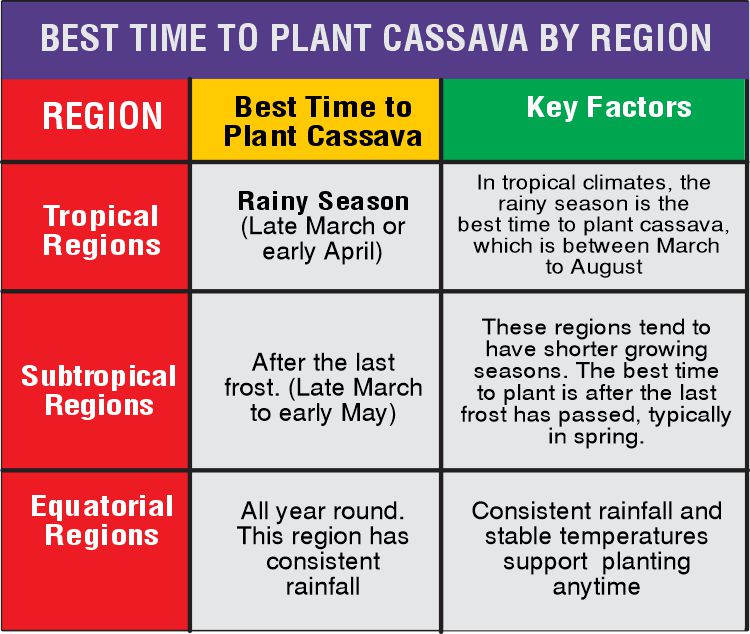
In tropical climates near the equator, planting right before or at the start of the rainy season gives cuttings the moisture they need to root well.
Nigeria and Thailand both follow this general pattern. In Nigeria, planting starts between April and May. If the rain comes early, planting may begin by March.
Thailand’s tropical savanna climate does allow planting across a wider window than most tropical regions, according to research indexed on PubMed Central.
The exact rainy season start still varies by specific location within each country.
Read the post on cutting cassava stems the right way, which covers preparing planting material before that window opens.
Subtropical Regions: Match Your Own Hemisphere’s Spring
Subtropical regions face real frost risk, so planting timing follows local spring, not a fixed calendar month.
Florida and Southern China, both in the Northern Hemisphere, plant after the last frost passes, typically March through May.
South Africa sits in the Southern Hemisphere, where spring falls in September through November instead.
South African farmers should plant closer to that window rather than following Northern Hemisphere spring months.
Confusing hemisphere-specific timing is a genuine, easy mistake, since many planting guides default to Northern Hemisphere assumptions without stating it.
Equatorial Regions: Genuine Year-Round Flexibility
Equatorial regions like Central Africa, Indonesia, and Brazil’s Amazon Basin see consistent rainfall and stable temperatures throughout the year.
This removes the tight seasonal window that other regions face entirely.
Farmers in these regions can time planting around market demand rather than climate risk alone.
Our guide on preserving cassava stems for the next season helps if your planting window does not line up with when cuttings are available.
The Real Risk: False-Start Rains
The biggest planting mistake is not climate ignorance; it is trusting the first rain too quickly.
In my community, the first rain sometimes falls in early April, and eager farmers plant immediately, assuming the rainy season has fully begun.
What regularly follows is a multi-week dry spell that leaves freshly planted cuttings without enough moisture to root, and the cuttings simply rot in the ground.
That failure wastes cuttings, labor, and an entire planting window, since replanting later pushes the whole season back.
Waiting for a full week of consistent rain, rather than a single storm, is a far more reliable signal that the planting season has actually started.
What Research Actually Shows About Planting Timing
Real field data backs up the caution around both early false starts and late delays.
Farmers who planted early in Ogun State, Nigeria, achieved a stronger profitability ratio than late planters.
This held despite late planters earning slightly higher total revenue, according to research published in Tropical Agriculture.
That same study found unpredictable climate variability hurt late planters more than early ones. A separate field trial in Alagoas, Brazil, tested five planting dates from April through July.
Cassava planted on the earliest dates, April 10 and May 5, reached 3.2 meters in plant height by 14 months.
Plantings delayed to late May through July measured about 15 percent shorter, according to research published through SciELO Brazil.
Both studies point to the same general conclusion: planting at the genuine start of consistent rain outperforms both jumping the gun and waiting too long.
That said, optimal timing still shifts by specific location.
A separate study in southwestern Nigeria found the highest root yields came from September and December plantings instead, according to research indexed through FAO’s AGRIS database.
Confirm the pattern that actually holds in your specific area rather than assuming one calendar fits every region.
Common Mistakes to Avoid
- Planting on the first isolated rain rather than waiting for a consistent, multi-day pattern to confirm the season has started.
- Delaying planting so long into the rainy season that waterlogging and root rot become the bigger risks instead.
- Applying a Northern Hemisphere calendar to a Southern Hemisphere farm, or the reverse, without adjusting for local seasons.
- Ignoring regional spacing and land preparation needs specific to your variety and plot.
- Losing track of your planting date, which makes it harder to judge when cassava is actually ready for harvest later.
Conclusion
The best time to plant cassava is not a fixed date; it is the genuine start of consistent rain in your specific region and hemisphere.
My own community’s yearly struggle with false-start rains in Abia State is far from an isolated case, and the research confirms that early, well-timed planting genuinely outperforms both jumping the gun and waiting too long.
Confirm a full week of steady rainfall before you plant, not just the first storm of the season.
Get the timing right this season, and you protect both your cuttings and the labor you put into planting them.
Frequently Asked Questions
When is the best time to plant cassava?
The best time is at the genuine start of consistent rain in your region, confirmed by a full week of steady rainfall rather than one isolated storm.
What happens if you plant cassava before the rains fully start?
Cuttings planted on an isolated early rain regularly rot during the dry spell that follows, wasting the cuttings, labor, and that entire planting window.
Does cassava planting time actually affect profitability?
Yes, research from Ogun State, Nigeria, found that early planters achieved stronger profitability ratios than late planters, largely due to unpredictable climate variability affecting late plantings.
Is the planting calendar the same in the Northern and Southern Hemisphere?
No, spring and rainy seasons fall in opposite months between hemispheres, so a calendar built for one region can mislead farmers in the other.

Chimeremeze Emeh is a tropical crop farmer and chemical engineer from Ntigha, Isiala Ngwa North LGA, Abia State, Eastern Nigeria, specializing in cassava and palm oil, with over 30 years of hands-on experience growing, harvesting, and processing cassava. He grows TMS series, TME 419, and local traditional varieties on his own farms and operates a small-scale cassava flour and starch production business through Cassava Pathway, which he founded as a CAMA-registered agribusiness in 2024. He is also the founder of Palm Oil Pathway, where he applies the same tropical farming expertise. His farms are located in Ntigha, Abia State.