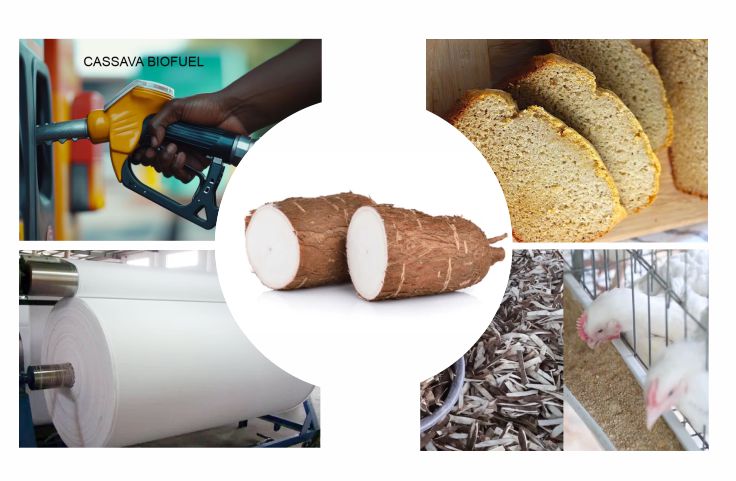
From corrugated boxes to biodegradable bags, from pharmaceutical tablets to textile looms, cassava is quietly powering some of the world’s most demanding industries. Here is the full picture of what this tropical root crop does beyond the dinner plate.
Cassava (Manihot esculenta) ranks among the world’s most productive starch crops, yet its greatest economic impact may lie far outside the kitchen.
Grown across sub-Saharan Africa, Southeast Asia, and Latin America, cassava delivers a high-yield, low-cost starch that industries have learned to refine, modify, and deploy at scale.
This article maps the major industrial sectors that depend on cassava-derived inputs, the processing methods that make those inputs possible, and the market opportunities that producers and processors can capture as global demand for renewable, plant-based materials accelerates.
A Chemical Engineer Who Grows the Crop Has a Particular View of Its Industrial Value
I studied chemical engineering at Enugu State University of Science and Technology and have spent my entire working life farming and processing the crop that feeds these industries.
That combination, processing science on one side, farm-level production on the other, gives me a specific lens on cassava’s industrial applications that neither a pure researcher nor a pure farmer typically has.
I understand what happens chemically when cassava starch is modified, gelatinized, or fermented.
I also understand what it takes to produce the raw material that those processes depend on, season after season, at the farm level in South Eastern Nigeria.
That dual perspective is what grounds this guide.
Table of Contents
Cassava as a Global Industrial Raw Material
For much of its history, cassava was regarded primarily as a food security crop. That framing has shifted decisively, a transition explored in White Gold: Cassava as an Industrial Base.
Today, cassava starch and its derivatives are traded globally as industrial feedstocks, with demand coming from paper mills, pharmaceutical manufacturers, textile factories, bioplastic producers, and chemical plants, a shift documented in research on the industrial applications of cassava.
Several factors make cassava attractive as a non-food industrial input:
- High starch concentration: Cassava roots contain 20-35% starch by fresh weight, yielding more extractable starch per hectare than maize or potato under comparable conditions. Cassava roots contain 20-35% starch by fresh weight, according to research on cassava raw material quality control, yielding more extractable starch per hectare than maize or potato under comparable conditions.
- Neutral flavor and odor profile: Unlike some cereal starches, cassava starch carries no off-notes that complicate formulation in cosmetics or pharmaceuticals.
- Functional flexibility: Native cassava starch responds well to chemical and physical modification, allowing processors to tailor viscosity, film-forming capacity, adhesion, and thermal stability for specific industrial applications.
- Geographic availability: Major cassava belts in Nigeria, Thailand, the Democratic Republic of Congo, Brazil, and Indonesia sit close to emerging manufacturing hubs, reducing logistics costs for regional processors. See top producers of cassava.
- Renewable supply chain: As industries face pressure to reduce fossil-based inputs, cassava fits naturally into sustainability frameworks because it is annually renewable and sequesters carbon during growth.
The global industrial starch market reached a multi-billion-dollar scale in the 2020s, with cassava starch holding a growing share alongside corn, potato, and wheat starch.
The following sections examine each major industrial sector in depth.
Cassava and the Polymer Industry
Cassava starch anchors heavy industrial manufacturing through adhesives, paper, and textile production, valued for its low cost, abundant supply, and adaptable molecular structure.
Cassava Starch in Adhesives & Glues
Gelatinized cassava starch acts as a natural industrial adhesive, forming strong, flexible bonds across multiple manufacturing contexts.
It serves as a binder in cardboard production, a paste for wallpaper, and a laminating agent for wood veneers.
Its gelatinized form enhances binding performance, offering a reliable, eco-friendly alternative to synthetic adhesives across manufacturing and construction applications.
Learn more about cassava in the adhesive and glue industry.
Cassava Starch in the Paper Industry
Cassava starch ranks among the paper industry’s key inputs, applied across multiple production stages.
It improves inter-fiber bonding to increase tensile and burst strength, seals pores during surface sizing for smoother printable sheets, and functions as a co-binder in coating formulations, improving ink holdout and gloss.
Against corn and potato starch, cassava competes on cost, film clarity, and gelatinization efficiency.
Its renewable, biodegradable profile further strengthens the business case as sustainability reporting becomes a procurement standard.
See the full post on cassava starch in the paper industry.
Cassava Starch in the Textile Industry
Cassava starch has served textile warp sizing for over a century, applied to yarn before it enters the loom to strengthen fiber bundles, reduce breakage at high speeds, and improve weaving efficiency.
It competes directly with synthetic sizing agents like PVA on cost, biodegradability, and worker safety.
Desizing is equally practical, with starch removed cleanly by hot water or enzymatic treatment, producing manageable effluent.
Some mills recover desizing liquors, reducing input costs and effluent load.
See the full article on cassava starch uses in textiles.
Eco-Friendly Packaging & Bioplastics
As global regulations tighten around single-use plastics, cassava has emerged as a leading feedstock for genuinely biodegradable alternatives, distinguishing itself from plastics merely labeled eco-friendly without truly breaking down.
Cassava Starch in Bioplastics
Cassava starch has emerged as a credible bioplastic feedstock, driven by regulatory pressure and brand sustainability commitments.
It enters manufacturing as thermoplastic starch for extrusion and film blowing, blended with PLA or PHA to retain biodegradability, or reinforced with natural fibers to reduce water sensitivity.
The resulting materials serve flexible packaging, compostable wrappers, disposable serviceware, and shopping bags.
Unlike petroleum-based plastics, cassava-based bioplastics degrade in industrial composting conditions within weeks to months, offering a genuine end-of-life pathway.
Read the full post on cassava starch in bioplastics.
Cassava Starch in Biodegradable Materials
Single-use plastic bans and extended producer responsibility regulations across the EU, Asia, and Africa are accelerating demand for cassava-based biodegradable materials.
Cassava starch’s film-forming and binding properties serve compostable packaging films for produce and e-commerce, biodegradable cutlery and food wrappers, and agricultural mulch films that break down in soil without residue.
Native starch limitations like brittleness and hydrophilicity are addressed through acetylation, crosslinking, and bio-based coatings, improving durability without compromising biodegradability.
Cassava Starch in the Packaging Industry
Cassava starch plays a growing role in packaging manufacturing, balancing performance, cost, and environmental profile.
It bonds fluted medium to liner sheets in corrugated board production using biodegradable, water-based adhesive formulations and functions as a surface coating co-binder in high-grade packaging, improving printability and structural finish.
Its renewable, biodegradable profile supports sustainability reporting and simplifies end-of-life compliance compared to synthetic alternatives.
Brands operating under tightening regulatory frameworks are actively shifting toward starch-based solutions. Read the full post on cassava packaging.
Biofuels and Renewable Green Energy
Cassava biofuel production is central to national energy strategies in Thailand, Nigeria, and Brazil.
Roots are cleaned, chipped, and converted through enzymatic liquefaction, fermentation, and distillation into fuel-grade ethanol.
End applications include fuel blending with gasoline to reduce transport emissions, industrial solvents for pharmaceutical and chemical manufacturing, and hygiene product production.
Cassava holds its strongest competitive position where sugarcane and maize cannot grow reliably or require costly imports.
Tightening blending mandates and growing voluntary carbon markets are adding further commercial momentum. Read the full article on cassava biofuel.
Biorefinery Methane Gas
Large-scale cassava processing generates significant volumes of wastewater and solid effluent, once considered an environmental liability.
Modern biorefineries have reimagined this waste as a renewable energy resource.
Through anaerobic digestion, microorganisms break down organic effluents, releasing methane-rich biogas that powers factory operations, generates electricity, and fuels boilers, reducing dependence on grid power or imported fuel.
The result is a circular system where processing waste becomes a usable energy source, simultaneously cutting environmental impact and operational costs for manufacturers.
Learn more about cassava biogas here.
Food Processing, Confectionery, & Bakery
Cassava flour has carved a functional role in commercial food manufacturing, driven by its gluten-free profile, neutral flavor, and versatility across production formats.
It substitutes wheat in industrial baking, delivering structure in breads, biscuits, and pastries, while forming the base of dedicated gluten-free product lines serving celiac and gluten-intolerant consumers.
In snack manufacturing, its binding and crisping properties perform reliably on high-speed lines.
It also features in coatings, batters, and convenience meal components where clean-label positioning adds commercial value. Read the full guide.
Tapioca Products and Their Industrial Applications
Tapioca moves through distinct product forms, serving diverse industries. Tapioca pearls anchor the global bubble tea market, while flakes bind and thicken processed foods.
Tapioca powders modify texture across bakery, confectionery, and snack production, and starch derivatives stabilize dairy-alternative beverages.
In confectionery, tapioca delivers texture and transparency in gummies and jellies.
Cassava starch also converts through enzymatic hydrolysis into glucose and tapioca syrups, supplying manufacturers as fermentable sugars and humectants across drinks, sauces, and convenience meals, while reducing dependence on imported corn, or wheat-based glucose.
Read the full guide on industrial uses of tapioca products.
The Pharmaceutical & Cosmetics Sectors
Cassava Starch in the Pharmaceutical Industry
Pharmaceutical-grade cassava starch serves as a versatile excipient, functioning as a binder, disintegrant, diluent, and stabilizer across tablet, capsule, and liquid formulations.
Non-toxic, hypoallergenic, and neutral in taste and color, it delivers consistent viscosity across production batches, supporting validated manufacturing processes.
Recognized by major pharmacopoeias including USP, BP, and EP, it gives procurement teams regulatory confidence when qualifying new suppliers.
Tapioca starch carries its own official monograph in the United States Pharmacopoeia, and pharmacopoeia harmonization efforts extend similar recognition to other major markets, giving procurement teams regulatory confidence when qualifying new suppliers.
For processors, pharmaceutical-grade starch commands premium contract pricing well above commodity markets. Read the full guide.
Cassava Starch in Cosmetics & Personal Care
Cassava starch has earned a functional role in cosmetics, valued for performance and clean-label appeal.
It adjusts rheology in creams and lotions, reduces reliance on synthetic thickeners, delivers a silky skin feel, and serves as the primary absorbent base in talc-free and dry shampoo formulations.
Compatible with COSMOS and NATRUE certification frameworks, it meets growing consumer demand for biodegradable, non-irritating, plant-based ingredients.
Starch ingredients from major manufacturers carry COSMOS and NATRUE certification today, meeting growing consumer demand for biodegradable, non-irritating, plant-based ingredients.
For processors supplying consistent cosmetic-grade starch, the natural beauty sector represents a compelling premium market.
See a comprehensive post on cassava in cosmetics
Modified Cassava Starch in Industrial Applications
Native cassava starch faces functional limitations in demanding industrial environments, including fragile gel formation, heat sensitivity, and variable solubility.
Chemical modification addresses these directly, producing derivatives with tailored performance profiles, as detailed in research on cassava starch chemical modification.
Oxidized starch delivers lower viscosity and improved adhesion for paper and textile sizing.
Acetylated starch reduces retrogradation for bioplastic blends.
Cross-linked starch resists heat, shear, and acid in corrugated adhesives and coatings.
Hydroxypropylated starch improves cold-water solubility for adhesive and textile applications.
Each modification delivers measurable gains in viscosity stability and film performance that native starch cannot match, commanding significant price premiums over commodity grades. See more on modified tapioca starch and its applications.
Cassava as a Feedstock for Industrial Fermentation
Cassava-derived glucose and hydrolysate serve as low-cost, renewable fermentation feedstocks competing favorably against corn and cane sugar derivatives.
Bacterial fermentation yields lactic acid for PLA bioplastics, cosmetics, and pharmaceuticals, while fungal fermentation produces citric acid for food, beverage, and cleaning product manufacturers.
Cassava hydrolysate also supports amino acid manufacturing, including glutamic acid and lysine, for animal feed and flavor industries.
Enzyme producers use cassava-derived glucose as a cost-effective growth substrate for detergent and textile sectors.
Biotechnology applications spanning vitamin synthesis and specialty biochemical production further benefit from its consistent glucose yield and low input cost.
Cassava Chips and Pellets in Industrial Markets
Cassava chips and pellets are among the most established forms of cassava processing for export and industrial markets.
Dried to low moisture levels, they offer a stable, transportable intermediate product that extends cassava’s commercial window far beyond the rapid deterioration of fresh roots, ensuring consistent year-round feedstock supply for large-scale buyers.
European animal feed importers have historically been among the largest buyers, incorporating chips and pellets as energy-dense carbohydrates in compound feed for poultry, swine, and cattle.
Ethanol distilleries increasingly source dried chips where fresh root supply is seasonal, maintaining year-round production.
Cassava in Animal Feed Manufacturing
Cassava contributes to animal feed manufacturing across several product forms, valued primarily for its energy-dense carbohydrate content, which complements protein-rich ingredients like soybean meal.
In regions where maize is expensive or unreliable, cassava-based ingredients offer nutritionists a practical substitution that maintains energy density without disrupting feed formulation.
Cassava meal serves compound feed across multiple livestock categories, while dried chips provide a storable carbohydrate source for feed mills with inconsistent fresh supply.
For a full ingredient, formulation, and market breakdown, read the complete guide: Cassava in Animal Feed.
Cassava By-products and Waste Management
Cassava processing generates substantial by-product volumes at every stage, from root peeling through starch extraction to wastewater discharge.
Circular economy thinking has reframed these streams as unconverted value rather than disposal problems.
- Cassava peels are converted into animal feed, compost, and biogas feedstock after treatment to reduce cyanogenic content.
- Fibrous bagasse from starch extraction serves as animal feed, dietary fiber, bioethanol fermentation, and composite material production.
- Processing wastewater undergoes anaerobic digestion, generating biogas for plant energy while reducing effluent load.
- Peel compost and processing sludge return nutrients to agricultural soils, reducing synthetic fertilizer dependency.
Processors integrating by-product streams into deliberate secondary value chains improve plant economics while strengthening their overall sustainability profile.
See the full post on cassava by-products and waste utilization.
Emerging Industrial Applications of Cassava
Cassava’s industrial footprint is expanding into newer application areas driven by green chemistry mandates, materials science research, and the broader shift toward bio-based inputs.
- Cassava-based fermentation yields green chemicals gaining traction as petroleum manufacturers face carbon pricing, regulatory pressure, and fossil feedstock scrutiny.
- Modified cassava starch is entering construction, woodworking, and packaging markets where low-VOC, biodegradable bonding solutions are increasingly specified.
- Cassava starch binders are being developed for particleboard, fiberboard, and earth-block construction in tropical regions where synthetic binder costs are high.
- Advanced biomaterials research explores cassava starch for drug delivery, wound dressings, and biodegradable medical packaging, leveraging its biocompatibility and film-forming capacity.
- Bio-refinery integration, starch nanoparticle development, and AI-assisted fermentation optimization are expanding the technical frontier of cassava-derived manufacturing inputs.
Sustainability Impact Across Industries
Cassava’s industrial use carries measurable sustainability advantages relative to the fossil-based and non-renewable materials it displaces.
- Renewable input: Cassava is harvested annually and can be replanted continuously on the same land with appropriate soil management, unlike petroleum, which is a finite resource.
- Reduced fossil-based material dependency: Replacing petroleum-derived plastics, synthetic adhesives, and fossil-based sizing agents with cassava inputs reduces net carbon emissions across multiple sectors.
- Waste utilization: Cassava processing generates peel, pulp, and bagasse residues that can be converted into animal feed, biogas, or compost. This circular approach reduces waste disposal costs and creates additional revenue streams.
- Carbon sequestration during crop growth: The cassava plant sequesters atmospheric carbon during its growing cycle. Well-managed life cycle assessments show favorable carbon balances for cassava-based bioplastics and bioethanol relative to their fossil alternatives.
- Biodegradable end products: Papers, textiles, and packaging materials incorporating cassava starch are easier to biodegrade or recycle than those incorporating synthetic polymers.
Challenges in Industrial Adoption of Cassava and its Products
Despite its advantages, cassava derivatives like starch faces real barriers to wider industrial adoption that producers and policymakers need to address.
- Quality Consistency: Starch quality varies with variety, soil, harvest timing, and storage, while industrial buyers require tight moisture, viscosity, and microbial specifications.
- Processing Infrastructure Gaps: Many cassava-producing countries lack wet milling, drying, and chemical modification capacity to supply industrial-grade starch at scale.
- Competition with Established Starches: Corn and wheat starch benefit from mature supply chains and decades of industrial formulation experience, requiring cassava to demonstrate consistent performance and competitive pricing.
- Price Fluctuations and Supply Chain Issues: Pest outbreaks, including cassava mosaic and brown streak viruses, and seasonal supply variability reduce buyer confidence relative to more stable commodity markets.
- Industrial Standardization Barriers: Cassava starch lacks uniform pharmaceutical, cosmetic, and food-grade specifications across markets, creating regulatory complexity for exporters and formulators.
Conclusion
Cassava has secured a position as a multi-sector industrial raw material with strategic relevance across paper, textiles, pharmaceuticals, cosmetics, biofuels, and biodegradable materials.
Its industrial case rests on agronomic productivity, functional starch chemistry, geographic availability in high-growth markets, and alignment with sustainability-driven procurement shifts.
For producing nations, it represents a path from commodity exporter to industrial input supplier.
For buyers, it offers a renewable alternative to fossil-derived inputs.
Realizing that potential requires investment in processing infrastructure, quality systems, and regulatory harmonization, but countries and companies that move systematically on these fronts will find cassava’s industrial contribution growing substantially in the decades ahead.
As a cassava farmer in one of the world’s largest producing regions, I have a direct stake in that outcome and a clear view of how far the gap between farm-level production and industrial-grade supply still needs to close before that potential is fully captured.
Frequently Asked Questions
What industries use cassava starch as an industrial raw material?
Cassava starch serves the paper, textile, pharmaceutical, cosmetics, bioplastics, bioethanol, and chemical manufacturing industries as a functional, renewable input.
How does cassava starch improve paper and packaging production?
It strengthens fiber bonding, improves surface sizing, bonds corrugated board, and acts as a co-binder in high-grade coating formulations.
Why do textile manufacturers use cassava starch in warp sizing?
It strengthens yarn, reduces fiber breakage at high loom speeds, costs less than synthetic agents, and desizes cleanly without harmful effluent.
What makes cassava starch suitable for pharmaceutical manufacturing?
It functions as a binder, disintegrant, and diluent in tablets and is non-toxic, hypoallergenic, and recognized by USP, BP, and EP pharmacopoeias.
How does cassava starch contribute to biodegradable and bioplastic materials?
It converts into thermoplastic starch for films, bags, and serviceware, degrading within weeks under industrial composting conditions, unlike petroleum-based plastics.
Chimeremeze Emeh
Chimeremeze Emeh is a tropical crop farmer and chemical engineer from Ntigha, Isiala Ngwa North LGA, Abia State, Eastern Nigeria, specializing in cassava and palm oil, with over 30 years of hands-on experience growing, harvesting, and processing cassava. He grows TMS series, TME 419, and local traditional varieties on his own farms and operates a small-scale cassava flour and starch production business through Cassava Pathway, which he founded as a CAMA-registered agribusiness in 2024. He is also the founder of Palm Oil Pathway, where he applies the same tropical farming expertise. His farms are located in Ntigha, Abia State.