Last updated on September 23rd, 2026 at 05:01 am
Most cassava fertilizer guides treat NPK ratios like a recipe to follow blindly. As a chemical engineer who has farmed cassava for thirty years, I read those ratios like a process spec, and the numbers only make sense once you know what each nutrient does underground.
Cassava needs several nutrients to be able to yield impressively. Nitrogen, phosphorus, and potassium each solve a different problem for the crop, and getting the ratio wrong wastes money either way, over-applying or under-applying.
I grow TME 419 on my own farm in Ntigha, the same variety researchers have specifically studied for how fertilizer changes not just root yield but the quality of the garri made from it afterward.
This guide covers what cassava actually needs, when to apply it, how to apply it correctly, and what peer-reviewed research shows about the real yield and quality gains, not just generic advice repeated across gardening sites.
Table of Contents
Nutrient Needs for Cassava
Nitrogen supports leaf growth, phosphorus supports root development and energy transfer, and potassium drives tuber bulking and drought resistance specifically.
Cassava also draws on magnesium, sulfur, calcium, and trace minerals like zinc and boron for chlorophyll production and disease resistance.
Combining chicken manure with mineral NPK fertilizer increased cassava yield by 24 to 29 percent over mineral fertilizer alone, according to research conducted in Zambia.
That gain came specifically from pairing organic and inorganic sources, not from applying more of either one alone.
Fertilizer response also interacts with when you plant. A separate study on planting dates and fertilizer effects on cassava growth found that timing changed how well plants used the nutrients applied.
Our guide to the best time to plant cassava covers that timing question in full.
A separate guide to soil requirements for cassava covers the baseline conditions that fertilizer alone cannot fix.
Our pillar guide to cassava farming covers where fertilizing fits into the wider growing process.
Start With a Soil Test to Know the Nutrient Needs
Skipping soil testing means guessing at exactly the numbers that matter most for your specific plot.
Our dedicated guide on how to test soil for cassava farming covers sample collection, timing, and reading your results in full. Use those results, not a generic blend, to decide your fertilizer type and rate.
Types of Fertilizer Suitable for Cassava
- Organic fertilizers like compost, animal manure, and crop residues build long-term soil structure and microbial health, though they release nutrients slowly. This guide on building a more sustainable cassava operation covers organic amendment data showing real yield gains from this approach.
- Inorganic fertilizers like urea, ammonium sulfate, and NPK blends such as 15:15:15 release nutrients quickly, which matters during specific growth stages. Relying on inorganic fertilizer alone, without replenishing organic matter, gradually reduces soil fertility across repeated seasons.
- Foliar fertilizers, sprayed directly on leaves around six to eight weeks after planting, correct micronutrient gaps like zinc or boron quickly without overloading the soil.
When to Apply Fertilizer to Cassava
Timing fertilizer to each growth stage matters as much as choosing the right blend.
- Before planting: Mix compost or manure into the soil, and consider a basal fertilizer to support early root formation.
- At planting: A balanced NPK blend like 15:15:15 helps cuttings establish strong roots quickly.
- Four to six weeks after planting: Side-dress with nitrogen-rich fertilizer like urea to support leaf growth and photosynthesis.
- Three to five months after planting: Shift toward higher-potassium blends like 20:10:10 to support tuber bulking and storage quality.
- Relative to rainfall: Apply just before rain where possible, since rainfall moves nutrients into the root zone more effectively than dry soil application.
How you place cuttings at planting also affects fertilizer uptake, and our guide to cassava planting methods covers that choice in full.
Spacing affects how far nutrients need to travel to reach each plant, as covered in our guide to cassava spacing.
How to Apply Fertilizer Correctly
Four distinct methods cover most cassava farming situations, each suited to a different farm size and stage.
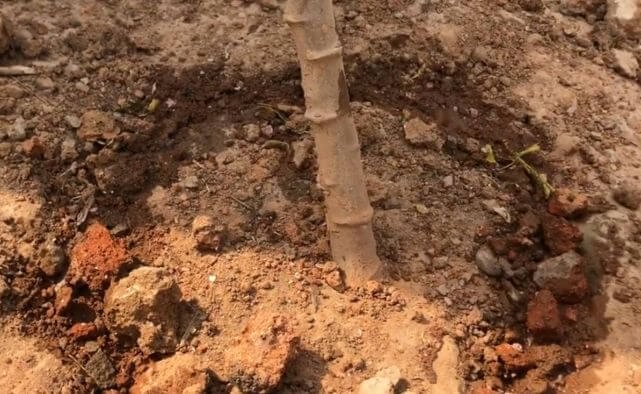
- Banding places fertilizer in a narrow line near the root zone, useful early in the season.
- Side dressing applies fertilizer in a shallow trench beside the plant, well suited to the nitrogen-boost stage.
- Spot application targets the base of each plant individually, practical on smaller plots.
- Broadcasting spreads fertilizer across an entire field quickly, though it risks uneven feeding on larger farms if not raked in carefully.
Never let fertilizer touch stems or leaves directly, since this causes fertilizer burn that damages the plant outright.
What Research Actually Shows About Fertilizer’s Effect
Fertilizer changes more than root size; it can change the quality of what you make from the root afterward.
A study using TME 419 and TMS 01/1412, the same variety I grow, tracked how fertilizer changed garri output specifically.
Full fertilizer treatment increased garri yield by 30 and 22 percent for each variety, respectively.
That same research on garri quality from fertilized cassava also found that cyanide content in the finished garri decreased as fertilizer levels increased.
Separately, pairing reduced phosphorus fertilizer with mycorrhizal fungal inoculants achieved a 25 percent yield increase in Nigerian field trials, according to research published through PubMed Central.
This suggests farmers may eventually need less synthetic phosphorus than current recommendations assume.
Dos and Don’ts
- Water after fertilizing to help nutrients reach the roots and dilute excess salts near the stem.
- Wear gloves and a mask when handling synthetic fertilizers, especially in concentrated form.
- Store fertilizer in a cool, dry, sealed container away from direct sunlight.
- Never apply directly to stems or leaves, since this causes a burn rather than absorption.
- Do not over-fertilize, since excess fertilizer can lock out the exact nutrients you are trying to add.
Monitoring and Adjusting Fertilizer Use
Yellowing leaves and stunted growth usually signal a nitrogen deficiency, while excessive leaf growth paired with poor root formation can signal too much nitrogen instead.
Keep a simple log of every application, including date, type, and amount, so you can connect specific choices to the results you actually see at harvest.
Revisit your plan once a year at a minimum, and sooner if plant health signals suggest something has changed.
Conclusion
Applying fertilizer to cassava well comes down to matching nutrient type and timing to what your specific plot and growth stage actually need, not a fixed recipe.
I still test my own soil in Ntigha before deciding what to apply, and the research backs up why that step matters more than the blend itself.
Combine organic and inorganic sources where you can, respect the timing windows tied to each growth stage, and keep a record of what you apply each season.
Test your soil before your next planting cycle, and let the results, not habit, decide your fertilizer plan.
Frequently Asked Questions
How do I know which fertilizer my cassava actually needs?
A soil test is the only reliable way to know, since it reveals your specific pH and nutrient levels rather than relying on a generic recommendation.
Does fertilizer affect the quality of garri made from cassava?
Yes, a study using TME 419 found that fertilized cassava produced garri with higher yield and lower cyanide content than unfertilized roots.
Can combining manure with mineral fertilizer really increase yield?
Yes, Zambian field trials found that combining chicken manure with mineral NPK fertilizer increased cassava yield by 24 to 29 percent over mineral fertilizer alone.
What happens if fertilizer touches the cassava stem directly?
Direct contact causes fertilizer burn, which damages plant tissue and slows growth rather than helping the plant absorb nutrients.

Chimeremeze Emeh is a tropical crop farmer and chemical engineer from Ntigha, Isiala Ngwa North LGA, Abia State, Eastern Nigeria, specializing in cassava and palm oil, with over 30 years of hands-on experience growing, harvesting, and processing cassava. He grows TMS series, TME 419, and local traditional varieties on his own farms and operates a small-scale cassava flour and starch production business through Cassava Pathway, which he founded as a CAMA-registered agribusiness in 2024. He is also the founder of Palm Oil Pathway, where he applies the same tropical farming expertise. His farms are located in Ntigha, Abia State.