

Last updated on August 5th, 2026 at 07:08 am
Ask five cassava processors to explain the difference between a grater and a grinder and you will likely get five very different answers, even though the two machines do genuinely separate jobs at completely different stages of the entire process.
Confusion between the two machines costs real money, since buying a grinder when you needed a grater, or the reverse, means reprocessing cassava you already paid to shred once.
This guide clears up exactly where a grater’s job ends and a grinder’s begins, then walks through the real types worth knowing, the specific parts that make grating possible, and the factors that matter before you buy.
You will also learn the genuine science behind why grating matters beyond texture, realistic price ranges across manual and motorized models, and where the broader taxonomy of grinding equipment lives if you need it.
Table of Contents
What Is a Cassava Grater Machine?
A cassava grater machine shreds peeled cassava tubers into a fine, fibrous mash used in traditional foods like fufu and garri.
Sharp rotating blades do the work faster and more evenly than a hand grater, keeping the grated texture intact rather than reducing it further into paste.
Readers wanting the broader equipment lineup should read our cassava grinding machine guide.

How a Cassava Grater Machine Works
A rotating grating disc, turned by hand or a motor, shreds peeled tubers as they contact its blades, dropping the mash into a basin below.
- Hopper. Guides tubers toward the grating disc safely, keeping hands away from the blades during feeding.
- Grating disc. The core component, covered in sharp blades that determine how fine and consistent the finished mash turns out.
- Motor or handle. Electric motors drive high-speed grating for volume work, while a hand crank powers simpler manual models.
- Collection basin. Catches grated mash as it falls, ready to move directly into a press or fermentation container.
Why Grating Matters Beyond Texture
Grating does far more than simply prepare cassava for cooking or shaping.
Breaking the root’s cell structure exposes linamarin, a natural cyanogenic compound, to the enzyme that breaks it down into a form that escapes as gas.
A peer-reviewed review identified grating and crushing as the most efficient methods for reducing cassava’s cyanide content.
This works precisely because grating creates intimate contact between the toxin and its breakdown enzyme, published in ScienceDirect.
A separate, broader review of cassava detoxification research reaches a similar conclusion about grating’s role, published by Gavin Publishers.
This process begins the moment cassava tissue is physically disrupted, according to research on cassava’s cyanide-producing mechanism published in PMC.
Combining grating with other steps, such as soaking and drying, works better than grating alone, according to the Food and Agriculture Organization.
Here is the complete safety picture; read our guide on removing cyanide from cassava root.
Types of Cassava Grater Machines
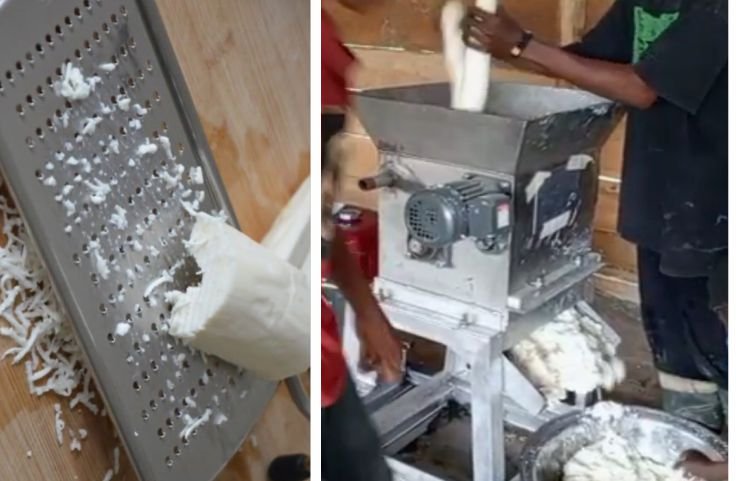
Manual Grater
Hand-powered and requiring no electricity, manual graters suit home cooks and small farms working with a few tubers at a time.
They cost noticeably less but demand more physical effort from the operator per batch.
Motorized Grater
An electric motor spins the grating drum at a consistent speed, delivering faster, more uniform output for cooperatives, food businesses, and larger farms processing bigger volumes daily.
Grater With Presser
A built-in pressing mechanism holds the tuber steady during grating, reducing injury risk and improving contact with the disc for a more even mash.
Mini Grater
Compact and lightweight, mini graters fit on a kitchen counter and suit home cooks or small businesses processing modest quantities without needing floor space.
Cassava Grater vs. Fine-Milling Grinders
A cassava grater is technically one type of grinding machine, alongside raspers, hammer mills, and pulverizers, all covered in our broader guide to cassava grinding machines.
In everyday use, though, “processor” usually means something narrower than “grinder”: the fine, dry-milling equipment used after grating to further refine cassava.
This comparison specifically uses the word “grinder” in that narrower, practical sense throughout.
| Factor | Grater | Fine-Milling Grinder |
|---|---|---|
| Output texture | Coarse, fibrous mash | Fine, smooth paste |
| Processing stage | First step after peeling | After grating, for further refinement |
| Best suited for | Fufu, garri, abacha | Flour, starch, industrial pulp |
| Typical power | Manual or motorized | Mostly motorized |
Use a grater first to prepare raw cassava for fermenting, pressing, or cooking directly.
Reach for a grinder afterward when the final product needs a smoother, more refined texture.
Readers building a full processing line should also read our guides on the cassava pressing machine, cassava dryer machine, and cassava peeling machine.
Factors to Check Before Buying
- Production capacity. Match kilograms per hour to your actual daily volume rather than buying more capacity than you need.
- Power source. Electric motors suit stable-power settings, while manual models work better where electricity is unreliable or unavailable.
- Blade quality. Stainless steel or similarly rust-resistant blades stay sharp longer and produce finer, more consistent mash.
- Ease of cleaning. Smooth surfaces and removable parts simplify washing, which matters directly for hygiene and food safety.
- Spare parts availability. Confirm blades, belts, and motors are available locally before buying, since downtime costs more than repairs.
Maintenance Tips
Wash removable parts with warm, soapy water after every use, paying close attention to the grating disc where residue builds up fast.
Sharpen or replace dull blades promptly, since dull edges tear rather than shred and slow the entire process.
Wipe down the motor housing regularly on electric models, and store the machine dry and covered between uses to prevent rust.
Cost and Where to Buy
Manual graters typically cost between 20 and 130 dollars, a practical entry point for home cooks and small farms.
Motorized graters range from roughly 65 to 400 dollars, depending on capacity, build quality, and included features.
Local fabricators typically offer custom builds and easier access to repairs, while established manufacturers provide more consistent quality and support.
Readers wanting a curated list of suppliers should read our guide on cassava processing equipment manufacturers, or see our processing equipment guide for the complete picture.
Conclusion
A cassava grater machine handles one genuinely specific job: turning peeled roots into consistent, fibrous mash ready for fermenting, pressing, or cooking.
Keep it distinct from a grinding machine, which refines that mash into fine flour or starch paste.
Manual graters suit home cooks and small farms, while motorized versions handle bulk work for food businesses and cooperatives.
Clean the disc after every batch, keep blades sharp, and store the machine dry to avoid rust and breakdowns.
Frequently Asked Questions
What is the purpose of a cassava grater machine?
A cassava grater machine shreds raw, peeled cassava tubers into fibrous mash, making food preparation genuinely faster and less labor-intensive for traditional dishes like fufu and garri specifically.
Can a cassava grater machine be used at home?
Yes, manual and mini cassava graters work well for regular home use, saving real time and effort while remaining easy to clean, store, and operate safely each time.
What is the difference between a cassava grater and a grinder?
A grater creates a coarse, fibrous mash directly from raw cassava, while a grinder processes that same mash further into a smoother paste for flour or starch specifically.
How much does a cassava grater machine cost?
Manual models typically cost between 20 and 130 dollars, while motorized versions range from roughly 65 to 400 dollars, depending on specific size, power, and actual materials used.

Chimeremeze Emeh is a tropical crop farmer and chemical engineer from Ntigha, Isiala Ngwa North LGA, Abia State, Eastern Nigeria, specializing in cassava and palm oil, with over 30 years of hands-on experience growing, harvesting, and processing cassava. He grows TMS series, TME 419, and local traditional varieties on his own farms and operates a small-scale cassava flour and starch production business through Cassava Pathway, which he founded as a CAMA-registered agribusiness in 2024. He is also the founder of Palm Oil Pathway, where he applies the same tropical farming expertise. His farms are located in Ntigha, Abia State.