
Last updated on August 2nd, 2026 at 08:57 pm
My own surplus cassava roots become flour and starch for a small regional market, but the global tapioca market operates on a literally different scale, moving millions of tonnes between Thailand, China, and buyers across dozens of countries every year.
The global tapioca market moves millions of tonnes a year, and Thailand alone accounts for roughly a quarter of all cassava product exports worldwide.
That dominance exists even though Nigeria grows more raw cassava than any other country, since most African cassava supplies local food staples like garri and fufu rather than industrial starch.
This guide breaks down verified production, trade, and price data, the demand drivers pushing growth, and the economic impact this market has on smallholder farmers and developing economies.
You will learn the challenges producers face and how this market differs from native starch and byproduct segments.
Table of Contents
What Is Driving the Global Tapioca Market?
Tapioca, refined from cassava root, holds a distinct place in global trade because most of it moves across borders rather than staying local.
Southeast Asian processors turn raw cassava into a traded commodity, while much of Africa’s larger harvest feeds home cooking and domestic food staples instead.
This split explains why Thailand dominates export volume despite growing far less raw cassava than Nigeria or the Democratic Republic of the Congo.
Readers wanting country-level production detail should read our post on top producers of cassava root.
Market Snapshot: Production and Trade
Global cassava production reached 333.7 million tonnes in 2023 (Krungsri Research, Cassava Industry Outlook 2025-2027).
Africa contributed nearly 64 percent of that total, with Asia contributing about 28 percent.
Nigeria led all single countries in production at 18.8 percent of the global total, followed by the Democratic Republic of the Congo, Thailand, and Ghana.
Despite ranking third in raw production, Thailand remained the world’s largest exporter of cassava products, securing roughly 25 percent of total global export volume.
Within Thailand’s own export mix, native tapioca starch accounted for about 62 percent of volume, with modified starch making up another 31 percent.
Estimates of the tapioca market’s total dollar value vary considerably between research firms, largely due to differing definitions of tapioca versus broader cassava starch.
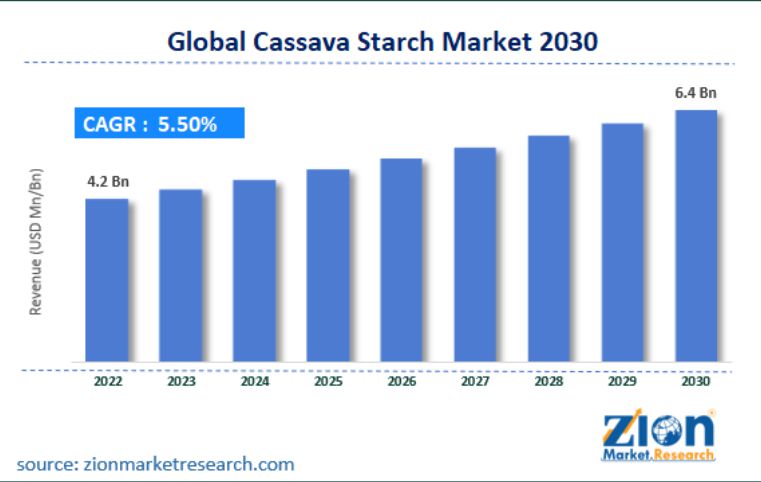
One widely cited estimate placed the global tapioca starch market at roughly 6.5 billion dollars in 2024 (Verified Market Reports).
That same estimate projects growth to around 10.8 billion dollars by 2033. Readers should treat any single dollar figure as a rough estimate rather than a settled fact, given how much these reports disagree.
Exporting and Importing Regions
Thailand, Vietnam, and Indonesia lead global tapioca exports, with Thailand dominating thanks to favorable climate, extensive farmland, and advanced processing infrastructure.
China remains the dominant buyer of Thai cassava products, absorbing well over half of all export volume in recent years (Thai Tapioca Trade Association).
The European Union and North America show strong secondary demand, driven largely by gluten-free food formulation and clean-label packaging trends.
African nations mainly consume cassava domestically, though several are gradually exploring export potential of their own.
Price Trends
Cassava starch and tapioca prices move with harvest cycles, currency shifts, and demand from major buyers like China.
Thai native starch export prices softened to about 512 dollars per tonne in 2024, according to the Krungsri research cited above.
Prices fell further still, to around 397 dollars per tonne, through the first five months of 2025.
Modified starch commanded a considerably higher price, averaging around 893 dollars per tonne in 2024, reflecting its added processing value.
Cassava chip, the least processed export category, traded at a much lower 232 dollars per tonne over the same period.
These gaps illustrate why many producers are shifting investment toward modified starch and other higher-value derivatives rather than raw exports alone.
Demand Drivers Behind Current Trends
Several converging trends continue to push tapioca demand higher across both food and industrial buyers.
Gluten-free growth
The global gluten-free products market reached an estimated 8.5 billion dollars in 2025, growing at a projected 10.1 percent annually (Grand View Research).
Tapioca starch benefits directly, since it works as a grain-free thickener and structural ingredient in gluten-free baking.
Clean-label preference
Consumers increasingly favor recognizable, minimally processed ingredients, and tapioca fits that expectation better than many synthetic thickeners.
Industrial applications
Tapioca starch shows up in textiles, adhesives, and biodegradable plastics, supporting manufacturers pursuing sustainability goals and eco-friendly certifications.
Pharmaceutical and cosmetic use
Tapioca starch serves as a natural binder and excipient in tablets, creams, and lotions, reflecting broader demand for plant-based formulation ingredients.
Economic Impact on Developing Economies
Cassava cultivation supports millions of smallholder farmers across tropical countries, shaping rural livelihoods well beyond the farm gate.
Processing tapioca into starch and flour creates additional jobs in grating, drying, packaging, and transport, extending income opportunities along the supply chain.
Export earnings from cassava products also strengthen national economies, since countries like Thailand and Vietnam channel that revenue into infrastructure and processing technology.
Nigeria, despite exporting comparatively little tapioca starch, still benefits economically through the domestic food processing built around garri, fufu, and cassava flour.
Challenges Facing the Market
Producers face several real pressure points that complicate what is otherwise a growing global market.
Climate volatility repeatedly disrupts the supply chain, since El Niño and La Niña cycles alternately bring drought and flooding to major growing regions.
Thai cassava output fell 6.5 percent in 2024 alone due to below-average rainfall and disease pressure, according to the same Krungsri research cited above.
Competition from corn and potato starch adds further pressure, since buyers can substitute freely when tapioca prices rise relative to alternatives.
Regulatory demands also weigh on producers, since export markets increasingly require certifications covering food safety, sustainability, and environmental impact before accepting shipments.
Opportunities and Future Outlook
Export volumes are projected to grow 2.7 to 4.7 percent annually through 2027, reversing a sharp 2024 contraction.
Chinese buyers seeking alternatives to domestic corn supplies are driving much of that rebound.
Modified starch exports specifically are forecast to keep expanding, supported by steady demand from food, pharmaceutical, and cosmetics manufacturers across Asia.
Producers who diversify into higher-value derivatives, including resistant starch and bioplastic feedstock, stand to capture more of this growth than those selling only raw native starch.
Readers interested in that broader picture should read our roundup of industrial uses of cassava starch and our guide on cassava starch in eco-friendly bioplastics.
Where This Market Analysis Fits
This post covers specifically the global trade and commodity market for tapioca, the refined, exported product, alongside its broader demand drivers and economic footprint.
It also differs from our coverage of the cassava starch pulp market, which tracks the byproduct stream left over after starch extraction.
Our post on the cassava starch food application market narrows in specifically on food-only uses.
Readers wanting the full value chain picture should start with our cassava market overview, or our foundational guide to what tapioca actually is.
Conclusion
The global tapioca market keeps expanding, driven by gluten-free demand, clean-label preferences, and industrial uses beyond food.
Thailand dominates exports, though Nigeria and other African nations grow more raw cassava overall, since most of that harvest feeds local staples rather than export markets.
This market also supports millions of smallholder farmers and strengthens national economies across the developing world.
Competition from corn and potato starch and climate-driven supply swings still remain pressure points.
Read our guides on modified tapioca starch next, or contact Cassava Pathway today.
Frequently Asked Questions
Who is the largest producer of tapioca starch in the world?
Thailand leads global tapioca starch exports, though Nigeria actually grows more raw cassava overall since most African cassava supplies local domestic food staples rather than industrial starch production.
What is tapioca starch used for in the industry?
Tapioca starch is widely used in food, textile, paper, and pharmaceutical manufacturing for everyday thickening, binding, and stabilizing needs in products like sauces, adhesives, fabrics, and medicine tablets.
What are the main challenges facing the tapioca market?
Climate-driven supply disruptions, stiff competition from corn and potato starch, and tightening international food safety regulations all pressure producers constantly trying to maintain consistent quality and fair pricing.
What drives global demand for tapioca?
Rising demand for gluten-free diets, clean-label preferences, and industrial applications in textiles, pharmaceuticals, and bioplastics all continue steadily driving global demand for cassava starch and tapioca flour worldwide.

Chimeremeze Emeh is a tropical crop farmer and chemical engineer from Ntigha, Isiala Ngwa North LGA, Abia State, Eastern Nigeria, specializing in cassava and palm oil, with over 30 years of hands-on experience growing, harvesting, and processing cassava. He grows TMS series, TME 419, and local traditional varieties on his own farms and operates a small-scale cassava flour and starch production business through Cassava Pathway, which he founded as a CAMA-registered agribusiness in 2024. He is also the founder of Palm Oil Pathway, where he applies the same tropical farming expertise. His farms are located in Ntigha, Abia State.