
Last updated on August 3rd, 2026 at 12:45 pm
I have peeled cassava all my life with a sharp knife for subsistence processing into fufu, garri, starch, and flour, and mature roots always peel easily, while immature ones test your patience and waste far more flesh in the process.
Peeling cassava the right way means removing both the brown outer skin and the pinkish cortex layer beneath it, since leftover skin affects taste and safety alike.
This post teaches three practical peeling methods: traditional knife work, home peeling with a vegetable peeler, and industrial machine peeling, along with the mistakes that waste flesh or leave the root only partly cleaned.
You will learn the real science behind why the peel matters so much for cyanide safety, plus what to do with cassava once it is peeled.
This matters as much for a quick dinner as for large-scale processing.
Table of Contents
Step-by-Step: How to Peel Cassava Root
What You’ll Need to Peel Cassava Root
- Traditional method: a short, sharp knife and a flat surface like a clean board, plus a bowl of water for rinsing sticky hands.
- Home method: a strong vegetable peeler and gloves, ideal for quick meal prep without deep cuts into the flesh.
- Industrial method: a dedicated peeling machine and trained workers, best suited for high-volume processing. Readers running larger operations should read our guide on cassava peeling machines for equipment options.
Traditional Manual Method of Peeling Cassava Roots

Rinse the cassava first to remove surface dirt, then cut the root into six- to eight-inch sections for easier handling.
Score each piece lengthwise with a sharp knife, cutting just deep enough to reach the white flesh underneath.
Use your fingers or the knife tip to lift and peel away the skin in long strips, working carefully to avoid removing too much flesh. Rinse the peeled sections in clean water once finished.
Modern Home Method
Rinse the whole root, then place it on a cutting board.
Use a strong vegetable peeler or small knife to remove the skin in downward strokes, cutting larger roots into manageable pieces first.
Wear gloves if your skin reacts to latex. Rinse the peeled cassava under running water before cooking.
Industrial Machine Method
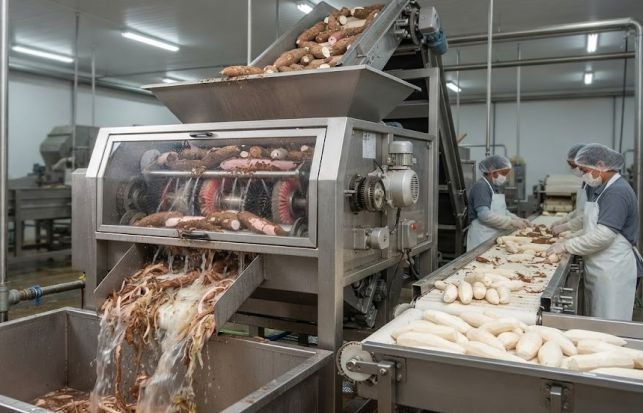
Roots are washed, then fed into a machine that strips the skin using abrasion or steam pressure.
Workers check each root afterward for leftover skin or damage.
Clean workspaces and trained staff keep this process both safe and efficient at scale.
Common Mistakes to Avoid
- Cutting too deep. Wastes edible flesh. Angle the blade to lift just the skin, going slowly until you get a feel for the right pressure.
- Skipping the scoring step. Makes peeling harder and slower. Shallow lengthwise cuts give the skin a starting point to separate cleanly.
- Forgetting to rinse afterward. Leaves dirt, latex, or stray skin fragments behind, which affects both taste and cleanliness.
- Using old or fibrous roots. Tougher, drier roots resist peeling and cook poorly. Choose firm, smooth-skinned roots for easier results.
Why the Peel Matters for Cyanide Safety
Cassava’s natural cyanogenic compounds are not distributed evenly through the root.
Research on cyanide processing methods, published in ScienceDirect, found that peeling and grating alone reduced cassava’s cyanide content by roughly 71 percent.
A separate study measuring cyanogenic compounds by root section, published via PubMed, found the cortex layer carried roughly 804 parts per million on average.
The inner flesh, by comparison, carried only about 305 parts per million.
Peeling thoroughly removes the highest-risk layer, though it does not make cassava fully safe on its own.
Readers wanting the complete safety picture should read our guide on removing cyanide from cassava root.
Why Cassava Sap Can Irritate Sensitive Skin
Cassava belongs to the Euphorbiaceae plant family, the same family as the rubber tree, and shares a specific protein that can cross-react with natural latex.
A case report published via Taylor & Francis documented allergic stomatitis following boiled cassava consumption in a patient with existing latex sensitivity.
An earlier clinical study on PubMed confirmed measurable cross-reactivity between cassava proteins and latex extract in affected patients.
Wearing gloves during peeling offers reasonable protection for anyone with known latex sensitivity.
What to Do After Peeling
- Rinse immediately under running water to remove leftover dirt, skin fragments, or latex residue, gently scrubbing the flesh as you go.
- Cook as soon as possible, since peeled cassava starts breaking down quickly and delays affect both taste and texture. Our guides on boiled cassava root, cooking cassava root, and air fryer yuca fries cover several preparation methods.
- Soak in water if not cooking right away, refrigerating and changing the water daily. Peeled cassava handled this way stays reasonably usable for up to three days.
Manual vs. Modern vs. Industrial Peeling
| Method | Best For | Tradeoff |
|---|---|---|
| Manual (knife) | Small batches, low cost | Slow, tiring for large volumes |
| Home (peeler) | Daily cooking, quick prep | Upfront tool cost, varies by root type |
| Industrial (machine) | High-volume processing | High setup and maintenance cost |
Readers processing cassava into flour or starch next should read our guides on making cassava starch at home and the traditional method of making cassava flour.
Frequently Asked Questions
How do I know when all the cassava skin is removed?
Check for a smooth, evenly white surface across the entire root. If any pink or brown patches remain, keep peeling until they are completely gone before actually cooking.
Can I use a regular potato peeler for cassava?
Yes, as long as the blade is strong and sharp enough to cut through cassava’s thicker skin, though a short knife typically works better for the toughest spots.
How long can I store peeled cassava in water?
If refrigerated and the water is changed daily, peeled cassava can stay reasonably fresh for up to three days before texture and taste even begin to noticeably decline.
Why does cassava sap or latex irritate the skin?
Cassava belongs to the same plant family as the rubber tree, and shares a protein that cross-reacts with latex, occasionally triggering skin or allergic reactions in sensitive people.

Chimeremeze Emeh is a tropical crop farmer and chemical engineer from Ntigha, Isiala Ngwa North LGA, Abia State, Eastern Nigeria, specializing in cassava and palm oil, with over 30 years of hands-on experience growing, harvesting, and processing cassava. He grows TMS series, TME 419, and local traditional varieties on his own farms and operates a small-scale cassava flour and starch production business through Cassava Pathway, which he founded as a CAMA-registered agribusiness in 2024. He is also the founder of Palm Oil Pathway, where he applies the same tropical farming expertise. His farms are located in Ntigha, Abia State.