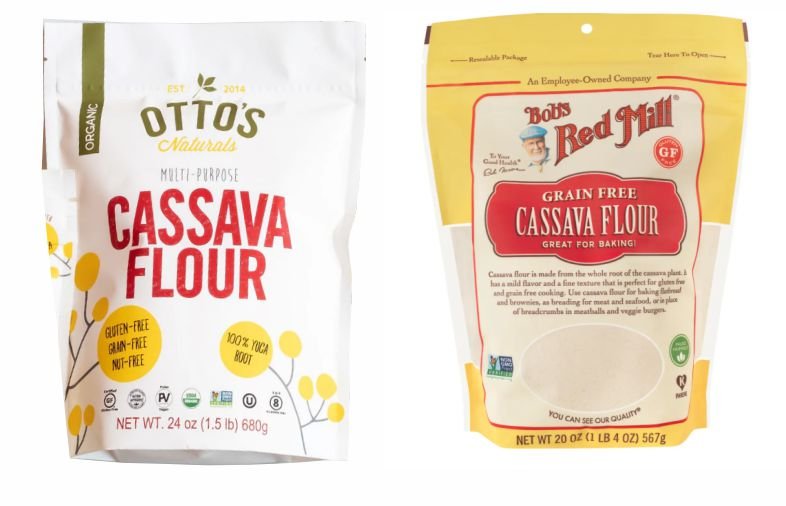
If you’ve been exploring cassava flour for AIP, Paleo, or gluten-free baking, you’ve likely come across two names more than any other: Otto’s Naturals and Bob’s Red Mill.
This article is a focused, side-by-side comparison of just these two brands, not a full roundup of every cassava flour on the market.
If you’re looking for a broader look at your options, check out our Best Cassava Flour Brands Compared guide for a more complete picture.
Both Otto’s and Bob’s Red Mill are well-regarded, widely used, and genuinely gluten-free.
But they aren’t interchangeable.
Depending on your diet, baking goals, and budget, one is likely a better fit for you than the other. Here’s what you need to know.
Table of Contents
Brand Overview
Otto’s Cassava Flour
Otto’s Cassava Flour has built its reputation around one thing: purity.
It’s the flour most associated with the Autoimmune Protocol (AIP) community and has become a go-to for grain-free bakers who need their ingredients to perform consistently in precise recipes.
Otto’s sources its cassava carefully, peeling and drying the root rather than fermenting it, which preserves a neutral flavor and fine texture.
Bob’s Red Mill Cassava Flour
Bob’s Red Mill Cassava Flour comes from one of the most recognized health food brands in the United States.
It’s a mainstream gluten-free option that sits comfortably on the shelves of most natural grocery stores and big-box retailers.
Bob’s Red Mill brings the same accessibility and reliability it’s known for across its entire flour lineup to its cassava offering.
Both are single-ingredient products. Both are gluten-free. But the differences between them matter more than you might expect.
Key Difference #1: Ingredients & Processing
At first glance, both flours look identical on the label: cassava flour, nothing else.
But the processing behind that single ingredient tells a different story.
Ottos’s
Otto’s Cassava Flour is produced using a small-batch approach that prioritizes the integrity of the root.
The cassava is hand-peeled and slowly dried, a method that keeps the flour aligned with strict AIP standards. See cassava flour production.
There are no additives, no shared allergen facilities to worry about for most users, and the sourcing is tightly controlled.
For people following elimination diets like Whole30, or healing protocols, this level of transparency matters enormously.
Bob’s Red Mill’s
Bob’s Red Mill, by contrast, is produced at a large commercial scale.
It’s still a single-ingredient flour with no additives, but the manufacturing process is built for volume and wide distribution.
Bob’s Red Mill does run a dedicated gluten-free facility, which is a genuine plus for celiac sufferers.
However, for those on strict AIP or highly sensitive elimination protocols, the commercial scale of processing can be a concern, not because anything harmful is added, but because stricter protocols often prioritize minimal industrial handling.
Bottom line: If you’re on a strict elimination diet, the processing difference between these two matters. Otto’s wins on purity of process. Bob’s Red Mill wins on certified gluten-free facility transparency at scale.
Key Difference #2: Texture & Baking Performance
This is where the two flours diverge most noticeably for home bakers.
Otto’s
Otto’s Cassava Flour is widely praised for its fine, consistent texture that closely mimics all-purpose wheat flour.
It performs exceptionally well in AIP baking recipes, particularly those requiring a soft, pliable dough like cassava flour tortillas, flatbreads, and soft-baked cookies.
The absorption rate is predictable, which is critical when you’re following grain-free recipes that have been specifically developed and tested with Otto’s in mind.
Many popular AIP recipe developers explicitly test and recommend Otto’s for this reason.
Bob’s Red Mill’s
Bob’s Red Mill Cassava Flour has a slightly coarser grind and can behave differently in terms of liquid absorption.
Depending on the recipe, you may find you need to adjust moisture levels slightly, adding a touch more water or fat to achieve the same result.
This isn’t necessarily a dealbreaker, but it does mean Bob’s Red Mill performs best in more forgiving recipes where small variations in texture or structure won’t significantly affect the final result.
It works well for thicker flatbreads, pancakes, and recipes where a slightly denser crumb is acceptable.
Bottom line: For precision baking, especially AIP recipes developed with Otto’s in mind, Otto’s outperforms. For general grain-free baking where some flexibility is fine, Bob’s Red Mill holds its own.
Key Difference #3: Taste & Consistency
Cassava flour is prized across the board for its neutral, mild flavor, and both of these flours deliver on that front.
Neither has a strong taste that competes with the other ingredients in your recipe, which is exactly what you want from a flour substitute.
Taste
That said, subtle differences do exist. Otto’s tends to produce a slightly lighter, cleaner flavor profile in baked goods, particularly noticeable in more delicate recipes like crepes or thin wraps.
Bob’s Red Mill is equally neutral but can occasionally carry a faintly starchy undertone in very simple preparations.
Consistency
Batch-to-batch consistency is another important factor, especially for bakers who develop their own recipes.
Otto’s scores well here, with bakers frequently noting that results are reliable and repeatable across different purchases.
Bob’s Red Mill is generally consistent, though given its larger production scale, minor variations between bags can occasionally occur.
For casual baking, this is unlikely to matter. For recipe development or strict protocol baking, it’s worth noting.
Bottom line: Both are mild and neutral. Otto’s edges ahead on flavor delicacy and batch consistency. Bob’s Red Mill is reliable enough for everyday use.
Key Difference #4: Availability & Price
This is where Bob’s Red Mill has a clear, undeniable advantage.
Otto’s
Otto’s Cassava Flour is considered a specialty product.
You’ll find it online, most commonly on Amazon and through natural food retailers, but it’s rarely stocked on the shelves of mainstream grocery stores.
It also carries a higher price point, typically running more expensive per pound than Bob’s Red Mill.
For people baking casually or in large quantities, that cost can add up quickly.
Bob’s Red Mill’s
Bob’s Red Mill Cassava Flour, on the other hand, is available in Whole Foods, Sprouts, Target, Walmart, and most natural grocery chains, as well as easily online.
It’s priced more accessibly, making it a practical choice for everyday baking or for those new to cassava flour who want to experiment without a significant financial commitment.
Bottom line: For accessibility and budget, Bob’s Red Mill wins easily. Otto’s requires more effort to source and comes at a premium price.
Key Difference #5: Best Use Cases
Matching the flour to your use case is ultimately what matters most.
Otto’s Cassava Flour shines in:
- AIP tortillas, wraps, and flatbreads
- Precisely developed grain-free recipes
- Elimination protocol baking where ingredient purity is non-negotiable
- Soft-baked goods like cookies, biscuits, and dumplings
Bob’s Red Mill Cassava Flour works best for:
- General gluten-free baking and everyday substitutions
- Pancakes, waffles, and thicker flatbreads
- Recipes with more flexibility in texture and structure
- Beginner cassava flour bakers exploring grain-free options
Who Should Choose Otto’s?
Otto’s Cassava Flour is the right choice if you are following a strict AIP or elimination diet where processing purity matters.
If you’re using recipes specifically developed and tested with Otto’s, or if consistent, fine-textured results in grain-free baking are a priority for you.
It’s the flour for bakers who treat their kitchen like a protocol, not just a hobby.
Who Should Choose Bob’s Red Mill?
Bob’s Red Mill Cassava Flour is the better fit if you’re a casual gluten-free baker looking for a convenient, widely available option.
It’s also the smarter choice for budget-conscious shoppers, those new to cassava flour, or anyone who simply needs to grab a bag from their local grocery store without ordering online and waiting for delivery.
Final Verdict
There’s no absolute winner here, only the right flour for the right person.
If purity, precision, and AIP compliance are your priorities, Otto’s Cassava Flour is worth the higher price and extra sourcing effort.
It’s the gold standard in the AIP baking community for good reason.
If convenience, affordability, and general gluten-free baking are what you’re after, Bob’s Red Mill Cassava Flour is an excellent, practical choice that doesn’t require any compromise on quality for everyday use.
Choose based on your diet strictness and your baking goals, and you won’t go wrong with either.



Chimeremeze Emeh is a tropical crop farmer and chemical engineer from Ntigha, Isiala Ngwa North LGA, Abia State, Eastern Nigeria, specializing in cassava and palm oil, with over 30 years of hands-on experience growing, harvesting, and processing cassava. He grows TMS series, TME 419, and local traditional varieties on his own farms and operates a small-scale cassava flour and starch production business through Cassava Pathway, which he founded as a CAMA-registered agribusiness in 2024. He is also the founder of Palm Oil Pathway, where he applies the same tropical farming expertise. His farms are located in Ntigha, Abia State.