
Last updated on July 22nd, 2026 at 04:57 pm
Weeds can silently steal more than half of your cassava harvest before you ever notice the damage. After three decades of farming cassava in Abia State, Nigeria, I have tested hand hoeing, mulching, and herbicides, and timing wins in the end.
Every rainy season on my farm in Ntigha, weeds compete with young cassava plants for water, nutrients, and sunlight.
If you are the type that plants cassava and goes to sleep, you will wake up and see that your cassava farm stands no chance.
Grass weeds, broadleaf weeds, and sedges each cause different damage, and cassava is most vulnerable during its first three to four months, before the canopy closes over the soil.
Research from the International Institute of Tropical Agriculture shows weed competition can account for more than 30 percent of cassava yield loss across smallholder farms in Nigeria.
This post discusses weed types that threaten cassava, the cultural, mechanical, chemical, and biological controls available, and the timing that protects your harvest.
Table of Contents
Why Cassava Is So Vulnerable to Weeds
Cassava grows slowly for its first eight to twelve weeks, and weeds exploit that window before the crop forms a full canopy.
IITA agronomists have documented that this early period, roughly the first three to four months after planting, decides most of the season’s yield outcome.
A widely cited review found that uncontrolled weeds cut cassava root yield by 50 to 100 percent.
This happens most when farmers delay their first weeding past the critical window.
On my own farm, I have watched a field planted in June become choked with spear grass by August if I skip the first weeding round.
That single missed cycle can cost a farmer several sacks of garri come harvest time.
Types of Weeds in Cassava Fields
Cassava fields in Nigeria host dozens of weed species, but three broad groups cause most of the damage.

- Grass weeds, including spear grass and Guinea grass, spread through underground rhizomes and regrow quickly after cutting.
- Broadleaf weeds, such as Siam weed and pigweed, grow tall fast and block sunlight from reaching young cassava leaves.
- Sedges, like yellow nutsedge, reproduce through underground tubers rather than seeds, which makes them harder to remove permanently.
A 1997 IITA agronomy research guide confirms that cassava’s slow initial sprouting is the reason these three groups gain such an early advantage.
Knowing which group dominates your cassava planting site tells you which control method to reach for first.
The Critical Weeding Window
Timing decides more than any single method you choose to rely on.
Field research from the National Root Crops Research Institute in Nigeria found root yield losses reached 85 percent.
This happened when giant sensitive plant was left uncontrolled through the growing season, according to a study published in the journal Weed Technology.
A separate Brazilian trial recorded yield losses climbing toward 90 percent once weeds coexisted with cassava for 140 days without weeding.
This finding comes from research published in the African Journal of Agricultural Research.
IITA’s practical recommendation, drawn from its Six Steps toolkit, calls for weeding at 4, 8, and 12 weeks after planting.
Continue weeding as needed each season until the canopy fully closes over the soil.
I follow a version of this schedule on my own farm, adjusted for how fast the rains bring weeds back.
Related: The Ideal Climate Conditions for Cassava Cultivation
Cultural Methods
Cultural methods change field conditions so weeds struggle to establish, and I lean on these before reaching for a hoe or a sprayer.
Correct Spacing
Planting cassava at closer, more uniform spacing helps the crop close its canopy sooner and shade out emerging weeds.
Research summarized by Wikifarmer found that spacing cassava at 1 meter by 0.8 meters improved weed suppression through faster canopy formation.
I use this tighter spacing on parts of my own farm and notice a visibly cleaner field by the tenth week.
Crop Rotation
Rotating cassava with legumes or cereals disrupts the life cycle of weeds that specialize in root crop fields.
This also improves soil structure, which is worth pairing with a look at cassava crop rotation and soil recovery if you are planning next season’s layout.
Intercropping
Growing cassava alongside maize or melon fills the space between young cassava stems, denying weeds the light and room they need to establish.
Our guide on what crops can be intercropped with cassava covers combinations that work well in West African conditions.
Mulching
Covering bare soil between cassava rows with dried grass, cassava peels, or other crop residue blocks sunlight from reaching weed seeds.
I recycle peels from my own flour processing line as mulch, which cuts waste and suppresses weeds at the same time.
Mechanical Methods
Mechanical control removes weeds through direct physical action, and it remains the dominant method among Nigerian smallholders.
That is the method we have been using till today, because of the apprehension that comes with herbicides.
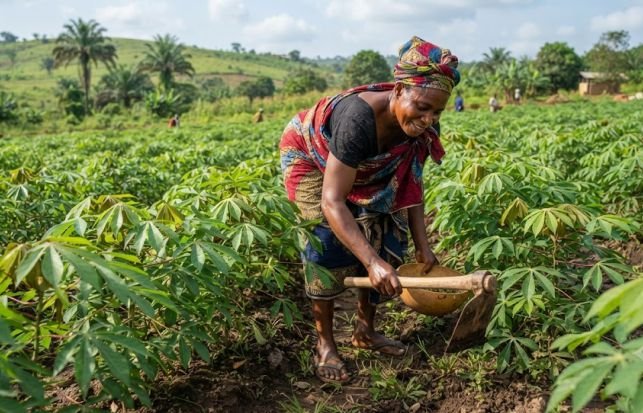
Hand weeding with a hoe is still how most of the labor budget on a cassava farm gets spent.
A 2021 study published in PMC found that weeding alone can consume 30 to 50 percent of the total labor budget on smallholder cassava farms.
Women perform more than 90 percent of this task in most Nigerian communities.
Mowing before weeds flower or set seed reduces the weed seed bank for the following season, which matters most on larger mechanized plots.
Chemical Methods
Herbicides can cut labor costs sharply, but they need correct timing and product selection to avoid harming the crop.
Pre-emergence herbicides, applied to moist soil within a day of planting, form a barrier that stops weed seeds from germinating.
IITA researchers screening several pre-emergence products identified formulations including Fierce 75 WG and Merlin 75 WG.
These controlled broadleaf and grass weeds effectively for up to eight weeks after planting, according to an IITA field report.
Post-emergence herbicides work differently, applied once cassava is 8 weeks old and weeds cover roughly 30 percent of the field.
A large on-farm trial across 96 sites in Nigeria tested this directly. Combining herbicides with sound agronomic practice raised root yield 11 to 68 percent over no herbicide use, based on research published in Field Crops Research.
The same study found farmers relying only on their usual weeding practice typically ended the season with a net loss once labor costs were counted.
I use herbicides sparingly on my own farm, mainly on the sections I cannot reach with hand weeding before the rains intensify.
Biological Methods
Biological control uses natural enemies, including insects and fungal agents known as mycoherbicides, to suppress weed populations without chemical inputs.
This approach remains mostly experimental in West African cassava systems and works best layered alongside cultural and mechanical methods rather than as a stand-alone solution.
Integrated Weed Management
Integrated Weed Management combines cultural, mechanical, chemical, and biological methods into a single plan matched to your field.
Rather than depending on one method, IWM adjusts based on which weed species dominate, how much labor you have, and your budget for herbicides.
On my farm, this means correct spacing and mulching year-round, plus hand weeding at the standard 4, 8, and 12 week marks.
I add a pre-emergence herbicide only where heavy rain makes hand weeding difficult.
Common Challenges in Cassava Weed Management
Nigerian smallholders face specific obstacles that decide which weed control methods are realistic.
- Labor costs: Manual weeding remains the most accessible method for most farmers, but it consumes a large share of the total production budget across a season.
- Limited access to herbicides: Genuine, correctly labeled herbicide products can be hard to find in rural markets, which pushes many farmers toward hand weeding by default.
- Weather timing: Heavy rain shortly after a herbicide application can wash the product away before it takes effect, wasting both money and time.
For more on the broader pressures facing farmers like these, see our overview of the challenges facing the cassava value chain.
Best Practices From My Own Farm
A few habits have made the biggest difference on my fields in Ntigha over the past three decades.

- Weed within the first four weeks after planting, before cassava’s slow early growth lets weeds gain ground.
- Match your spacing to your weed pressure, tightening rows where grass weeds dominate.
- Keep a simple record of which weeds appear each season, since the mix shifts with rotation and rainfall.
- Recycle processing waste, like cassava peels, as mulch instead of buying separate materials.
You can see how these practices played out in one recent season in our post on farming data from Ntigha, Abia State.
Conclusion
Cassava weed management decides how much root yield you harvest at season end.
Grass weeds, broadleaf weeds, and sedges each demand a slightly different response, and the first three to four months after planting matter most.
On my farm in Ntigha, combining early hand weeding with mulching and selective herbicides has cut labor and protected yield better than any single method.
Integrated weed management, built around your field and budget, remains the most reliable path forward.
Start by mapping which weeds dominate your field, then build a weeding schedule around it.
Frequently Asked Questions
What are the most damaging weeds in cassava fields?
Grass weeds like spear grass and Guinea grass, broadleaf weeds like Siam weed, and sedges like nutgrass are the most damaging in cassava fields before canopy closure.
How much cassava yield can weeds actually destroy?
IITA research shows uncontrolled weed competition can reduce cassava root yield by 25 to 100 percent, with losses concentrated in the first three to four months after planting.
Do herbicides really work for cassava weed control?
Yes, pre-emergence herbicides applied within a day of planting and post-emergence herbicides applied at 8 weeks both raised cassava root yield notably in Nigerian on-farm field trials.
What does Integrated Weed Management actually mean?
Integrated weed management combines hand weeding, mulching, crop rotation, correct plant spacing, and herbicides, matched to your specific field and budget, instead of relying on one method.

Chimeremeze Emeh is a tropical crop farmer and chemical engineer from Ntigha, Isiala Ngwa North LGA, Abia State, Eastern Nigeria, specializing in cassava and palm oil, with over 30 years of hands-on experience growing, harvesting, and processing cassava. He grows TMS series, TME 419, and local traditional varieties on his own farms and operates a small-scale cassava flour and starch production business through Cassava Pathway, which he founded as a CAMA-registered agribusiness in 2024. He is also the founder of Palm Oil Pathway, where he applies the same tropical farming expertise. His farms are located in Ntigha, Abia State.