Last updated on August 2nd, 2026 at 05:08 pm
In my farming community in Ntigha, Abia State, relatives with diabetes have eaten cassava for decades without cutting it out entirely, simply by watching portion size carefully, choosing boiling over frying, and always pairing it with protein and leafy vegetables.
Cassava’s glycemic index research varies dramatically, from the mid-40s to the mid-90s, depending on variety, preparation, and even how a sample was stored before testing.
This guide explains what the research shows about cassava, blood sugar, and preparation methods.
You will learn which cassava foods fit more easily into a diabetic diet, which ones deserve caution, and how to build a balanced meal around cassava without blood sugar spikes.
Disclaimer: This article is for informational purposes only and does not constitute medical advice. The author is not a medical doctor or registered dietitian. Always consult a qualified healthcare provider before making dietary or medical decisions related to cassava consumption.
Table of Contents
Can Diabetics Eat Cassava?
Yes, most people with diabetes can include cassava in their diet without eliminating it.
The real question is not if cassava belongs on the plate, but how much, prepared which way, and eaten alongside what.
Portion size, cooking method, and the rest of the meal all influence how cassava affects blood sugar far more than the root itself does.
Why Glycemic Index Research on Cassava Varies So Widely
Most articles quote a single glycemic index number for cassava as if it were settled science, which it is not.
Boiled cassava from Kenya tested with a glycemic index around 46, according to compiled data from international glycemic index tables (FoodStruct cassava glycemic index data).
By contrast, peeled cassava that was boiled, frozen, thawed, and reheated tested at 94 in the same dataset.
That near fifty-point spread comes down to cassava variety, moisture content, cooking method, and even how long a sample sat before testing.
Readers curious about the underlying cassava varieties behind this variation, including the difference between bitter and sweet cassava, can find more detail in our dedicated guides.
How Preparation Method Changes Cassava’s Blood Sugar Effect
A Ghanaian study measured predicted glycemic index across several cassava-based staples prepared in different ways.
Boiling and steaming actually increased glycemic index compared to raw cassava in that research (Journal of Food and Nutrition Sciences, Akyereko et al.).
Fermentation, by contrast, showed no measurable effect on the finished product’s glycemic index.
Raw cassava, boiled cassava, and dried-then-cooked cassava flour products ranged from roughly 40 to 79 in that specific study.
Frying adds fat and calories without meaningfully lowering the underlying carbohydrate load.
Raw cassava should never be eaten unprocessed, regardless of its effect on blood sugar.
Garri vs. Fufu: Which Has a Gentler Blood Sugar Impact?
Processing method matters as much as cassava variety when it comes to blood sugar response.
A 2021 study compared garri and fufu made from the same cassava varieties for their starch properties (ScienceDirect, Adinsi et al.).
Fufu carried the highest resistant starch content of the two fermented products.
Garri, meanwhile, carried the highest rapidly digestible starch and the highest predicted glycemic index, ranging from 54 to 67.
The researchers concluded that fufu likely releases glucose more slowly than garri after eating.
That lines up with what I have watched among relatives, where fufu paired with soup feels gentler than a large soaked garri meal.
Does Cassava Cause Diabetes? Debunking an Old Concern
A long-standing worry claims that cassava’s natural cyanide content contributes to diabetes in communities that eat it daily.
A landmark study compared two rural Tanzanian communities, one with heavy lifelong cassava consumption and high cyanide exposure and one that rarely ate cassava at all.
Researchers found no meaningful difference in diabetes prevalence between the two groups (Diabetes Care, Swai et al.).
They concluded that cassava consumption is unlikely to be a major cause of diabetes.
This finding directly addresses a genuine, long-standing historical concern about cassava safety.
It does not, however, remove the separate need to process cassava properly and avoid raw roots.
Resistant Starch: Cassava’s Quiet Advantage
Raw and properly cooled cassava contains meaningful resistant starch, a type that resists digestion in the small intestine.
This starch instead travels further along and feeds beneficial bacteria in the gut.
A recent review of resistant starch research found that it can help regulate blood glucose by supporting gut microbiota and slowing digestion (Molecules, Liu et al.).
The review also linked resistant starch to better insulin response across repeated meals.
Readers wanting the full picture can compare cassava against other starches in our guide on resistant starch in cassava versus potato.
Our broader post on cassava as a resistant starch source covers this in more depth.
Cassava’s Fiber Advantage Over Wheat
A critical review comparing cassava with wheat found that cassava can supply up to sixteen times more fiber, alongside roughly four times less digestible sugar.
The same review calculated that cassava’s carbohydrate-to-fiber and fat-to-fiber ratios run 14 and 55 times lower than wheat’s (Journal of Intercultural Ethnopharmacology, Nwose et al.).
Dietary fat tends to worsen metabolic conditions, while fiber tends to help control them.
Readers wanting the fuller nutritional picture should read our guide on cassava root benefits, and our page asking is cassava genuinely good for you.
Which Cassava Foods Are Better Choices for Diabetics
Different cassava products carry meaningfully different blood sugar impact, so choosing the right form matters.
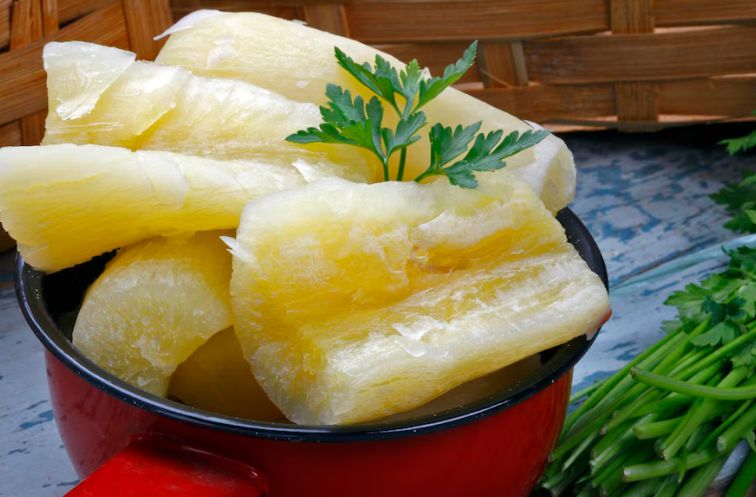
- Boiled or steamed whole cassava root, the form most commonly sold fresh or frozen in US, UK, and Canadian grocery stores, works well in moderate, measured portions.
- Fufu, prepared through fermentation and pounding as described in our fufu guide, tends to release glucose more gradually than garri based on resistant starch content.
- Garri, best eaten dry alongside protein rather than soaked in sugar, as covered fully in our garri guide.
- Cassava flour products, including high-quality cassava flour, work similarly to wheat flour for portion purposes and suit readers avoiding gluten, detailed in our gluten-free cassava guide.
- Tapioca pearls and sweetened desserts digest quickly and typically carry added sugar, so portion size matters even more here than with whole root cassava.
Cassava Foods Diabetics Should Limit
Fried cassava chips, sweetened tapioca puddings, cassava flour pastries, deep-fried fritters, and sugar-soaked garri all combine concentrated carbohydrates with added fat or sugar.
That combination consistently produces sharper blood sugar spikes than whole, simply prepared cassava eaten in a measured portion.
How to Eat Cassava Without Spiking Blood Sugar
A few consistent habits make the biggest difference in how cassava affects blood sugar.
- Start with a moderate portion, roughly half a cup of cooked cassava per meal, then adjust based on your own glucose response.
- Pair cassava with a protein source at the same meal to slow digestion and blunt the resulting glucose rise.
- Add non-starchy vegetables generously, since their fiber content further slows carbohydrate absorption.
- Include a source of healthy fat, such as avocado or olive oil, which also slows gastric emptying.
- Avoid pairing cassava with sugary drinks, since the combination compounds the overall glycemic load.
- Spread carbohydrate intake across the day rather than concentrating it into one large cassava-heavy meal.
Best Pairings for a Cassava-Based Meal
Fish, chicken, eggs, beans, lentils, and tofu all slow digestion and improve fullness when eaten alongside cassava.
Leafy greens, broccoli, green beans, cabbage, zucchini, and bell peppers add fiber that further slows carbohydrate absorption and improves the overall nutritional density of the plate.
This pattern mirrors how cassava is eaten across cultures that rely on it daily.
West African groundnut pairings and Caribbean bean-and-rice combinations both follow the same logic.
That inherited habit happens to align closely with current research on meal composition.
Common Mistakes Diabetics Make When Eating Cassava
Eating too much cassava in one sitting is a common misstep, along with skipping protein or fiber entirely.
Choosing fried over boiled or fermented preparations, and assuming natural automatically means gentle on blood sugar, are two more.
Each mistake raises the odds of an unpredictable glucose response after the meal, regardless of which cassava variety was used.
Conclusion
Diabetics do not need to remove cassava from their diet completely.
Portion size, cooking method, and pairing with protein and fiber matter more than any single glycemic index number.
Research on cassava’s glycemic index swings by variety and study, which is why tracking your blood sugar response matters more than a published average.
In farming communities like mine, cassava has never been eaten alone, but always alongside groundnuts, vegetables, or fish.
Read our guides on garri and fufu next, or talk with a healthcare provider before changing your meal plan.
Frequently Asked Questions
Does cassava raise blood sugar?
Yes, cassava is carbohydrate-dense and can raise blood sugar meaningfully, especially in large portions or fried preparations, though pairing it with protein and fiber helps moderate the response.
Can diabetics eat cassava every day?
Large daily portions are not advisable for most diabetics, but occasional, carefully portioned servings rotated with other carbohydrate sources can still fit safely into many diabetes meal plans.
Is garri good for diabetics?
Garri can fit into a diabetic diet in moderation, especially eaten dry alongside a protein source rather than soaked in sugar, which adds unnecessary glycemic load and calories.
Is fufu safe for diabetics?
Fufu can be eaten in moderation, ideally paired with a protein and vegetable-rich soup, since fufu tends to release glucose more gradually than roasted, granular garri usually does.

Chimeremeze Emeh is a tropical crop farmer and chemical engineer from Ntigha, Isiala Ngwa North LGA, Abia State, Eastern Nigeria, specializing in cassava and palm oil, with over 30 years of hands-on experience growing, harvesting, and processing cassava. He grows TMS series, TME 419, and local traditional varieties on his own farms and operates a small-scale cassava flour and starch production business through Cassava Pathway, which he founded as a CAMA-registered agribusiness in 2024. He is also the founder of Palm Oil Pathway, where he applies the same tropical farming expertise. His farms are located in Ntigha, Abia State.