Last updated on July 11th, 2026 at 09:48 pm
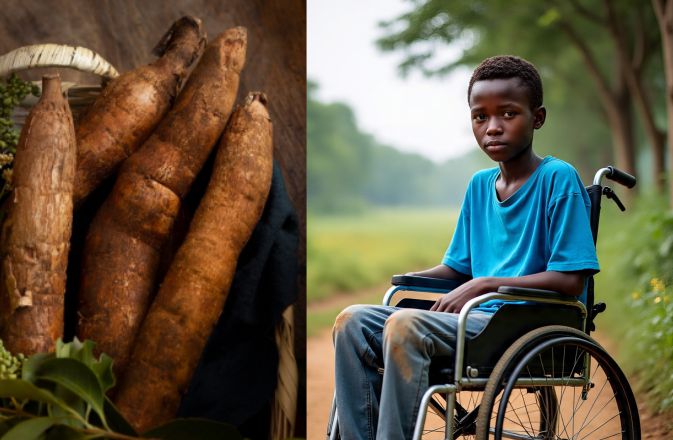
A child can walk normally in the morning and never walk the same way again by evening, not from injury, but from a disease most people who eat cassava daily have never even heard of.
A child can walk normally in the morning and never walk the same way again by evening, not from injury, but from a disease most people who eat cassava daily have never even heard of.
Konzo is a real, documented neurological disease tied directly to cassava, and it deserves clear, specific information rather than vague fear.
It causes sudden, permanent, non-progressive paralysis in the legs, striking hardest in communities where bitter cassava makes up most of the daily diet.
First identified in 1938 in the former Belgian Congo, konzo remains active today in parts of sub-Saharan Africa.
Growing up, we heard about konzo in Congo, a country not far from us, but our own farming community in Nigeria never experienced a single case.
For a while, some of us wondered if something other than cassava was truly behind what outsiders were attributing to the crop.
The science behind konzo answers that question directly. A 2021 comparative study of communities in the Democratic Republic of Congo found that cyanide exposure alone did not predict konzo.
Nutritional status was the real differentiator between groups that developed it and those that did not.
Disclaimer: This article is for informational purposes only and does not constitute medical advice. The author is not a medical doctor or registered dietitian. Always consult a qualified healthcare provider before making dietary or medical decisions related to cassava consumption.
Table of Contents
What Causes Konzo Disease
Konzo results from chronic exposure to cyanide from bitter cassava that has not been fully processed, combined with a diet too low in protein.
A 2021 systematic review of konzo risk factors confirms both as well-documented causes.
The name comes from a Central African word meaning to tie or bind the legs, describing the stiff, sudden gait that follows onset.
Cases concentrate in the Democratic Republic of Congo, Mozambique, and Tanzania, regions where bitter cassava serves as a dominant calorie source during food shortages.
Bitter cassava contains cyanogenic glycoside levels exceeding 50 milligrams of hydrogen cyanide per kilogram, well above the Codex Alimentarius safety threshold that defines sweet cassava.
Sulfur-rich amino acids from protein sources like fish, legumes, and eggs help the body clear cyanide safely, which is why low protein intake sharply raises konzo risk.
Women of childbearing age and young children face the highest risk, since their nutritional needs are greatest exactly when cassava-heavy diets are most common.
Drought, conflict, and famine all increase konzo cases, since these conditions push families toward faster processing shortcuts on an already risky food source.
Symptoms and Diagnosis
Symptoms appear suddenly rather than gradually, with both legs affected symmetrically, distinguishing konzo from many other neurological conditions doctors must rule out.
There is no laboratory test for konzo, so diagnosis relies on symptom pattern, dietary history, and ruling out conditions like polio or spinal injury.
The paralysis konzo does not improve or reverse, making prevention the only real defense against its lifelong impact on mobility and independence.
How to Prevent Konzo
Soaking peeled cassava roots in water for at least three days remains one of the most effective ways to reduce cyanogenic content before cooking.
Fermentation breaks down cyanogenic compounds further while improving both flavor and nutritional value, which is why traditional foods like garri and fufu rely on it.
Thorough drying in the sun or heat reduces remaining cyanide levels well, an important step for cassava intended for flour or long-term storage.
Pairing cassava with protein-rich foods, even in small amounts, meaningfully lowers konzo risk by supporting the body’s own cyanide-clearing capacity.
Related Cassava Safety Risks
Our full guide on how to remove cyanide from cassava root walks through each processing method in complete detail.
Acute cyanide poisoning, a separate but related risk, is covered in our guide to cyanide poisoning from cassava.
The broader question of how much raw cassava is dangerous is answered directly in our post on how much cassava will kill you.
Communities that combine proper processing with protein-diverse diets have seen konzo cases decline substantially over recent decades, proof that this disease is genuinely preventable.
Awareness matters as much as the processing steps themselves, since konzo persists mainly where knowledge of safe preparation has been lost or was never fully passed down.
If cassava forms a major part of your household’s diet, teaching proper preparation to everyone who cooks it is one of the most protective steps available.
Conclusion
Konzo is preventable, and the science behind it is specific rather than mysterious.
It results from bitter cassava eaten without proper processing, combined with too little protein to clear the resulting cyanide.
Soaking, fermenting, drying, and pairing cassava with protein-rich foods together remove nearly all of that risk.
The disease itself causes permanent paralysis with no cure, which makes prevention the only real defense available.
If cassava is a daily staple in your household, treat processing as necessary, not optional, and share that knowledge with others who prepare it too.
Frequently Asked Questions
What exactly causes Konzo disease?
Konzo is caused by eating bitter cassava with high cyanogenic content that has not been properly soaked, fermented, or dried, combined with a diet too low in protein.
Can konzo be treated or reversed once it occurs?
No, konzo causes permanent, irreversible paralysis in the legs, since there is currently no treatment that reverses the underlying nerve damage once it has occurred.
Who faces the highest risk of developing konzo?
Women of childbearing age and young children in communities relying heavily on bitter cassava with limited protein intake face the highest documented risk of konzo.
Does boiling cassava alone prevent konzo?
Boiling alone is not always sufficient, since soaking and fermenting before cooking remove far more cyanogenic content than heat exposure does on its own.

Chimeremeze Emeh is a tropical crop farmer and chemical engineer from Ntigha, Isiala Ngwa North LGA, Abia State, Eastern Nigeria, specializing in cassava and palm oil, with over 30 years of hands-on experience growing, harvesting, and processing cassava. He grows TMS series, TME 419, and local traditional varieties on his own farms and operates a small-scale cassava flour and starch production business through Cassava Pathway, which he founded as a CAMA-registered agribusiness in 2024. He is also the founder of Palm Oil Pathway, where he applies the same tropical farming expertise. His farms are located in Ntigha, Abia State.