Last updated on September 23rd, 2026 at 06:38 am
On paper, one metric ton of dry cassava starch can become about 568 kilograms of ethanol. In practice, a ton of fresh roots yields closer to 150 liters, and many cassava ethanol projects succeed or fail inside that stubborn gap.
This guide is for investors, processors, and engineering students weighing ethanol as an outlet for cassava roots.
As a chemical engineer who farms and processes cassava, I start with the chemistry, because it sets a hard ceiling on output.
From there, I walk through each process step, plant scale, the cost drivers that decide profit, and the risks that sank earlier Nigerian projects.
I do not run an ethanol plant myself, so the plant figures here come from published studies rather than my own ledger.
Where my farm and processing experience adds something useful, I say so in the text.
Table of Contents
Yield Math: The Chemistry Sets Your Ceiling
Starch is a chain of glucose units, and each unit picks up one water molecule during hydrolysis before yeast can ferment it.
Yeast then splits each glucose molecule into two molecules of ethanol and two of carbon dioxide.
Working through the molecular weights, 162 kilograms of starch can produce at most 92 kilograms of ethanol, a ratio of about 0.568.
That means one ton of pure starch has a theoretical ceiling near 568 kilograms, or roughly 720 liters of ethanol.
No plant reaches that ceiling, because some sugar feeds yeast growth and some starch never converts at all.
A study on PubMed Central cites Ecofys figures of 150 liters per ton of fresh roots and 333 liters per ton of dry chips.
The same research found yield differences between varieties came down to starch, protein, fiber, and dry matter content.
Our variety selection guide explains which improved types carry the high starch that an ethanol buyer should pay for.
Fresh Roots or Dried Chips: Your First Big Decision
FAO’s cassava post-harvest compendium notes that fresh roots start spoiling within 48 to 72 hours of harvest.
A plant running on fresh roots therefore needs farms close by and a steady stream of daily deliveries.
Dried chips store for months, carry less water to transport, and let a plant run between harvests.
The trade-off is drying cost, and a Colombian study in Sustainability found artificial chip drying dragged down the energy performance of centralized plants.
From my own farm, I would add that sun-drying chips works well in the dry season but struggles once the rains arrive.
Timing the harvest well also protects starch levels, as our guide to reading harvest readiness in the field shows.
The Cassava Ethanol Process, Step by Step
Industrial plants differ in equipment, but almost all follow the same eight stages from root to fuel-grade alcohol.
- Receiving and cleaning. Roots or chips are weighed, sampled for starch content, and washed to remove soil that would wear pumps and foul tanks.
- Milling. A hammer mill or rasper reduces the material to a fine meal, since smaller particles let water and enzymes reach the starch.
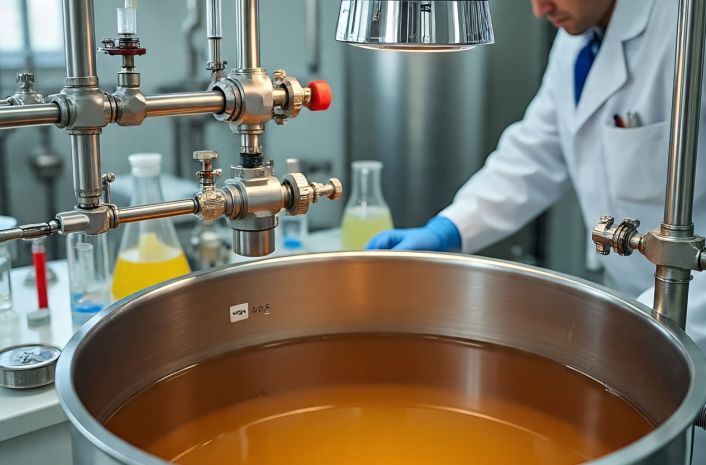
- Liquefaction. The meal is slurried with water and heated with alpha-amylase, which breaks long starch chains into shorter, soluble dextrins.
- Saccharification. Glucoamylase then converts those dextrins into glucose, and many plants run this step inside the fermenter to save time and tank space.
- Fermentation. Saccharomyces cerevisiae yeast converts the glucose into ethanol and carbon dioxide, with temperature control keeping the yeast active and healthy.
- Distillation. Steam-heated columns separate ethanol from the fermented mash, leaving behind stillage, and simple distillation stops near 95 percent purity. That limit exists because ethanol and water form an azeotrope, a mixture that boils without changing composition.
- Dehydration. Molecular sieves adsorb the remaining water, producing anhydrous ethanol that can be blended into gasoline.
- Storage. Finished ethanol goes into sealed, grounded tanks, because its vapor is flammable and it absorbs moisture from the air.
In a published process simulation, distillation columns were the least energy-efficient units in every starchy feedstock route studied.
That is why heat recovery around the columns deserves early attention in any plant design.
For how milling and washing compare with food processing lines, see our overview of cassava processing systems.
Plant Scale, Equipment, and Standards
Plants range from small units serving local solvent and beverage markets to industrial refineries built for fuel blending.
For scale, a well-run cassava plant in Shandong, China, described in the journal Water, produced about 106 tons of ethanol per day.
That same plant drew about 1,156 tons of fresh water daily, a reminder that water supply belongs in site selection from day one.
Core equipment includes a mill, liquefaction and fermentation tanks, distillation columns, a dehydration unit, a boiler, and effluent treatment.
In Nigeria, SON has developed standards for fuel-grade ethanol, according to the Major Energies Marketers Association of Nigeria.
Before committing capital, map your feedstock base the way our commercial farming roadmap recommends, starting with contracted supply.
What It Costs and What Decides Profit
Published cost figures vary so widely by country and year that I would not trust any single number without a local quote.
What stays consistent across studies is the list of cost drivers you must price for your own site:
- Feedstock: roots or chips, priced by starch content where possible, plus transport from farm to plant.
- Enzymes and yeast: recurring inputs whose dose depends on how completely your liquefaction step converts starch.
- Energy: steam for cooking and distillation, plus electricity for mills, pumps, and cooling.
- Water: the Colombian study put demand at 21 to 23 liters per liter of ethanol, depending on reuse.
- Land: the same study estimated 0.27 to 0.35 hectares of cassava for every ton of ethanol produced.
The same simulation reported a 64.41 percent return on investment for a cassava plant at 80 percent capacity utilization.
It also placed break-even at an ethanol price of $3.27 per gallon, so treat those results as modeled, not proven.
Capacity utilization matters because fixed costs stay the same when tanks run half empty.
Model your own numbers with the structure in our cassava business plan template before approaching lenders.
Nigeria’s Ethanol Story: A Lesson for Investors
Nigeria adopted a biofuels policy in 2007 with an E10 target, but the IEA notes blending was suspended soon after oversupply and monitoring problems.
A 2010 review in Energy Policy reported over $3.86 billion in planned investment, yet only one of 20 pioneer projects was operating.
From where I stand in Abia, the lesson I draw is that many plants were planned before securing reliable cassava supply at a workable price.
Any new cassava ethanol venture should treat feedstock contracts as the foundation, not an afterthought once the equipment arrives.
Our analysis of supply and market bottlenecks across the value chain explains why steady root supply remains so hard to guarantee.
Environmental Performance and By-Products
Ethanol is one of several energy routes for this crop, and our main guide to cassava biofuels compares them directly.
Blending ethanol from cassava into gasoline cuts emissions, but the gain depends heavily on blend level and plant design.
A Thai study of pulp-based ethanol in the Journal of Cleaner Production found savings of 6, 10, and 48 percent for E10, E20, and E85.
Its best-case plant replaced fuel oil with biogas for steam, which links ethanol directly to waste-to-energy design.
In the Colombian study, systems using solar-dried chips and digesting their residues produced three to five times more energy than they needed.
Stillage is the key residue, and our cassava waste-to-biogas guide covers digesting it for plant heat.
Whatever the digester misses still needs treatment, as our guide to handling processing effluent safely explains.
Plants that grind whole roots or chips also leave fibrous residue, with competing outlets covered in our look at the market for cassava starch pulp.
Risks to Plan For
- Feedstock competition: garri and fufu processors bid for the same roots, and food demand pushes prices up in lean years.
- Policy uncertainty: without an enforced blending mandate, fuel ethanol depends on buyers who may switch to imports.
- Spoilage: fresh-root plants lose starch quickly if a delivery sits, so chip storage works as insurance.
- Fermentation upsets: bacterial contamination or poor temperature control can waste a whole batch of sugar.
- Effluent liability: stillage is strong, acidic waste, and regulators treat careless dumping as a punishable offense.
Our broader look at the cassava industry and its markets places ethanol alongside starch, flour, and feed as competing buyers.
Conclusion
Cassava ethanol makes technical sense, because the chemistry is well understood and the equipment has been proven in Asia and Latin America.
The hard part is commercial: securing high-starch roots at a steady price, managing stillage, and selling into a market without firm blending rules.
Nigeria’s stalled projects from the last two decades show what happens when plants are planned before supply chains exist.
If you are weighing a plant, share your target capacity and location in the comments, and I will outline a realistic feedstock plan for your site.
Frequently Asked Questions
How much ethanol does a ton of cassava produce?
Estimates run about 150 liters per ton of fresh roots and 333 per ton of chips. Real output depends on starch content and how efficiently the plant runs.
Why can’t distillation alone produce fuel-grade ethanol?
Ethanol and water form an azeotrope near 95 percent ethanol, which boils without separating further. Plants therefore use molecular sieves to remove the final water for fuel blending.
Is Nigeria currently blending ethanol into petrol?
Nigeria set an E10 target in 2007, but the IEA reports blending was suspended soon after. Nationwide blending has stayed limited, so always check current policy before investing.
What happens to stillage from an ethanol plant?
Stillage can feed an anaerobic digester, producing biogas that supplies heat to the plant’s boilers. Any liquid left after digestion still needs proper treatment before it is discharged.

Chimeremeze Emeh is a tropical crop farmer and chemical engineer from Ntigha, Isiala Ngwa North LGA, Abia State, Eastern Nigeria, specializing in cassava and palm oil, with over 30 years of hands-on experience growing, harvesting, and processing cassava. He grows TMS series, TME 419, and local traditional varieties on his own farms and operates a small-scale cassava flour and starch production business through Cassava Pathway, which he founded as a CAMA-registered agribusiness in 2024. He is also the founder of Palm Oil Pathway, where he applies the same tropical farming expertise. His farms are located in Ntigha, Abia State.