Last updated on July 10th, 2026 at 06:19 am
One root becomes cassava bread on four continents from the flour or the grated root, pressed into crisp Caribbean casabe, fermented into tangy Central African chikwangue, or baked into a soft cheese loaf in Paraguay, and every single version starts from the same starchy tuber, staying naturally wheat-free.
Cassava bread is not just one recipe but a family of breads built from the same root, grated fresh or milled into flour, then pressed, fermented, baked, or fried depending entirely on the country and local tradition.
I first heard about cassava bread which was introduced in 2022 through the Nigerian Government’s cassava bread policy and was continued through 2011, but the policy failed.
Why the policy failed is a long story, but I picked interest in cassava bread and discovered that cassava bread is not made with just the flour, but also with grated cassava root.
As a curious cassava farmer, I have tried a few of the breads and they came out well. Watch out for a full cassava cookbook that contains all the cassava recipes around the world, including cassava bread.
This detailed guide walks through the major cassava bread types found worldwide, then breaks down what each delivers nutritionally, using verified data rather than guesses.
Readers managing gluten intolerance or blood sugar today will find complete, useful figures below.
Disclaimer: This article is for informational purposes only and does not constitute medical advice. The author is not a medical doctor or registered dietitian. Always consult a qualified healthcare provider before making dietary or medical decisions related to cassava consumption.
Table of Contents
What is Cassava Bread
Cassava breads are made from cassava roots, using cassava flour, starch, or grated cassava root.
The grated method produces a denser, more rustic bread, typical of Caribbean and Central African traditions.
The flour method produces a lighter, more pliable loaf, with a texture closer to conventional wheat bread.
Every version stays naturally gluten-free, since cassava contains no wheat, rye, or barley protein at any stage of processing.
Types of Cassava Bread Around the World
Cassava Flour Bread
Cassava flour bread replaces wheat flour entirely with milled cassava, producing loaves ranging from dense sandwich bread to lighter, egg-leavened rolls.
Bakers can prepare it with or without yeast, and it accepts mix-ins like seeds, herbs, or other gluten-free flours without losing its bind.
The full recipe breakdown, including egg-free and bread machine methods, is covered in the site’s cassava flour bread guide.
This is the most accessible starting point for home bakers new to cassava, since it behaves most like a conventional loaf.
Traditional Flat Cassava Bread
Traditional flat cassava bread, like casabe, is made by using grated fresh cassava, squeezing out excess moisture, and baking or roasting on a flat surface.
This process produces a thin, crisp bread that is popular in South America and the Caribbean.
Its light, crunchy texture makes it perfect as a snack or accompaniment to soups and stews.
Preparing it requires minimal ingredients, typically just cassava and salt, highlighting the root’s natural flavor.
The simplicity of this bread emphasizes cassava’s adaptability and long-standing cultural significance.
The full flatbread guide on this site covers both preparation methods side by side in detail.
Casabe
Casabe is the Caribbean’s oldest cassava bread, made by grating bitter cassava, pressing out the toxic juice, then baking the dry pulp on a hot griddle until firm.
Indigenous Taíno communities developed the technique long before European contact, and it remains largely unchanged today across Venezuela, Colombia, Cuba, and the Dominican Republic.
UNESCO recognized cassava bread traditions across the wider Caribbean as Intangible Cultural Heritage in 2024.
Its long shelf life, commonly several months without refrigeration, made it a practical staple long before modern preservation existed.
Dominican Casabe
Dominican households still make casabe using the traditional grate-press-bake method, valued for its long shelf life and neutral flavor that pairs with nearly anything.
Families serve it plain, buttered, or alongside stews and dips, treating it as a bread substitute rather than a specialty item.
The full preparation walkthrough is covered in the site’s Dominican cassava bread guide, including sourcing tips for readers outside the Dominican Republic.
Bammy
Bammy is Jamaica’s version of pressed cassava bread, descended directly from Taíno casabe, traditionally soaked in coconut milk before frying or steaming.
Modern Jamaican bammy factories, supported by farmer cooperatives, now supply supermarkets and export markets across the Caribbean diaspora.
The coconut milk soak distinguishes bammy from drier Caribbean casabe, giving it a softer bite once cooked. It remains most commonly served alongside fried or escovitch fish as a starchy side.
Haitian Cassava Bread (Cassave)
Haitian cassava bread, called cassave or kasav, follows the same grate-press-bake method as casabe, sold fresh in large round pieces at local markets.
Families choose between dry, crisp bread or a softer version moistened with water before serving.
The complete step-by-step method, including flavor additions like coconut or ground peanuts, appears in the site’s Haitian cassava bread guide.
It remains a symbol of resilience tied closely to Haiti’s Taíno and colonial history.
Guyanese Cassava Bread (Quinches)
Guyanese cassava bread, known locally as quinches, uses only grated cassava with no flour, yeast, or baking powder, making it thinner and drier than most Caribbean casabe.
Indigenous Arawak and Warrau communities developed the technique as a primary food source long before Guyana’s modern food industry existed.
It pairs traditionally with pepperpot, Guyana’s national stew, soaking up the cassareep-based sauce.
The full recipe and serving traditions appear in the site’s Guyana cassava bread guide.
Ereba
Ereba is Garifuna cassava bread, baked on wide griddles from grated and pressed bitter cassava, found in Garifuna communities across Belize and Honduras.
Producers still use a traditional woven press to extract the toxic juice before baking, following methods passed down since Garifuna communities settled in the region.
It functions as both an everyday food and a marker of Garifuna cultural identity, commonly served alongside hudut, a fish and coconut stew.
Pan de Yuca and Pandebono
Pan de yuca and pandebono are South American cheese breads made from fermented cassava starch mixed with cheese, producing a small, chewy roll rather than a flat bread.
Colombia’s pandebono blends cassava starch with corn flour, while Venezuela’s pan de yuca relies on starch alone.
Research on gluten-free bread made from sour cassava starch found that fermentation improves both rise and shelf life compared to unfermented starch.
Both breads are sold warm from bakeries each morning as a breakfast staple.
Chipá
Chipá is Paraguay’s national bread, a ring-shaped cheese roll made from cassava starch, cornmeal, and aged cheese, baked until the crust cracks.
Paraguay’s national government formally declared chipá the country’s national food, with a dedicated holiday each August.
Its cassava starch base keeps it gluten-free by nature, meeting the FDA’s 20-parts-per-million limit for any product carrying that label in the United States.
Beiju
Beiju is Brazil’s tapioca-based flatbread, made by spreading hydrated tapioca granules across a hot pan until they fuse into a thin, chewy disc with no added batter.
Vendors along Brazilian beaches fill it with cheese, coconut, or condensed milk, folding it like a taco.
The technique relies entirely on starch gelatinization, which is why the disc holds together without any flour or egg.
It cooks in under two minutes, making it one of the fastest cassava breads to prepare.
Chikwangue (Kwanga, Bobolo, Miondo)
Chikwangue is Central Africa’s fermented cassava bread, known as kwanga in Lingala and bobolo or miondo in Cameroon.
Producers soak peeled cassava in water for up to fourteen days before steaming it.
The extended fermentation breaks down the root’s natural toxins while producing the bread’s distinctive sour flavor and dense, clay-like texture.
Producers wrap the fermented paste in banana or marantaceae leaves before steaming it for up to two hours.
It remains a staple across the Democratic Republic of Congo, the Republic of Congo, Cameroon, and Gabon, typically served alongside saucy stews like moambe chicken.
Tapioca Cassava Bread
Tapioca cassava bread is a Brazilian specialty, commonly known as pão de queijo or cheese bread.
It is made by mixing tapioca starch, derived from cassava, with cheese, eggs, and milk.
The starch gives the bread a characteristic chewy texture, while cheese adds a savory, rich flavor.
This bread is naturally gluten-free and often served warm as a snack or breakfast item.
Its popularity extends beyond Brazil, appearing in bakeries and cafes worldwide.
Preparing it at home allows you to enjoy its unique texture and taste, making it a favorite among both children and adults.
Fermented Cassava Bread
Fermented cassava bread is made by grating cassava and allowing it to ferment before cooking.
Fermentation imparts a slightly sour taste and enhances digestibility, reducing anti-nutrients naturally found in cassava.
After fermentation, the mixture is shaped and baked, roasted, or cooked on a hot surface.
This type of bread is commonly found in African and South American cuisines, where traditional methods preserve its unique flavor.
Fermented cassava bread pairs well with savory dishes and spreads, offering a tangy contrast.
Its natural fermentation process adds probiotics and a depth of flavor, making it both nutritious and flavorful.
Cassava Tortillas
Cassava tortillas are thin, flexible breads used as wraps or for sandwiches.
Made from grated or milled cassava mixed with water and sometimes salt, the dough is rolled or patted thin and cooked on a griddle.
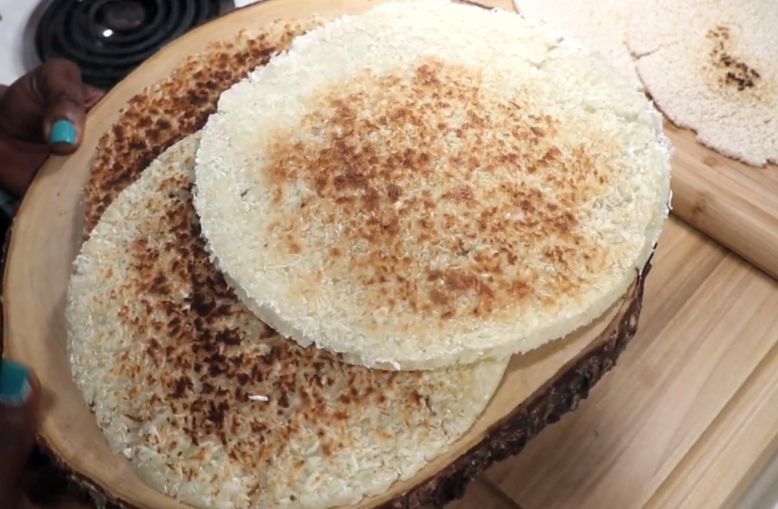
This bread is soft yet sturdy, making it perfect for filling with meats, vegetables, or sauces.
Popular in South America, Africa, and the Caribbean, these flatbreads are convenient, portable, and easy to prepare.
Their versatility allows them to be served warm, toasted, or used as a base for creative culinary dishes, highlighting cassava’s ability to adapt to diverse cooking styles.
Cassava Bread Nutrition Facts
Nutrition varies a great deal by preparation method, since drying concentrates calories and carbohydrates while frying or adding coconut milk raises the fat content.
Figures below are per 100 grams and drawn from USDA FoodData Central where a direct entry exists; estimated figures are marked and should be treated as approximate.
| Cassava Bread Type | Calories | Carbs (g) | Fiber (g) | Protein (g) | Fat (g) | Data Source |
|---|---|---|---|---|---|---|
| Cassava root, raw | 160 | 38.1 | 1.8 | 1.4 | 0.3 | USDA FoodData Central |
| Cassava flour | 330 | 78.0 | 1.9 | 1.5 | 0.6 | USDA FoodData Central |
| Casabe (dried flatbread) | 299 | 74.3 | 3.5 | 2.7 | 0.5 | USDA FoodData Central (FNDDS) |
| Cassava flour bread (baked loaf) | 305 | 76.0 | 2.0 | 4.3 | 1.5 | Estimated from recipe formulation |
| Bammy (fried, coconut milk soak) | 350 | 68.0 | 2.5 | 3.0 | 8.0 | Estimated, no standardized entry |
| Pan de yuca / chipá (cheese bread) | 280 | 42.0 | 1.0 | 7.5 | 10.0 | Estimated from ingredient composition |
| Chikwangue (fermented, steamed) | 165 | 39.0 | 1.7 | 1.2 | 0.3 | Estimated, comparable to boiled cassava |
Casabe carries more than three times the fiber of raw cassava root per 100 grams, since drying concentrates the root’s existing fiber into a smaller mass.
Cheese-based breads like pan de yuca and chipá carry noticeably more protein and fat than plain cassava breads.
That difference comes entirely from the added cheese and eggs, not the cassava itself.
For a deeper breakdown of the root’s full vitamin and mineral profile, see the site’s cassava nutritional information and cassava flour nutrition facts pages.
Cassava Bread vs. Wheat Bread
| Nutrient (per 100g) | Cassava Flour Bread | White Wheat Bread |
|---|---|---|
| Calories | 305 | 265 |
| Carbohydrates (g) | 76 | 49 |
| Protein (g) | 4.3 | 9.0 |
| Fat (g) | 1.5 | 3.2 |
| Gluten | None | Present |
Cassava bread carries less protein than wheat bread, since cassava root itself is low in protein compared to wheat grain.
A full side-by-side comparison, including baking behavior and substitution ratios, is covered in the site’s cassava flour vs wheat flour guide.
Health Benefits and Considerations
Cassava bread’s biggest advantage is its complete absence of wheat, rye, or barley, making it safe for celiac disease and gluten sensitivity when prepared without cross-contamination.
The resistant starch in cassava root feeds beneficial gut bacteria, a mechanism reviewed in resistant starch and gut microbiome research.
It supports digestion the same way it does in cassava starch products generally.
Because most cassava breads carry little protein and fat, pairing a slice with eggs, beans, or meat helps moderate blood sugar and extend satiety.
Raw and undercooked cassava contains natural cyanogenic compounds that the body cannot safely process.
This is why every traditional preparation method, pressing, fermenting, or thorough cooking, exists specifically to neutralize them before the bread is safe to eat.
Storage Tips
For short-term use, store the bread in an airtight container at room temperature.
For longer storage, wrap each piece in plastic and then aluminum foil before freezing.
Thaw at room temperature or reheat in the oven to restore softness and flavor.
Meal Pairing
Cassava bread pairs well with stews, soups, salads, and spreads.
You can use it as a base for dips or wraps, adding creativity to your meals.
Try different combinations of flavors and textures to make each meal more satisfying and enjoyable.
Conclusion
Cassava bread spans a wide range, from Guyana’s dry, cracker-thin quinches to Paraguay’s soft, cheese-filled chipá.
Every version still starts from the same root, handled with different intentions.
Nutrition varies just as widely, since drying, frying, and added cheese each shift the calorie and fat profile in different directions.
Readers managing gluten intolerance or blood sugar issues should check the specific type before assuming one nutrition profile applies broadly.
For a full recipe library covering every type mentioned here, browse cassava recipes and start with whichever bread fits your kitchen.
Frequently Asked Questions
Is cassava bread healthier than wheat bread?
Cassava bread is gluten-free and lower in fat than wheat bread, but it carries less protein, so pairing it with protein-rich foods creates a more balanced overall meal.
How many calories are in cassava bread?
Calories range from about 160 per 100 grams for boiled cassava root to over 300 for dried casabe or cheese-based breads like chipá, depending heavily on preparation method.
Is cassava bread safe for celiac disease?
Yes, cassava contains no wheat, rye, or barley protein whatsoever, meeting FDA gluten-free labeling standards when processed correctly without any cross-contamination from wheat-handling facilities or shared kitchen equipment.
What is the difference between casabe, bammy, and chikwangue?
Casabe and bammy are pressed and baked or fried, while chikwangue ferments for up to two weeks before steaming, giving it a distinctly sour flavor and softer texture.
What is the difference between cassava bread and regular wheat bread?
Cassava bread is gluten-free and grain-free, lower in protein and fat, but rich in carbohydrates, making it suitable for gluten-sensitive or energy-focused diets.
Yes, cassava bread is naturally gluten-free, making it a safe option for individuals with celiac disease or gluten intolerance when prepared without wheat additives.
Can cassava bread be part of a balanced diet?
Yes, pairing cassava bread with protein and fiber-rich foods helps moderate blood sugar and ensures it contributes to a balanced, healthy meal plan.
References

Chimeremeze Emeh is a tropical crop farmer and chemical engineer from Ntigha, Isiala Ngwa North LGA, Abia State, Eastern Nigeria, specializing in cassava and palm oil, with over 30 years of hands-on experience growing, harvesting, and processing cassava. He grows TMS series, TME 419, and local traditional varieties on his own farms and operates a small-scale cassava flour and starch production business through Cassava Pathway, which he founded as a CAMA-registered agribusiness in 2024. He is also the founder of Palm Oil Pathway, where he applies the same tropical farming expertise. His farms are located in Ntigha, Abia State.