
Last updated on July 8th, 2026 at 10:13 pm
In my small-scale flour operation in Abia, Nigeria, I mill cassava root the same way industrial plants do, yet almost every blog article online quotes a wildly different glycemic index for the same flour, and the real research explains why.
Cassava flour has become a popular gluten-free substitute in kitchens across the US, UK, and Nigeria alike, yet most articles quoting its glycemic index rely on guesswork rather than published research.
I run a small-scale cassava flour and starch operation on my farm, with my chemical engineering background as a strong backing in milling and fermentation science.
This guide breaks down cassava flour’s actual nutrition profile, walks through peer-reviewed glycemic index research, and explains why fermentation changes the numbers more than most assume, especially when comparing raw flour to fermented traditional products.
Disclaimer: This article is for informational purposes only and does not constitute medical advice. The author is not a medical doctor or registered dietitian. Always consult a qualified healthcare provider before making dietary or medical decisions related to cassava consumption.
Health Benefits of Cassava Flour, Backed by Research
- Retains more fiber than refined starch. Because cassava flour uses the whole peeled root rather than only the extracted starch, published proximate studies measure its crude fiber near 3 to 4 grams per 100 grams, noticeably higher than tapioca starch’s negligible fiber content.
- Naturally gluten-free for baking. Cassava flour substitutes for wheat flour at roughly a 1:1 ratio in many recipes, making it a practical option for celiac and gluten-sensitive bakers.
- Contains resistant starch for gut support. Some of cassava flour’s starch resists digestion in the small intestine, functioning similarly to fiber and feeding gut bacteria once it reaches the colon.
- Naturally low in fat. Peer-reviewed proximate composition studies consistently measure cassava flour’s crude fat content below 1 gram per 100 grams across multiple tested varieties.
- Meets tested safety standards when properly processed. Published testing across cassava varieties found residual cyanide content as low as 4.85 mg/kg in well-processed flour, far below levels linked to acute toxicity. This still depends heavily on variety and processing method, so sourcing matters.
- Supports long-term food storage. Unlike fresh cassava root, which spoils within days, properly dried cassava flour stores for months without refrigeration, a genuine advantage for food security in regions without reliable cold storage.
- Offers a lower-glycemic path when fermented. Traditional fermentation before drying, as used to make lafun and pupuru, measurably lowers cassava flour’s glycemic index compared to plain, unfermented flour.
- Provides steady baking energy for active diets. At roughly 330 to 345 calories per 100 grams, mostly from carbohydrates, cassava flour works as a dense energy ingredient in bread, pancakes, and other baked staples.
Cassava Flour Nutritional Profile (Per 100 Grams)
These figures come from published proximate composition research on cassava flour rather than a single averaged estimate, since values genuinely shift by variety and processing method.
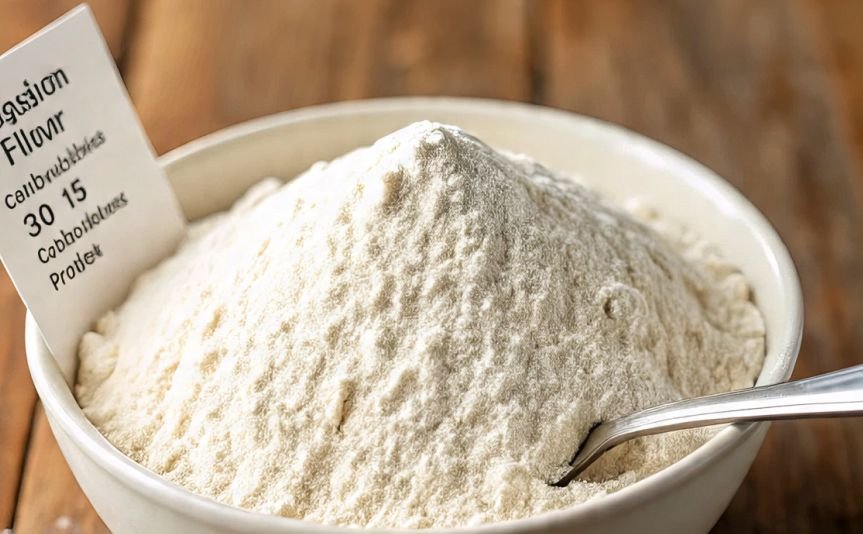
Here is what each figure means in practice:
- Calories: Cassava flour provides roughly 330 to 345 calories per 100 grams, more concentrated than raw root because drying removes most of the water weight.
- Carbohydrates: Published testing measures cassava flour’s carbohydrate content between 79 and 83 grams per 100 grams, almost entirely from starch rather than sugar.
- Protein: Cassava flour contains only about 1.1 to 1.7 grams of protein per 100 grams, meaning it needs pairing with beans, eggs, or meat for a balanced meal.
- Fat: Crude fat sits below 1 gram per 100 grams in nearly every tested variety, making cassava flour a naturally low-fat baking ingredient.
- Fiber: Crude fiber measures roughly 2.9 to 3.8 grams per 100 grams, higher than tapioca starch since the whole root’s fibrous structure carries through milling.
- Cyanide content (processed): Properly processed flour tested between 4.85 and 48.05 mg/kg of residual hydrogen cyanide, depending on variety, underscoring why processing method and sourcing genuinely matter.
Here is the same data side by side for quick reference:
| Nutrient | Amount per 100g |
|---|---|
| Calories | About 330 to 345 kcal |
| Carbohydrates | 79 to 83 grams |
| Protein | 1.1 to 1.7 grams |
| Fat | Below 1 gram |
| Fiber | 2.9 to 3.8 grams |
Drying and milling also reduce cassava flour’s vitamin C content well below that of fresh raw root.
Vitamin C breaks down with prolonged heat and oxygen exposure during processing.
Cassava Flour’s Glycemic Index: Why the Numbers Vary So Widely
Most articles quote a single glycemic index for cassava flour, but controlled human studies tell a more layered story.

A study in the Journal of Dietary Supplements fed healthy volunteers wheat bread blended with 10, 15, and 20 percent cassava flour.
Across all the tested blends, glycemic index values landed between 91 and 94.
That means plain, unfermented cassava flour baked into bread behaves like a genuinely high-GI ingredient, not the moderate one many blog posts describe.
Fermentation changes this picture in a way plain drying never does.
A study in the Journal of Food Measurement and Characterization measured the estimated glycemic index of Pupuru, a traditionally fermented cassava flour, at 65.27 in its unenriched control form.
That figure sits noticeably lower than the unfermented bread blends described above.
When researchers enriched the same fermented flour with moringa seed, glycemic index values dropped further, into the 35 to 49 range.
In practice, this means:
- Plain, unfermented cassava flour baked into bread tests in the high glycemic range, around 91 to 94
- Traditionally fermented cassava flour products, like lafun and pupuru, test meaningfully lower, closer to 65
- Adding fiber-rich ingredients during processing can push fermented cassava flour’s glycemic index down further still
Who Should Be Careful With Cassava Flour
- People managing diabetes should favor fermented cassava flour products over plain unfermented flour where possible, and always pair meals with protein or fiber. Our dedicated guide on cassava root for diabetics covers portioning in more depth.
- Anyone sourcing cassava flour should confirm it comes from a properly processed batch, since residual cyanide content varies meaningfully by variety and drying method. Our guide on how to remove cyanide from cassava root explains the science behind safe processing.
- Bakers substituting cassava flour for wheat should expect a denser, less elastic texture, since cassava flour contains no gluten protein to trap air during rising.
How Cassava Flour Differs From Root and Starch
Cassava flour sits between the whole root and refined starch in both nutrition and processing.
Our guide on cassava processing methods breaks down how milling, fermenting, and drying each change the final product.
For the raw root’s own nutrition profile and glycemic index research, see our health benefits of cassava guide, and for the fully refined starch form, see our health benefits of cassava starch guide.
If you want to see cassava flour used in practice, browse our cassava flour recipes collection, and for the four established methods of producing cassava flour at scale, see our guide on how cassava flour is made.
Frequently Asked Questions
What is the glycemic index of cassava flour?
Plain cassava flour baked into bread tested at a glycemic index of 91 to 94 in human volunteers, while fermented cassava flour products tested notably lower, near 65.
Does fermenting cassava flour actually lower its glycemic index?
Yes. A peer-reviewed study on Pupuru, a fermented cassava flour, measured a glycemic index around 65, compared to much higher values for unfermented flour blends used in bread.
How much protein and fiber does cassava flour contain?
Cassava flour typically contains just 1 to 2 grams of protein and around 3 grams of fiber per 100 grams, according to published proximate composition studies across varieties.
Is cassava flour a good gluten-free substitute for wheat flour?
Yes, cassava flour substitutes for wheat flour at roughly a 1:1 ratio in many recipes, though its high glycemic index still calls for careful portions in diabetic diets.
Conclusion
Cassava flour earns its place as a gluten-free kitchen staple, but its glycemic index runs higher than many articles admit in its plain, unfermented form.
Fermenting cassava before drying, as traditional lafun and pupuru methods do, measurably lowers glycemic impact compared to plain flour baked into bread.
Pair cassava flour with protein and fiber, favor fermented versions when managing blood sugar, and always source flour processed to reduce cyanide to safe levels.



Chimeremeze Emeh is a tropical crop farmer and chemical engineer from Ntigha, Isiala Ngwa North LGA, Abia State, Eastern Nigeria, specializing in cassava and palm oil, with over 30 years of hands-on experience growing, harvesting, and processing cassava. He grows TMS series, TME 419, and local traditional varieties on his own farms and operates a small-scale cassava flour and starch production business through Cassava Pathway, which he founded as a CAMA-registered agribusiness in 2024. He is also the founder of Palm Oil Pathway, where he applies the same tropical farming expertise. His farms are located in Ntigha, Abia State.