Last updated on July 22nd, 2026 at 07:31 pm
A weak cassava stem can cost you your whole harvest before you even touch the soil. After thirty years of farming cassava in Nigeria, I have learned that good stems matter more than fertilizer, spacing, or almost anything else.
Every cassava harvest starts long before planting, with the quality of the stem you cut.
While seasoned cassava farmers find it easy to source the stems, knowing how to source cassava stems is one of the numerous questions newbies ask.
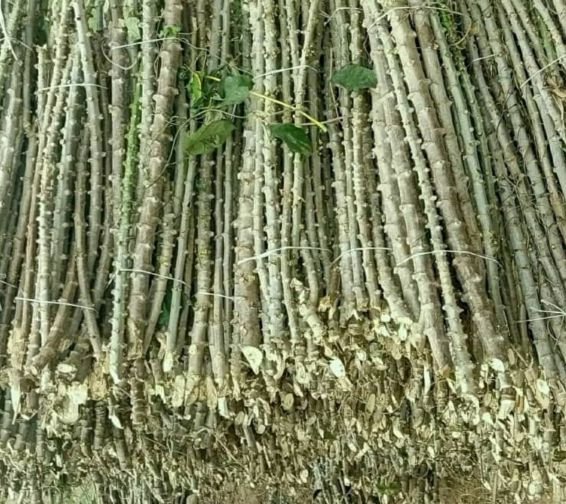
A vigorous stake needs a minimum diameter of 2 centimeters and at least 5 to 7 healthy nodes, according to research compiled by IITA’s seed programs.
Thin, immature, or diseased stems sprout poorly and set your season back before it begins.
In my farming community in Eastern Nigeria, we source stems by cutting mature cassava from the previous season’s own farm, before the roots come out.
This guide walks through where to find reliable stems, how to judge quality, and how to store them until planting.
Table of Contents
Why Stem Quality Decides Your Whole Season
Cassava stems, commonly called stakes, are the only planting material this crop uses, unlike seed-grown staples.
A field study across IITA sites in Nigeria found node count, diameter, and weight vary sharply along a stem, according to research published on CGSpace.
Diameter in that study ranged from 1.8 to 3.1 centimeters within 25-centimeter cuttings taken from the same plant.
This means two stakes cut from the same stem can perform very differently once planted.
I always set aside a few extra stems at cutting time, since some inevitably fail the diameter and node checks once I inspect them closely.
Factors to Weigh Before You Source Cassava Stems
A few decisions early on determine how well your planting materials perform once they hit the soil.
- Variety fit: choose high-yielding, disease-resistant, and early-maturing cassava varieties suited to your specific growing zone.
- Climate match: match your variety to your region’s rainfall and temperature, covered in our guide on ideal climate conditions for cassava farming.
- Local adaptability: stems already adapted to your soil and pests tend to establish faster than imported material.
- Market demand: table-consumption varieties differ from those grown for flour, starch, or animal feed.
- Timely availability: secure your stems well before planting season to avoid rushed, lower-quality choices.
How My Community Sources Cassava Stems
Sourcing cassava stems in my community in Eastern Nigeria means cutting mature stems from our farm, grown the prior season, in a generational cycle.
For each new planting, we use mature stems from the prior season’s crop, cut before the roots are finally harvested.
This is how it works: For example, if four mature stems are growing in a particular mound (of course, there are several cassava stems in a mound), we cut one or two and leave the rest.
We cut from as many mounds as will be enough for replanting on the new cassava farm.
This cycle occasionally breaks when a confirmed new variety proves itself and earns a place in our rotation.
Outside our own fields, we only bring in new stems to introduce a promising variety or strengthen resistance traits already in our stock.
Other Places to Source Reliable Cassava Stems
Beyond your own farm, several other sources can supply healthy planting material.
- Local farmers and community networks offer fast access to fresh stems, though you should still inspect firmness, color, and node count before accepting any.
- Agricultural research institutes maintain verified varieties bred for high yield and disease resistance, usually available directly to visiting farmers.
- Government extension services supply certified planting material that meets national agricultural standards for health and performance.
- Cooperatives and farmer groups allow group purchasing at better prices, along with shared knowledge from other growers.
- Online marketplaces and agritech platforms expand your options when local supply runs short, provided you check seller ratings first.
How to Identify a High-Quality Cassava Stem
A handful of physical checks separate a strong planting stake from a weak one.
- Look for a stem diameter of at least 2 centimeters, paired with 5 to 7 nodes. A study on gendered cassava seed systems found this combination gives the most reliable sprouting rate.
- Stems should feel firm rather than soft or spongy, since firmness signals healthy moisture content and rules out early rot.
- Nodes should sit roughly 10 to 15 centimeters apart, since each node can produce its own roots and shoots once planted.
- For length, the certification standard used by IITA’s GoSeed program calls for cuttings of 20 to 25 centimeters, which balances sprouting strength against wasted stem material.
- Cuttings taken from the lower third of the stem generally root and yield better than material from the tip, according to Wikifarmer’s propagation guide.
- Finally, examine every stem for lesions, discoloration, or pest damage, since planting infected material can spread disease across your entire field.
For a deeper breakdown of node structure, see our post on cassava stems.
Age of the Mother Plant
The age of the parent plant matters as much as the stake itself.
Mother plants should be at least 10 months old before you cut stems for the next season, based on Wikifarmer’s cassava propagation research.
Stems from younger plants typically lack the stored energy needed for vigorous early rooting.
A separate study on rapid propagation systems found that even younger mini-cuttings can perform well under controlled tunnel conditions.
These were harvested at 7 to 9 months with three buds, according to research published on PMC.
For ordinary field farming, though, waiting the full 10 months or more remains the safer standard.
Harvesting and Preparing Cassava Stems
Timing and handling both matter once you cut, starting with mother plants that are mature and disease-free, harvested right before or during root harvest itself.
Use clean, sharp tools to cut stakes into 20 to 25-centimeter lengths, since ragged cuts bruise the tissue and shorten stem life.
Our guide on how to cut cassava stems covers the correct angle and technique in detail.
After cutting, sort stems by size and quality, then keep them moist, shaded, and protected until you plant.
Cassava stem tissue stays metabolically active after cutting and is sensitive to dehydration, according to research published on PMC.
Rushed or careless handling at this stage can undo good sourcing decisions.
Common Challenges in Sourcing Quality Stems
A few recurring obstacles make sourcing quality planting material harder than it should be for most smallholder farmers.
- Limited variety availability means high-yielding or disease-resistant types are not always accessible locally, pushing farmers toward less suitable stock.
- Disease transmission risk means infected stems can carry cassava mosaic disease or brown streak disease into a clean field. Our guide on preventing cassava mosaic disease on farms covers warning signs to check for.
- Difficulty judging quality means new farmers regularly struggle to tell healthy stems from weak ones without training or guidance.
- Inconsistent stem quality means sorting and grading before planting helps even out uneven growth across a field.
Long-Term Stem Management Practices
A few habits keep your planting material reliable and healthy across seasons, protecting the work you put into sourcing it well.
- Store stems in a cool, dry spot, laid horizontally and covered with dry leaves or thatch. Our post on preserving cassava stems next farming season covers this process step by step.
- Check stored stems monthly for decay, mold, or pest activity, and remove damaged ones right away.
- Rotate varieties across seasons to protect soil health, which pairs well with sound cassava planting methods more broadly.
- Introduce a few new varieties most seasons to build genetic diversity into your stock each year.
Conclusion
Sourcing quality cassava stems decides your harvest before a single seed goes into the ground.
Look for stems with a minimum diameter of 2 centimeters, 5 to 7 nodes, and no signs of disease.
In my community, we rely on stems from our own previous season’s farm, adjusting only when a proven new variety earns the switch.
No matter if you source from your own field, a neighbor, or a certified nursery, inspect every stake before you cut it.
Start your next season by testing a small batch of stems for germination before committing your field.
Frequently Asked Questions
Where can you source reliable cassava stems for planting?
Source cassava stems from certified nurseries, agricultural research institutes, extension services, cooperatives, or your own farm’s healthy mother plants from the previous season.
How do you identify disease-free cassava stems before planting?
Check for firm texture, uniform color, a diameter of at least 2 centimeters, 5 to 7 healthy nodes, and no visible spots, rot, or pest damage.
Why is sourcing cassava stems locally recommended?
Locally sourced stems adapt faster to your soil and climate, resist local pests better, and root more reliably than stems brought in from distant regions.
When is the best time to source cassava stems?
Source cassava stems close to planting season, ideally from mother plants at least 10 months old, cut just before the roots are finally harvested.

Chimeremeze Emeh is a tropical crop farmer and chemical engineer from Ntigha, Isiala Ngwa North LGA, Abia State, Eastern Nigeria, specializing in cassava and palm oil, with over 30 years of hands-on experience growing, harvesting, and processing cassava. He grows TMS series, TME 419, and local traditional varieties on his own farms and operates a small-scale cassava flour and starch production business through Cassava Pathway, which he founded as a CAMA-registered agribusiness in 2024. He is also the founder of Palm Oil Pathway, where he applies the same tropical farming expertise. His farms are located in Ntigha, Abia State.