Last updated on June 21st, 2026 at 08:19 pm
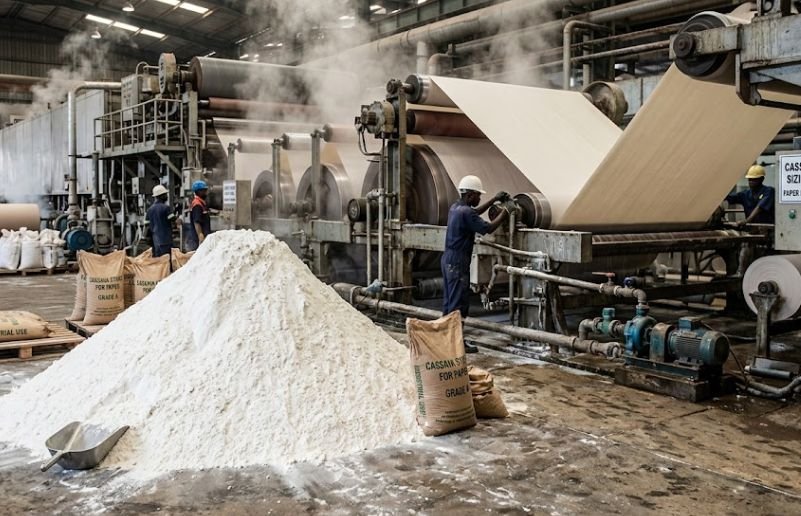
Paper mills worldwide are turning to cassava starch to boost sheet strength, cut costs, and meet rising demand for bio-based additives. This tropical root crop is quietly reshaping how manufacturers approach paper chemistry from wet-end processing to final coating.
Starch has been a workhorse in paper manufacturing for centuries, binding fibers, sealing surfaces, and imparting the properties printers and packagers demand in finished sheets.
As mills look beyond traditional corn and potato starch, cassava starch has emerged as a compelling option.
Derived from the cassava root (Manihot esculenta), it offers high purity, low protein content, and consistent viscosity profiles that suit both wet-end and surface applications.
This article covers every dimension of cassava starch use in paper production, from application methods and performance benefits to sustainability credentials and market outlook.
Table of Contents
Why Starch Is Important in Paper Manufacturing
Starch performs several roles that synthetic chemicals either cannot replicate or can only match at significantly higher cost.
Understanding those roles explains why mills consume millions of tonnes of starch annually.
Functions of starch in paper production:
- Strength enhancement: Starch molecules bond to cellulose fibers and to one another, forming a network that resists tearing, bursting, and delamination. Without starch, many paper grades would fail basic mechanical tests.
- Surface quality improvement: When applied at the size press or coater, starch fills micro-pores in the sheet, creating a smoother, more uniform surface that behaves predictably under printing conditions.
- Printability and ink absorption: A properly sized surface controls the rate at which ink penetrates the sheet. Too fast and dot gain blurs images; too slow and ink sets poorly. Starch lets paper makers dial in the right balance.
- Cost efficiency benefits: Starch is far less expensive per tonne than most synthetic retention aids and surface sizing agents. Even modest additions of starch can reduce the loading of costlier specialty chemicals, lowering overall additive spend without sacrificing sheet performance.
How Cassava Starch Is Used in the Paper Industry
Cassava starch enters the papermaking process at several distinct stages, each demanding different viscosity profiles and degrees of modification.
Wet-End Applications
The wet end is where a dilute fiber suspension is formed into a sheet on a moving wire. Adding cassava starch at this stage delivers three key benefits:
- Fiber bonding: Cassava starch adsorbs onto cellulose surfaces and bridges adjacent fibers, increasing the contact area between them. The result is a denser fiber network with measurably higher dry strength.
- Retention improvement: Fine fibers, fillers, and pigments that would otherwise drain through the wire are captured in the sheet when cationic cassava starch attracts them electrostatically. Better retention reduces raw material loss and eases effluent treatment.
- Strength development: The combination of improved bonding and higher fines retention produces a sheet with greater tensile and burst strength, allowing mills to reduce basis weight without weakening the final product.
Surface Sizing
Surface sizing applies a starch solution to the formed sheet, typically at a size press positioned after the initial drying section.
- Improving surface strength: The starch film locks loose surface fibers in place, reducing the tendency of the sheet to pick or tear under the mechanical stress of printing.
- Reducing dusting and picking: Paper dust contaminates printing equipment and causes costly downtime. A well-formed cassava starch film binds surface fibers firmly enough to suppress both dusting during sheeting and picking during offset printing.
- Enhancing printing performance: Surface-sized sheets accept ink more evenly, produce sharper dot structures, and show less mottle in large solid areas. Cassava starch, with its neutral flavor and low protein content, causes less yellowing than some alternatives, keeping brightness values high.
Coating Applications
In coated paper grades, cassava starch functions as a binder within the coating color, which is a mixture of pigments, binders, and additives applied to the base sheet.
- Binder functions: Starch holds pigment particles together and anchors the coating layer to the base sheet. It must provide adequate binding strength without making the coating brittle.
- Pigment adhesion: The adhesive properties of gelatinized cassava starch keep clay, calcium carbonate, and other pigments bonded together even under the flexing stress of web converting.
- Surface smoothness: Cassava starch contributes to a level, closed coating surface that yields high gloss and superior ink holdout in high-quality printing applications.
Adhesive Formulations for Paper Products
Beyond the paper sheet itself, cassava starch is formulated into adhesives used throughout paper-based converting operations.
- Corrugated board manufacturing: Cassava starch adhesive bonds the fluted medium to the liner boards in corrugated box production. Its fast tack and strong wet-bond strength make it well suited to high-speed corrugators.
- Paper tube production: Spiral-wound and parallel-wound tubes rely on starch adhesive to laminate multiple plies of kraft paper. The high solids content achievable with cassava starch pastes reduces drying energy and increases line speed.
- Paper bag manufacturing: Multi-wall paper bags for cement, flour, and feed use starch adhesive at bottom seams and ply laminations. Cassava starch provides the open time and bond strength these demanding applications require.
Benefits of Cassava Starch in Paper Production
High Purity and Consistency
Cassava starch contains very low levels of protein and lipids compared to corn or wheat starch.
Fewer impurities mean less interference with sizing chemistry and more predictable viscosity development during cooking, which simplifies process control.
Excellent Film-Forming Properties
When gelatinized, cassava starch forms a continuous, flexible film that adheres well to cellulose surfaces.
This film resists cracking under the stress of calendering and converting, maintaining surface integrity through downstream operations.
Strong Fiber Bonding Capability
The long amylopectin chains characteristic of cassava starch create extensive contact points with cellulose fibrils.
This molecular architecture translates into measurable dry strength gains, often allowing mills to reduce fiber furnish costs or lighten basis weight while holding strength targets.
Improved Paper Strength Characteristics
Cassava starch additions at both the wet end and size press contribute to tensile index, burst index, and internal bond strength improvements.
These gains are cumulative: wet-end starch builds the fiber network while surface starch reinforces the sheet surface.
Renewable and Biodegradable Source
Cassava is a tropical crop that grows in poor soils with minimal inputs.
The starch extracted from its roots is fully biodegradable, breaking down naturally in mill effluent systems without generating persistent chemical residues.
Competitive Production Costs
In cassava-growing regions, particularly Southeast Asia, South America, and sub-Saharan Africa, cassava starch is often less expensive per tonne than imported corn or potato starch.
Even in markets where it must be shipped longer distances, its consistent quality and high starch content relative to dry matter make it cost-competitive on a performance basis.
Cassava Starch vs Other Starches Used in Paper Manufacturing
Cassava Starch vs Corn Starch
Corn starch is the dominant industrial starch globally, benefiting from large-scale agricultural infrastructure in the United States, China, and Europe.
However, cassava starch offers several technical differences that paper makers weigh carefully:
- Cassava starch granules gelatinize at a slightly lower temperature than corn starch, reducing cooking energy requirements.
- Cassava starch pastes are generally clearer and less prone to retrogradation (gelling on cooling), which reduces the risk of blocked pipes and nozzles on size presses.
- Corn starch typically contains more protein and lipid impurities, which can interfere with sizing chemistry.
- On a practical level, corn starch often has a cost advantage in North America and Europe, while cassava starch is more economical in Asian and African markets.
Cassava Starch vs Potato Starch
Potato starch produces very high-viscosity pastes with excellent film-forming properties, making it favored for specialty papers in some European markets. Compared to cassava starch:
- Potato starch granules are larger and gelatinize at lower temperatures, which suits certain low-shear cooking systems.
- Potato starch tends to be more expensive than cassava starch and is predominantly produced in Europe, limiting its availability in tropical-market paper mills.
- Cassava starch offers comparable film-forming quality at lower cost and with better year-round supply reliability in tropical regions.
Cassava Starch vs Wheat Starch
Wheat starch is a by-product of gluten extraction and is used mainly in European paper mills. Key comparisons with cassava starch include:
- Wheat starch has a bimodal granule size distribution, leading to variable viscosity profiles that require careful process management.
- Cassava starch delivers more consistent rheological behavior, simplifying process control at the size press and coater.
- Wheat starch supply is closely linked to the wheat processing industry, making it subject to grain price volatility. Cassava starch supply chains are more dedicated, providing greater pricing stability for paper manufacturers who rely on large, consistent volumes.
Key Paper Properties Improved by Cassava Starch
Tensile Strength
Tensile strength measures the force per unit width needed to break a strip of paper under tension.
Cassava starch at the wet end increases dry tensile strength by reinforcing inter-fiber bonds, with typical improvements of 10 to 25 percent depending on starch addition level and furnish type.
Burst Strength
Burst strength reflects resistance to puncture under uniform hydraulic pressure.
It is particularly important in packaging paper and corrugated board liner.
Wet-end cassava starch additions consistently improve burst index, supporting the higher stacking loads demanded in modern warehousing.
Internal Bond Strength
Also called Z-direction tensile or Scott bond strength, internal bond measures resistance to delamination.
Surface-applied cassava starch penetrates the outer plies of the sheet and increases the cohesion of surface fibers, reducing delamination during calendering and printing.
Surface Strength
Wax-pick and IGT pick tests quantify the force needed to tear the paper surface during printing.
Cassava starch films formed at the size press raise surface pick resistance markedly, reducing the printing defects that cost converters time and materials.
Printability
Printability encompasses ink holdout, dot sharpness, and color consistency.
Cassava starch, by controlling ink absorption rate and smoothing the surface topography, improves all three.
This is particularly apparent in offset and flexographic printing on packaging grades.
Smoothness and Appearance
Cassava starch coating binder contributes to Parker Print Surf smoothness values that satisfy the requirements of high-resolution printing.
The brightness stability of cassava starch (low protein browning) also helps maintain sheet whiteness, an important selling point for printing and writing papers.
Types of Paper That Benefit from Cassava Starch
Printing and Writing Paper
Copy paper, offset paper, and coated printing grades all rely on starch for surface sizing and coating.
Cassava starch contributes to the smooth, bright surfaces that digital and offset printers require for clean, consistent results.
Packaging Paper
Kraft-based packaging grades for wrapping, bags, and multiwall sacks use cassava starch at the wet end and size press to meet the tensile and burst strength specifications required by food, construction, and industrial customers.
Corrugated Board
Both the liner and the fluted medium in corrugated boxes benefit from cassava starch.
Wet-end addition builds base strength while the cassava-based adhesive that bonds the layers provides the peel and shear resistance corrugated boxes need throughout a demanding supply chain.
Tissue Products
While tissue relies less on mechanical strength, controlled fiber bonding and softness are important.
Low-addition cassava starch at the wet end helps tissue makers balance sheet integrity against the softness consumers expect without over-bonding fibers.
Specialty Papers
Release papers, barrier papers, and technical papers for industrial applications may use cassava starch as a base for further chemical treatment.
Its high purity and predictable behavior make it a good platform starch for specialty coating formulations.
Modified Cassava Starch for Paper Applications
Native cassava starch performs well in many applications, but paper manufacturers frequently specify modified grades to achieve particular viscosity targets, charge characteristics, or processing behaviors.
Oxidized Cassava Starch
Oxidation with hypochlorite or hydrogen peroxide reduces molecular weight, producing lower-viscosity pastes that can be cooked to higher solids content.
Oxidized cassava starch is the standard choice for size press and coating applications where high-concentration runs are needed to minimize drying loads.
Cationic Cassava Starch
Introducing quaternary ammonium groups onto the starch molecule creates a positive charge that attracts negatively charged cellulose fibers, fines, and fillers.
Cationic cassava starch is the primary wet-end strength additive in many mills, combining retention improvement with dry strength development in a single product.
Enzyme-Modified Cassava Starch
Controlled enzymatic hydrolysis with alpha-amylase breaks starch chains to specific viscosity targets without the chemical side reactions associated with oxidation.
Enzyme-converted cassava starch is valued for its clean rheology and consistent behavior across a wide range of solids contents.
Pregelatinized Cassava Starch
Cold-water-soluble pregelatinized starch requires no cooking, making it suitable for mills with limited or no starch cooking infrastructure.
It is commonly used in corrugated adhesive formulations and in surface sizing applications where on-site cooking equipment is unavailable.
Factors Paper Manufacturers Consider When Selecting Cassava Starch
Choosing the right cassava starch grade is a multi-variable decision that balances process requirements against paper performance targets.
- Viscosity requirements: Each application has a viscosity window. Wet-end starches typically need to perform at low addition levels without building excessive drainage resistance. Size press starches must flow evenly through nip rolls at the target solids content.
- Solids content: Higher solids mean less water to evaporate and faster machine speeds. Oxidized or enzyme-modified grades allow higher solids without exceeding viscosity limits.
- Degree of modification: The extent of cationization, oxidation, or enzymatic conversion determines charge density, molecular weight, and paste stability. Mills specify modification level based on their furnish chemistry and additive system.
- Processing conditions: Cooking temperature, pressure, and shear in jet cookers or batch cookers influence how starch pastes behave. Some cassava starch grades are more sensitive to over-cooking than others.
- End-use paper specifications: A tissue mill and a coated paper mill have fundamentally different requirements. The starch supplier must understand the end product to recommend the correct grade.
Sustainability Advantages of Cassava Starch in the Paper Industry
The paper industry faces growing pressure from brand owners, retailers, and regulators to reduce its environmental footprint.
Cassava starch supports several sustainability objectives simultaneously.
- Renewable agricultural raw material: Cassava is a perennial crop that regenerates from cuttings. Unlike fossil-derived synthetic sizing agents, cassava starch is part of the biological carbon cycle.
- Reduced dependence on synthetic chemicals: Replacing synthetic dry-strength resins or surface sizing agents with starch reduces the mill’s reliance on petroleum-derived inputs and simplifies effluent chemistry.
- Biodegradability benefits: Cassava starch breaks down readily in aerobic and anaerobic effluent treatment systems. Mills that use starch as a primary sizing agent report lower biological oxygen demand loads from starch-specific synthetic chemicals.
- Supporting sustainable paper production goals: Many paper manufacturers publish sustainability reports with targets for bio-based additive content. Cassava starch, with a clear agricultural provenance and full biodegradability, contributes directly to those targets and supports third-party certification such as FSC or PEFC.
Challenges and Limitations of Cassava Starch in Paper Manufacturing
Despite its strong performance profile, cassava starch comes with supply chain and technical considerations that mills must manage carefully.
Supply Chain Considerations
Cassava is grown predominantly in tropical regions.
Mills outside those regions depend on international shipping, which introduces lead time, currency risk, and exposure to crop variability caused by drought, disease, or changing land use patterns.
Quality Consistency Requirements
Moisture content, purity, and viscosity can vary between harvest seasons and growing regions.
Paper manufacturers generally require certificates of analysis for each shipment and may perform incoming quality checks to verify that starch meets specification before accepting delivery.
Storage and Handling Factors
Cassava starch is hygroscopic and will absorb moisture from the atmosphere if stored improperly.
Clumped or partially hydrated starch causes erratic viscosity in the cooking system, disrupting process control.
Proper silo design, desiccation, and inventory rotation are necessary to maintain quality.
Competition from Alternative Starches
In markets where corn or wheat starch has deep infrastructure and established supply chains, switching to cassava starch may face resistance from procurement teams accustomed to existing supplier relationships.
The total-cost calculation must account for switching costs, not just raw material price per tonne.
Future Trends for Cassava Starch in the Paper Industry
Several converging forces point toward growing demand for cassava starch in paper manufacturing over the coming years.
Increasing Demand for Bio-based Additives
Regulatory trends in the European Union, North America, and Asia are pushing paper manufacturers toward bio-based chemistry.
Cassava starch, as a fully natural product, is well positioned to capture share from synthetic alternatives as regulations tighten.
Growth in Sustainable Packaging
The global shift away from single-use plastics is driving demand for paper-based packaging, particularly e-commerce corrugated boxes and flexible paper packaging for food.
Both sectors consume large quantities of cassava starch in adhesive and wet-end applications.
Advances in Starch Modification Technologies
Researchers are developing new enzymatic, physical, and chemical modification routes that expand what cassava starch can do.
Dual-modified grades combining cationization with cross-linking, for instance, may allow cassava starch to replace more expensive specialty additives in demanding packaging grades.
Emerging Opportunities in Specialty Paper Grades
Barrier papers, recyclable food-contact papers, and fiber-based flexible packaging all require functional coatings and sizing treatments.
Modified cassava starch is being evaluated as a binder and film-former in several of these next-generation paper concepts, where its clean label profile and biodegradability are as important as its technical performance.
Frequently Asked Questions
Why is cassava starch used in paper manufacturing?
Cassava starch is used for cost-effective fiber bonding, surface strength, and coating performance due to its purity, viscosity stability, and biodegradability.
Is cassava starch better than corn starch for paper production?
Neither is universally better; cassava suits local supply regions with stable pastes, while corn starch dominates where supply chains are well established.
What paper properties does cassava starch improve?
It improves tensile strength, burst strength, internal bonding, surface resistance, printability, and smoothness depending on application point and starch modification type.
Can cassava starch be used in paper coatings?
Yes, oxidized cassava starch works as a coating co-binder, improving pigment adhesion and surface smoothness while reducing latex usage and costs.
What types of paper products use cassava starch?
It is used in printing paper, packaging, corrugated board, tissue, specialty papers, and adhesives for tubes, bags, and multi-wall applications.
Is cassava starch environmentally friendly for paper manufacturing?
Yes, it is renewable, biodegradable, reduces reliance on petroleum additives, and supports sustainability goals across modern paper manufacturing and packaging industries.
Conclusion
Cassava starch has moved beyond its agricultural origins to become a key functional additive in paper manufacturing.
It enhances fiber bonding, surface strength, printability, and coating performance across grades from copy paper to corrugated packaging.
Its high purity, low protein content, and stable rheology allow it to compete with corn, potato, and wheat starch, often at lower cost in tropical regions.
Being renewable and fully biodegradable, it supports sustainability goals in the paper industry.
With growing demand for bio-based packaging and advancing modification technologies, cassava starch is set to play an even larger role in future paper production.

Chimeremeze Emeh is a tropical crop farmer and chemical engineer from Ntigha, Isiala Ngwa North LGA, Abia State, Eastern Nigeria, specializing in cassava and palm oil, with over 30 years of hands-on experience growing, harvesting, and processing cassava. He grows TMS series, TME 419, and local traditional varieties on his own farms and operates a small-scale cassava flour and starch production business through Cassava Pathway, which he founded as a CAMA-registered agribusiness in 2024. He is also the founder of Palm Oil Pathway, where he applies the same tropical farming expertise. His farms are located in Ntigha, Abia State.