Last updated on August 1st, 2026 at 08:08 am
Both flours are gluten-free, but almost nothing else about them matches. I have milled cassava for years, and coconut flour remains the one alternative that behaves nothing like it in a mixing bowl.
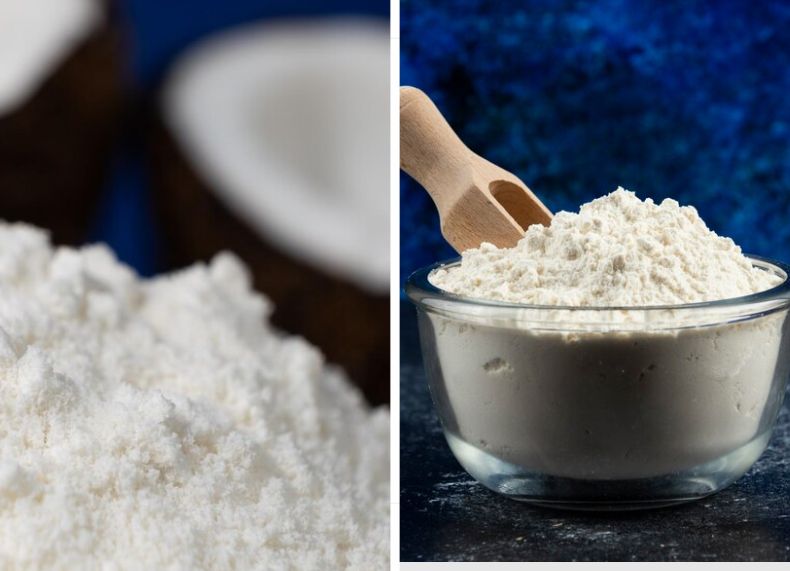
Cassava flour and coconut flour both show up in gluten-free baking, but they come from entirely different sources and behave nothing alike.
Cassava flour is milled from the whole root of the cassava plant, giving it a neutral taste and a texture close to wheat flour.
Coconut flour comes from dried, defatted coconut meat, carrying a mild coconut flavor and an extremely high fiber content that absorbs liquid aggressively.
Their nutrition profiles diverge sharply too, with cassava flour carbohydrate-heavy and coconut flour built around fiber, protein, and healthy fat.
This guide compares both using USDA nutrition data, so you can choose the right one for your recipe.
Disclaimer: This article is for informational purposes only and does not constitute medical advice. The author is not a medical doctor or registered dietitian. Always consult a qualified healthcare provider before making dietary or medical decisions related to cassava or coconut consumption.
Table of Contents
Understanding Cassava Flour
Cassava flour is made by peeling, drying, and grinding the whole root into a fine powder, blending easily into both sweet and savory dishes.
It supports baking, thickening, and tortillas well, though its carbohydrate content makes it a poor fit for low-carb diets.
Our complete cassava flour guide covers its production, types, and full nutrition profile in more depth.
If you are weighing other alternatives, our comparisons of cassava flour vs tapioca flour and cassava flour vs almond flour cover two more popular options.
What Is Coconut Flour
Coconut flour comes from dried coconut meat left over after coconut milk extraction, ground into a light, highly fibrous powder.
It carries a mild coconut flavor that can influence a dish’s taste, and it typically needs eggs or another binder to hold structure in baking.
Its low net carb count makes it a genuine favorite in keto and low-carb kitchens specifically.
Nutrition Side by Side
Cassava flour and coconut flour differ sharply across nearly every nutrient category.
| Nutrient (per 100g) | Cassava Flour | Coconut Flour |
|---|---|---|
| Calories | 360 kcal | 443 kcal |
| Carbohydrates | 87g | 59g |
| Fiber | 3g | 38g |
| Protein | 1 to 2g | 18g |
| Fat | 0.5g | 15g |
These figures come from USDA-sourced nutrition data for cassava flour and the USDA FoodData Central entry for coconut flour.
Coconut flour carries roughly ten times the fiber and protein of cassava flour, along with a meaningfully lower carbohydrate count per serving.
Cassava flour holds the advantage in raw carbohydrate energy, which matters for anyone needing a calorie-dense staple food rather than a nutrient-dense specialty flour.
Baking Performance
Cassava flour mimics wheat flour closely, holding structure well as a near 1:1 substitute in many simple recipes.
Our post on cassava flour vs wheat flour covers this comparison fully.
Coconut flour behaves nothing like wheat flour, since its extreme fiber content demands considerably more liquid and typically an added egg or two per cup used.
Cassava flour suits breads, tortillas, and thickening applications, while coconut flour performs best in dense, moist bakes like muffins and pancakes.
Getting coconut flour ratios wrong produces dry, crumbly results, which is the single most common mistake home bakers make when switching to it.
Which Flour Fits Your Diet
Choose coconut flour if low-carb or keto compatibility is your priority, since its fiber-heavy profile fits that goal well.
Ketogenic diets restrict carb intake to 20 to 50 grams daily; per clinical research on ketogenic diet implementation, a target easier to hit with coconut flour.
Most adults fall well short of recommended daily fiber intake, with average consumption near 16 grams against a target of 25 to 38 grams.
This comes from USDA dietary intake data, making coconut flour a meaningful way to close that gap.
Choose cassava flour if you want a neutral, wheat-like texture with easier digestion, since coconut flour’s fiber content can cause bloating for some in large amounts.
For another protein-forward option, our comparison of cassava flour vs chickpea flour is worth a look.
Both flours are naturally gluten-free and paleo-friendly, making either a reasonable base for grain-free baking depending on your specific goal.
Our post on whether cassava flour is healthy covers broader dietary tradeoffs, and our guide on cassava flour and cyanide safety addresses a separate common concern.
Conclusion
Cassava flour and coconut flour solve different problems, and your recipe should decide which one you reach for.
Choose cassava flour when you want a neutral, wheat-like texture for tortillas, breads, or general baking without heavy liquid adjustments.
Choose coconut flour when fiber and lower carbs matter more than mimicking wheat, and you are prepared to add extra eggs or liquid.
On my own farm, cassava flour is what I know best, but coconut flour earns its place in recipes that specifically call for it.
Test a small batch before committing a full recipe to either flour.
Frequently Asked Questions
Is coconut flour healthier than cassava flour?
Coconut flour is lower in carbs and much higher in fiber and protein, making it more nutrient-dense, though cassava flour is easier to digest for many people.
Can I substitute coconut flour for cassava flour 1:1?
No, coconut flour is extremely absorbent, so recipes typically need noticeably more liquid or eggs compared to using cassava flour at the same volume.
Which flour is better for a keto diet?
Coconut flour fits keto and low-carb diets better due to its lower carbohydrate content, while cassava flour is too carb-heavy for strict carb limits.
Does coconut flour cause digestive issues?
Cassava flour tends to be gentler on digestion, since coconut flour’s very high fiber content can cause bloating or discomfort for some people.

Chimeremeze Emeh is a tropical crop farmer and chemical engineer from Ntigha, Isiala Ngwa North LGA, Abia State, Eastern Nigeria, specializing in cassava and palm oil, with over 30 years of hands-on experience growing, harvesting, and processing cassava. He grows TMS series, TME 419, and local traditional varieties on his own farms and operates a small-scale cassava flour and starch production business through Cassava Pathway, which he founded as a CAMA-registered agribusiness in 2024. He is also the founder of Palm Oil Pathway, where he applies the same tropical farming expertise. His farms are located in Ntigha, Abia State.