
Last updated on October 28th, 2026 at 06:43 pm
The cassava chips price per ton moved from $185 to $260 between early 2025 and mid-2026, according to Thai export data. Knowing what drives that number, and why Nigerian chips cost more in China, matters before anyone dries a root.
People in southeastern Nigeria call me regularly to ask if I buy dried cassava chips for animal feed.
I do not buy or trade chips myself, so this guide relies on published export data rather than rumors from middlemen.
It shows the official monthly export prices from Thailand, the world’s leading chip exporter, from January 2023 through to September 2026.
It compares Southeast Asian and Nigerian chip costs once delivered to Chinese ports and lists the quality specifications buyers enforce.
It also explains what moves prices from month to month, and where farmers and processors can track the numbers themselves.
Table of Contents
Which Cassava Chips These Prices Cover
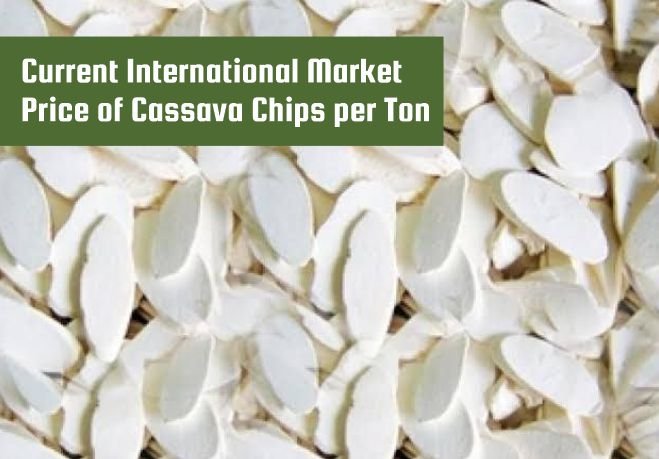
These prices refer to dried cassava chips, the sliced and sun-dried roots sold in bulk for ethanol, animal feed, and industrial fermentation.
They do not refer to fried snack chips, which are a consumer food covered in our recipe for crispy fried cassava chips.
Production steps, pellet manufacturing, and uses are explained in our guide to cassava chips and pellets, so this article sticks to prices.
Most quotes are free on board, or FOB, meaning the price covers loading at the export port but not ocean freight.
Cost, insurance, and freight quotes, called CIF, include shipping to the buyer’s port and therefore run higher.
Cassava Chips Price per Ton Today
The Thai Tapioca Trade Association recorded a chip export price of $260 per ton every month from April to September 2026.
A weekly market summary from TQ Industry relayed a TTTA export quote of $255 to $265 per ton FOB on 20 October 2026.
Prices can change weekly, so treat these figures as a benchmark rather than a contract price.
| Year | January | June | September | December |
|---|---|---|---|---|
| 2023 | $269 | $263 | $280 | $269 |
| 2024 | $253 | $236 | $245 | $190 |
| 2025 | $185 | $220 | $215 | $215 |
| 2026 | $218 | $260 | $260 | Not yet published |
Figures are Thai export prices in US dollars per ton, as published by the Thai Tapioca Trade Association.
How Prices Moved From 2023 to 2026
Thai chip prices held between $263 and $283 per ton throughout 2023, before sliding steadily through 2024.
By December 2024 the price had fallen to $190, and it stayed at $185 from January to April 2025.
Thai chip exports slumped 55 percent to 2.0 million tonnes in 2024, and chip prices averaged $232 per tonne that year, Krungsri Research reported.
Prices recovered from mid-2025, climbing to $253 by March 2026 and holding at $260 from April onward.
Southeast Asia Versus Nigeria
Southeast Asian chips reach China far more cheaply than Nigerian chips, mainly because of freight costs and scale.
FOB chip prices averaged about $222 per tonne from Southeast Asia and around $250 from Nigeria, the Nigeria Cassava Investment Accelerator reported in April 2026. Freight to China costs roughly $12 per tonne from Southeast Asia, compared with about $75 from Nigeria.
Together, those gaps leave Nigerian exporters about $91 per tonne more expensive on a delivered basis.
Scale is the other barrier, since Chinese buyers typically need 700 to 1,400 tonnes daily, while many Nigerian processors manage 15 to 30.
What Buyers Pay For: Quality Specifications
Chinese buyers judge chips against strict technical thresholds before agreeing on a price, according to the same accelerator report.
- Starch content: at least 67 percent, because starch is what ethanol plants convert into alcohol.
- Moisture: below 14 percent, since wetter chips grow mold and lose weight during shipping.
- Fiber: below 5 percent, so woody root ends and peel fragments must be kept low.
- Sand and silica: below 3 percent, which means drying chips off bare soil.
Drying surfaces and moisture control are covered in our guide to cassava drying techniques.
What Moves Chip Prices
China dominates demand, taking 99.9 percent of Thailand’s chip exports, Krungsri notes, so Chinese conditions drive world prices.
- Chinese corn prices: higher corn prices push Chinese feed and ethanol makers toward cassava chips, lifting demand.
- Ethanol policy: chips feed alcohol and ethanol plants, so fuel blending rules affect how much buyers need.
- Thai and Vietnamese harvests: weather events such as El Niño can cut supply and push prices up.
- Exchange rates: a weaker baht or dong makes Asian chips cheaper in dollars and pressures other exporters.
Feed demand is part of this picture, as our guide to cassava in animal feed explains with inclusion rates for each animal.
From Root Price to Chip Price
In Thailand, TQ Industry relayed an August 2026 farm-gate root price of 3.04 baht per kilogram from official data.
The same summary listed a farm-gate chip price of 5.66 baht per kilogram for that week.
Exporter buying prices for chips stood at 7.40 to 7.60 baht per kilogram in October 2026. In my community, glut seasons have pushed fresh roots below ₦1,000 per bag, as I described in our report on the cassava glut.
That gap between cheap roots and export prices is why so many people call me hoping to sell chips.
Where to Track Prices Yourself
The Thai Tapioca Trade Association publishes monthly chip export prices, which is the most reliable public benchmark.
Nigerian exporters can follow the Nigeria Cassava Investment Accelerator at Lagos Business School for local market analysis.
Always confirm if a quote is FOB or CIF, which port it refers to, and which quality specifications apply.
The wider demand picture beyond chips is covered on our cassava market overview page.
Paperwork for shipping chips abroad appears in our guide on how to export cassava.
Conclusion
The cassava chips price per ton stood near $260 FOB in Thailand through most of 2026, up from $185 in early 2025.
Chinese demand, driven by corn prices and ethanol, sets the pace for world chip prices.
Nigerian chips start about $91 per tonne behind Southeast Asian supply once freight is included, and volume requirements are huge.
Buyers also enforce strict starch, moisture, fiber, and sand limits on every shipment.
Before drying chips for export, check current TTTA prices and secure a buyer, then contact Cassava Pathway for practical advice.
Frequently Asked Questions
What is the current cassava chips price per ton?
The Thai Tapioca Trade Association recorded $260 per ton from April to September 2026. A weekly market summary reported $255 to $265 per ton FOB in October 2026.
Why are Nigerian chips more expensive in China?
Nigerian chips cost $250 FOB versus $222 from Asia, and freight adds $75 instead of $12. That leaves Nigerian chips roughly $91 per tonne more expensive once delivered.
What quality do chip buyers require?
Buyers want at least 67 percent starch, under 14 percent moisture, and limited fiber and sand. Chips that fail these limits are much harder to sell to buyers.
What is the difference between FOB and CIF prices?
FOB covers chips loaded at the export port, while CIF also adds insurance and ocean freight. CIF prices therefore run higher than FOB prices for the same chips.

Chimeremeze Emeh is a tropical crop farmer and chemical engineer from Ntigha, Isiala Ngwa North LGA, Abia State, Eastern Nigeria, specializing in cassava and palm oil, with over 30 years of hands-on experience growing, harvesting, and processing cassava. He grows TMS series, TME 419, and local traditional varieties on his own farms and operates a small-scale cassava flour and starch production business through Cassava Pathway, which he founded as a CAMA-registered agribusiness in 2024. He is also the founder of Palm Oil Pathway, where he applies the same tropical farming expertise. His farms are located in Ntigha, Abia State.