Last updated on August 6th, 2026 at 09:32 am
Guides on cassava drying disagree with themselves nearly as much as with each other, one section recommending slices 1 to 2 centimeters thick, another calling for just 8 to 12 millimeters, a real gap wide enough to change drying time.
Getting the basics consistent matters more than most guides genuinely admit, since slice thickness and moisture targets directly determine if your dried cassava stores safely or spoils early.
This guide covers drying methods, from traditional sun drying to solar and mechanical systems, along with the preparation steps that genuinely set up good results.
You will find a single, consistent moisture target backed by real sources, not two different numbers floating around in the same document.
Readers wanting the fuller post-harvest picture, including harvesting and storage before drying begins, should read our own guide on post-harvest handling of cassava instead.
Table of Contents
Why Proper Drying Matters
Moisture left in cassava invites bacteria, fungi, and mold, directly shortening shelf life across storage, transport, and processing stages.
Properly dried cassava takes less storage space and resists deterioration without refrigeration, a real advantage for processors and traders alike.
Well-dried cassava also commands better market value, since color, texture, and safety all improve with consistent moisture removal.
Readers wanting the safety science behind this should read our guide on removing cyanide from cassava root.
Preparation Before Drying
Select healthy, firm, pest-free roots, since poor selection undermines every step that follows regardless of drying method chosen.
Wash thoroughly to remove soil and contaminants, then peel to remove the outer layer where cyanogenic compounds concentrate most heavily.
Cut into uniform slices around 1 to 2 centimeters thick, since consistent sizing is what actually prevents the uneven drying and mold risk that inconsistent slicing causes.
Readers wanting the broader traditional process should read our guide on traditional methods of processing cassava.
Sun Drying
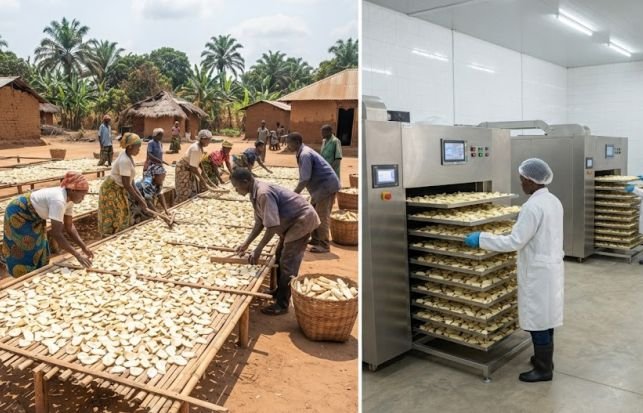
Sun drying remains the most accessible method, spreading slices in a single layer on clean mats under six to eight hours of daily sun exposure.
This method depends heavily on weather, and rain or high humidity can slow or spoil an entire batch.
Open sun drying took 35 hours to reach 13 percent moisture in one comparative study.
Hybrid solar drying reached a similar target in just 7 hours, according to research published in the Asian Food Science Journal.
Dust, insects, and animals also pose real contamination risks, making protective covering and regular monitoring genuinely necessary throughout the process.
Mechanical and Solar Drying
Mechanical dryers control temperature and airflow precisely, completing drying in hours rather than days while reducing weather dependency entirely.
A flash dryer specifically reduced moisture content from roughly 47 percent to under 10 percent in a single pass.
This comes from CGIAR pilot research cited in our guide on how to produce cassava flour.
Solar dryers split into direct, indirect, and hybrid designs, with indirect systems separating cassava from direct sunlight for better hygiene and more stable drying conditions.
Readers wanting the full equipment comparison should read our guides on the cassava flash dryer and cassava dryer machine.
The Real Moisture Target
Dried cassava should reach 12 to 15 percent moisture for safe storage.
This range is consistent with both drying guidance in the FAO Post-Harvest Compendium and cassava flour standards documented in ScienceDirect.
A recent peer-reviewed review of cassava drying methods confirms that pre-drying and drying technique choices directly affect final product quality and shelf stability, published in Foods.
Moisture meters remove the guesswork that visual inspection alone cannot reliably provide.
Common Mistakes to Avoid
- Overlapping slices. This reduces airflow, causing uneven drying and moisture retention that leads directly to mold growth.
- Dirty drying surfaces. Contaminated racks or mats affect both taste and safety regardless of how well slicing was done.
- Inconsistent conditions. Fluctuating temperature and humidity during drying increase spoilage risk even with otherwise careful preparation.
- Harvesting immature roots. Immature tubers carry higher moisture and lower starch, weakening drying performance from the very start.
Storage After Drying
Let dried cassava cool completely before packing, since warm storage traps moisture inside containers and triggers mold growth quickly.
Use airtight or vacuum-sealed packaging to block moisture and reduce air exposure during storage.
Store in a cool, dark, dry space, away from sunlight, which weakens nutrients and affects taste over the storage period.
Readers wanting the equipment behind large-scale drying and storage operations should read our processing equipment guide.
Conclusion
Cassava drying succeeds or fails on details many guides get inconsistent within their own pages: slice thickness and moisture target above all.
Cut slices to a consistent 1 to 2 centimeters, and dry to 12 to 15 percent moisture, a range backed by real sources rather than guesswork.
Sun drying works well with consistent weather and monitoring, while mechanical and solar systems trade upfront cost for speed.
Store cooled cassava in airtight containers away from light.
Frequently Asked Questions
What slice thickness works best for drying cassava?
Uniform slices around 1 to 2 centimeters thick genuinely dry more evenly than thicker or inconsistently cut pieces, meaningfully reducing mold risk and improving final product quality overall.
What is the correct moisture target for dried cassava?
Dried cassava should reach 12 to 15 percent moisture for genuinely safe storage, a range confirmed by both real FAO drying guidance and published cassava flour quality standards.
Is sun drying or mechanical drying better for cassava?
Sun drying costs less but depends entirely on weather, while mechanical drying costs more upfront yet completes considerably faster with genuinely more consistent, reliable, weather-independent results each time.
How long does cassava take to sun dry?
Sun drying typically requires 6 to 8 hours of daily direct sun exposure, though total drying time genuinely varies with humidity, slice thickness, and actual weather conditions overall.

Chimeremeze Emeh is a tropical crop farmer and chemical engineer from Ntigha, Isiala Ngwa North LGA, Abia State, Eastern Nigeria, specializing in cassava and palm oil, with over 30 years of hands-on experience growing, harvesting, and processing cassava. He grows TMS series, TME 419, and local traditional varieties on his own farms and operates a small-scale cassava flour and starch production business through Cassava Pathway, which he founded as a CAMA-registered agribusiness in 2024. He is also the founder of Palm Oil Pathway, where he applies the same tropical farming expertise. His farms are located in Ntigha, Abia State.