Last updated on September 22nd, 2026 at 03:39 pm
Millions of tonnes of cassava waste pile up annually across processing factories in Africa, Asia, and Latin America. What if that waste could rebuild depleted soils and replace costly chemical fertilizers entirely?
Cassava processing generates enormous volumes of waste at every production stage.
For decades, factory operators treated these residues as disposal problems, paying to manage materials that offered no return.
That thinking is changing.
Researchers and agro-industrialists across Thailand, Nigeria, Brazil, and beyond are demonstrating that cassava peels, bagasse, processing wastewater, sewage sludge, and anaerobic digestate all carry recoverable nutrients.
Converting these streams into organic fertilizer reduces environmental liability, cuts synthetic fertilizer dependency, and opens a secondary revenue line for processors willing to invest in the right infrastructure.
Table of Contents
The Five Cassava Waste Streams Used in Organic Fertilizer Production
Each of the waste enters the fertilizer production pathway differently and contributes a different nutrient and organic matter profile.
Processors working across multiple product lines will often generate several of these streams simultaneously, making integrated by-product management both practical and financially attractive.
Understanding the specific value of each stream helps factories design collection, treatment, and conversion systems that match their production reality.
Cassava Peels
The most researched cassava waste stream for composting, peels are composted with goat manure or cow dung to produce nutrient-rich organic fertilizer for crop production. More on casssava peels.
Cassava Bagasse
The fibrous pulp left after starch extraction carries around 30 to 35 percent carbohydrate content, making it a rich substrate for microbial fertilizer fermentation.
Processing Wastewater
Organic-rich liquid residue from root pressing and washing carries dissolved starch and fermentable compounds suitable for conversion into liquid organic fertilizer. Learn more about cassava wastewater here.
Sewage Sludge from Tapioca Factories
Factory sludge contains plant-available organic materials that, after grinding and fermentation, deliver nitrogen, phosphorus, potassium, calcium, and magnesium to soils.
Anaerobic Digestate
The solid and liquid byproduct of biogas production from cassava waste carries recoverable nutrients that function as effective organic manure for crop production.
How Cassava Peels Are Converted Into Organic Fertilizer
Cassava peels are generated in the largest volumes during root preparation.
They represent the most accessible entry point for fertilizer production.
Fresh cassava skins carry residual starch, moisture, and organic compounds.
They also contain cyanogenic glycosides requiring reduction before agricultural application.
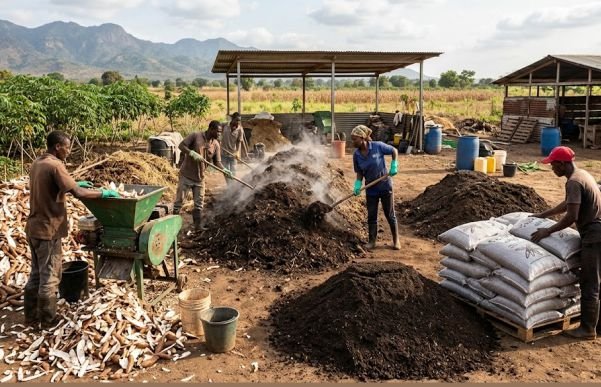
Composting is the most widely adopted conversion method. Peels are mixed with goat manure, cow dung, or poultry manure.
The mixture composts under aerobic conditions.
Research from Bogor City, Indonesia confirmed that the right peel-to-manure ratio meets national compost quality standards.
The Takakura composting method has also worked successfully at community scale.
The resulting compost improves soil organic matter, water retention, and microbial activity.
It delivers measurable benefits to cassava, rice, sugarcane, and maize crops.
Cassava Bagasse and Wastewater as Fertilizer Feedstocks
Cassava bagasse, the fibrous residue remaining after starch extraction, is produced in large quantities by starch factories and has historically been burned or dumped rather than recovered.
Its carbohydrate content makes it a biologically active substrate that responds well to microbial inoculation for composting or fermentation-based fertilizer production.
Processing wastewater follows a parallel pathway.
Cassava wastewater accounts for roughly 30 per cent of the weight of the raw cassava processed, containing dissolved organic matter, residual starch, and fermentable compounds.
Both streams have been studied for their potential to yield organic acids, enzymes, and fertilizer through microbial biotechnology.
Researchers have identified specific microbial strains capable of converting these organic compounds into bio-organic fertilizer through controlled fermentation.
In Vietnam, a research team identified three microbial strains with activity in carbohydrate metabolism, phosphate decomposition, and free nitrogen fixation.
Combining them into a microbial inoculum that successfully converts cassava waste into bio-organic fertilizer meeting regulatory specifications.
Turning Sewage Sludge Into a Plant Nutrient Source
Sewage sludge from tapioca factories is nutrient-dense but technically demanding to convert.
Tapioca production generates large process water volumes.
Once treated, it produces organic sludge requiring further processing.
Professor Warawut Chulalaksananukul of Chulalongkorn University developed a conversion process. Read the report here.
It combines cassava waste with factory sewage sludge.
The mixture is coated with a microbial inoculum. It then ferments for two months.
The resulting fertilizer delivers nitrogen, phosphorus, and potassium.
It also supplies calcium, magnesium, manganese, copper, iron, and zinc.
Trial applications confirmed effectiveness across cassava, rice, sugarcane, and maize.
The microbial strains used are safe for humans and the environment.
They satisfy regulatory and commercial certification requirements for agricultural products.
Anaerobic Digestate as Organic Manure
When cassava waste undergoes anaerobic digestion for biogas production, the remaining solid and liquid material is called digestate.
Research on digestate derived from cassava peels and palm oil sludge found that liquid digestate produced the strongest plant growth outcomes across all measured parameters.
This includes root length, shoot length, and leaf count, outperforming both solid digestate and chemical fertilizer treatments.
Processors already running anaerobic digestion systems can separate digestate into liquid and solid fractions using a screw press, then dry and apply it directly to agricultural land or package it for sale as an organic soil amendment.
Building a Circular Cassava Processing System
The strongest economic case rests on integrating multiple waste streams.
A starch factory that simultaneously generates peels, bagasse, wastewater, sludge, and digestate has strong fertiliser production potential.
Processors building integrated by-product recovery systems achieve measurable outcomes.
Disposal costs fall significantly. Regulatory compliance becomes easier to demonstrate to authorities.
Organic fertilizer sales generate new revenue streams. Soil amendment markets offset input costs elsewhere in the plant.
The factory’s environmental profile improves in ways buyers and certifiers value.
The cassava belt across sub-Saharan Africa, Southeast Asia, and Latin America faces acute soil degradation.
Synthetic fertilizer costs remain high across these regions.
Converting waste into organic fertilizer addresses both challenges. It creates value for farmers, processors, and the wider agricultural economy.
Conclusion
Cassava waste is not a problem waiting to be managed. It is a resource waiting to be converted.
Peels, bagasse, processing wastewater, factory sludge, and anaerobic digestate each carry organic matter and nutrients that microbial technology can transform into productive, safe, and commercially viable organic fertilizer.
Processors that build recovery systems around these streams reduce costs, open new markets, and contribute to more sustainable food production systems. The science is established.
The economic case is clear. What remains is the investment in infrastructure and the will to act.
Frequently Asked Questions
What cassava waste is best for making organic fertilizer?
Cassava peels are the most widely researched and accessible waste stream for composting and organic fertilizer production at community and industrial scales.
Is cassava-based organic fertilizer safe for all crops?
Yes, research confirms it performs well across cassava, rice, sugarcane, maize, and other crops when properly processed and microbially treated.
How long does it take to compost cassava peels into fertilizer?
Composting time varies by method and mixture, but studies indicate usable compost meeting quality standards is achievable within a defined minimum period.
Can small-scale processors produce organic fertilizer from cassava waste?
Yes, community-scale composting programs using cassava peels and manure have been demonstrated successfully in Indonesia, Nigeria, and other cassava-producing countries.
What nutrients does cassava waste fertilizer deliver to soil?
Cassava waste fertilizer supplies nitrogen, phosphorus, potassium, calcium, magnesium, and micronutrients including manganese, copper, iron, and zinc for plant growth.

Chimeremeze Emeh is a tropical crop farmer and chemical engineer from Ntigha, Isiala Ngwa North LGA, Abia State, Eastern Nigeria, specializing in cassava and palm oil, with over 30 years of hands-on experience growing, harvesting, and processing cassava. He grows TMS series, TME 419, and local traditional varieties on his own farms and operates a small-scale cassava flour and starch production business through Cassava Pathway, which he founded as a CAMA-registered agribusiness in 2024. He is also the founder of Palm Oil Pathway, where he applies the same tropical farming expertise. His farms are located in Ntigha, Abia State.