Cassava sweeteners are transforming food manufacturing, beverage production, and industrial processing across the globe. Learn how this tropical root crop delivers functional, allergen-friendly, and commercially viable sweetening solutions.
Cassava has long served as a dietary pillar in Africa, Asia, and Latin America, but its role in modern food systems now extends far beyond the kitchen.
The starch extracted from this hardy root crop has become the foundation of a growing family of commercial sweeteners.
From glucose syrups to dextrose powders, cassava-derived sweeteners now serve bakeries, beverage producers, pharmaceutical companies, and fermentation industries.
This guide covers what cassava sweeteners are, how they are made, how they perform across applications, and how to select the right type for any production need.
Table of Contents
What Are Cassava Sweeteners?
Cassava sweeteners are carbohydrate-based sweetening agents produced by processing the starch found in the cassava root.
Through enzymatic or acid hydrolysis, the long starch chains in cassava break down into shorter glucose and maltose units with varying levels of sweetness, viscosity, and fermentability.
The resulting products range from thick liquid syrups to dry crystalline powders.
These ingredients serve as functional substitutes for cane sugar, corn syrup, and other conventional sweetening agents in food, beverage, and industrial manufacturing environments.
How Cassava Starch Becomes a Sweetener
Cassava roots are harvested, washed, and grated to release a starch slurry. The slurry is filtered, dried, and then subjected to enzymatic liquefaction and saccharification.
Specific enzymes, including alpha-amylase and glucoamylase, convert the starch molecules into glucose, maltose, and higher sugar chains.
The resulting liquid is then filtered, decolorized, and concentrated into syrup form or further processed through crystallization to produce dry dextrose.
The precise enzyme combinations and processing conditions determine the final sugar profile and dextrose equivalent (DE) of the product.
Common Characteristics of Cassava Sweeteners
These sweeteners generally share a mild, neutral sweetness with low color contribution, good water solubility, and manageable viscosity.
Their properties vary significantly by dextrose equivalent: low-DE syrups are less sweet, more viscous, and better at retaining moisture, while high-DE syrups and dextrose powders are sweeter and more fermentable.
Most cassava sweeteners are stable under moderate heat and acidic conditions, making them practical for a wide range of cooking, baking, and industrial processing applications.
Types of Cassava Sweeteners
Cassava starch processing produces several distinct sweetener categories, each serving a specific purpose in food and industrial manufacturing.
The differences between products come down to their dextrose equivalent value, sugar composition, moisture content, and viscosity.
Knowing these distinctions helps manufacturers, formulators, and purchasing teams select the right ingredient for each application without unnecessary substitutions or reformulation costs.
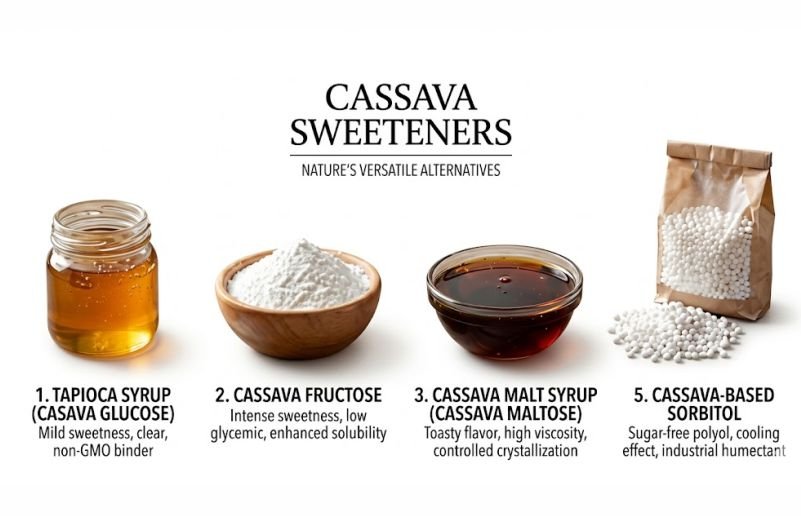
Cassava/Tapioca Syrup
Cassava or tapioca syrup is a thick liquid sweetener derived from partially hydrolyzed cassava starch, offering a mild taste and smooth texture for food use.
Tapioca syrup is typically lower than sucrose, with DE values ranging from 30 to 65 depending on processing conditions and intended application.
It is used in baked goods, confectionery, beverages, and sauces where a neutral-tasting liquid sweetener with good binding properties is required.
Learn more about tapioca syrup.
Cassava Glucose Syrup
Cassava glucose syrup primarily composed of glucose, maltose, and higher oligosaccharides derived from full saccharification of cassava starch with controlled enzyme activity.
It provides high fermentability, moderate sweetness, strong humectancy, and good resistance to crystallization in finished food products.
It is found in candy production, brewing, pharmaceutical syrups, fermentation substrates, and bakery systems requiring stable sweetening with technical performance.
High-Maltose Cassava Syrup
High-maltose cassava syrup contains a high proportion of maltose, offering lower sweetness intensity, greater thermal stability, and reduced browning compared to high-glucose alternatives.
Preferred in hard candy production, brewing, infant formula, and frozen desserts where maltose content delivers better clarity and stability than glucose-dominant syrups.
Cassava-Derived Dextrose
A purified, crystalline or anhydrous glucose powder produced by complete hydrolysis and purification of cassava starch through multi-stage refining.
Applied in confectionery, sports nutrition, pharmaceutical tablets, fermentation media, and food products where a clean-tasting, highly soluble dry sweetener is specified.
Specialty Cassava Sweetener Blends
Manufacturers blend cassava syrups with maltose fractions, fructose, or other sugars to match specific sweetness profiles and functional requirements.
New product lines include cassava-based low-glycemic sweeteners and reduced-calorie blends targeting health-conscious consumers in Asian and African markets.
How Cassava Sweeteners Compare to Other Sweeteners
Cassava Sweeteners vs Cane Sugar
Sweeteners made from cassava carry a lower perceived sweetness than sucrose from cane sugar and do not provide the same crystalline structure.
However, they resist crystallization during processing, manage moisture more effectively, and cost less in regions where cassava cultivation is abundant.
In many bakery and confectionery applications, cassava syrup replaces part of the sucrose to improve softness and shelf life without meaningfully affecting overall sweetness.
Cassava Sweeteners vs Corn Syrup
Corn syrup and cassava glucose syrup share very similar functional profiles because both come from starch hydrolysis.
The primary differences are feedstock origin, regional availability, and pricing.
Tapioca syrup is the preferred option in markets where corn cultivation is limited, or import costs are high, particularly across Sub-Saharan Africa and Southeast Asia.
In terms of performance, the two products are largely interchangeable in most food and industrial applications.
Cassava Sweeteners vs Honey
Honey delivers a complex, aromatic sweetness that cassava sweeteners cannot replicate.
Cassava syrups are neutral in flavor, while honey carries floral, herbal, and acidic notes depending on its botanical source.
However, cassava sweeteners offer consistent composition, stable pricing, and far greater production volume, making them more practical for industrial-scale manufacturing where honey’s cost and variable composition create formulation challenges.
Cassava Sweeteners vs Maple Syrup
Maple syrup carries a distinctive flavor profile, seasonal production constraints, and premium pricing that limits its use to specialty or premium product categories.
Cassava-based weeteners lack the characteristic taste of maple but provide a cost-effective, neutral alternative for large-scale food production.
Formulators sometimes blend cassava syrups with natural flavor compounds to approximate maple notes in mass-market bakery or breakfast products.
Cassava Sweeteners vs Artificial Sweeteners
Artificial sweeteners provide extreme sweetness with little or no caloric contribution, while cassava sweeteners are caloric, carbohydrate-based ingredients.
Cassava-based sweeteners win on functionality because they contribute to texture, browning, fermentation, and moisture retention, none of which artificial sweeteners can replicate.
In applications where bulk, texture, and technical performance matter as much as sweetness, cassava-derived ingredients consistently outperform zero-calorie synthetic alternatives.
Functional Benefits of Cassava Sweeteners
Cassava-based sweeteners are not selected solely for their ability to add sweetness.
They deliver a range of technical benefits that improve food texture, stability, color, and shelf life.
Manufacturers who understand these functional properties can use cassava sweeteners more strategically, reducing other ingredient costs while improving product quality across bakery, confectionery, beverage, and dairy categories.
Sweetening Properties
- Adjustable Sweetness: Dextrose equivalent values allow formulators to calibrate sweetness intensity precisely, providing mild to moderately sweet profiles depending on the chosen product.
- Neutral Flavor Profile: The absence of strong taste character makes cassava sweeteners ideal for applications where the sweetener should not compete with the primary flavor of the product.
Moisture Retention
- Humectancy in Baked Goods: Low-DE cassava syrups bind water effectively, keeping cakes, cookies, and breads soft for longer periods after baking without additional humectants.
- Anti-Staling Properties: The hygroscopic nature of cassava-derived glucose helps delay moisture loss in packaged products, extending the acceptable shelf life for retail distribution.
Texture Enhancement
- Body and Mouthfeel: Cassava syrups add viscosity and body to beverages, sauces, and confectionery products, creating a fuller and more satisfying sensory experience for consumers.
- Crystal Control in Confectionery: Glucose from cassava inhibits sucrose crystallization in candies and fondants, producing a smoother, creamier texture throughout the product’s shelf life.
Browning and Color Development
- Maillard Reaction Support: The free glucose content in cassava sweeteners participates actively in Maillard browning, helping baked goods develop appealing golden-brown crust color during baking.
- Caramelization Control: Formulators manage browning intensity by selecting cassava sweeteners with different DE levels, allowing precise color control across bakery and confectionery production.
Fermentation Support
- Ready Sugar Supply for Yeast: High-DE cassava glucose syrups provide immediately fermentable sugars that yeast can consume efficiently during bread proofing, brewing, and bioethanol production.
- Consistent Fermentation Performance: Standardized sugar profiles in cassava glucose syrup deliver predictable fermentation rates, reducing variability in alcohol production and leavened baked goods.
Shelf-Life Improvement
- Water Activity Management: By binding free moisture, cassava sweeteners lower water activity in finished products, reducing microbial growth potential and extending safe storage periods.
- Oxidation Delay: The moisture-retaining properties of cassava syrups help slow down staling and textural degradation caused by fat oxidation and moisture migration in packaged foods.
Applications of Cassava Sweeteners in Food Manufacturing
Cassava-based sweeteners are reliable, neutral-tasting, and versatile, serving as partial or complete replacements for cane sugar and corn syrup across dozens of product categories.
- Confectionery Products: Prevents crystallization in hard candy, toffee, and caramel, while humectancy keeps gummies soft and pliable throughout shelf life.
- Bakery Products: Binds moisture to extend softness in breads and cakes, while free glucose drives Maillard browning for visually appealing crust color.
- Beverages: Dissolves readily for soft drink production and maintains a neutral taste profile that doesn’t compete with fruit flavors in juice drinks and syrups.
- Dairy Products: Delivers clean sweetness to flavored milks and yogurt, while lowering the freezing point of ice cream mixes for improved scoopability and texture.
- Frozen Desserts: Lowers freezing point for smoother textures and improves air incorporation stability, helping ice creams and sorbets hold their texture longer after serving.
- Sauces and Condiments: Adds body, gloss, and mouthfeel to sauces and marinades, while reducing water activity to extend shelf life without additional preservatives.
Learn more about the applications of cassava sweeteners in the food industry.
Industrial Applications of Cassava Sweeteners
- Fermentation Industries: Beyond alcohol, cassava glucose serves as a fermentation substrate for producing organic acids, amino acids, and enzymes, and as a cost-effective carbon source for industrial biotechnology and biochemical manufacturing.
- Alcohol and Brewing: Provides readily fermentable sugars for beer, rice wine, and traditional beverages. Brewers use cassava syrups to supplement malt, adjust fermentable extract levels, and manage costs.
- Bioethanol Production: A leading bioethanol feedstock across Asia and Africa. Cassava’s high starch content makes it efficient for yeast fermentation into fuel-grade ethanol compared to many alternative crops.
- Pharmaceutical Manufacturing: Cassava dextrose is a key excipient in IV glucose solutions, tablet binding, coatings, and injectables. Pharmaceutical-grade production demands rigorous decolorization, demineralization, and controlled crystallization.
- Animal Feed Production: Cassava syrups and by-products like pulp are incorporated into livestock, poultry, and aquaculture feeds, offering an energy-dense carbohydrate supplement in cassava-surplus regions.
Learn more about the uses of cassava sweeteners in industries.
Nutritional Profile of Cassava Sweeteners
- What Consumers Should Know: Generally recognized as safe, gluten-free, and free from common allergens. Consumers with dietary needs should confirm processing facility practices directly with manufacturers.
- Carbohydrate Content: Almost entirely carbohydrates — glucose, maltose, and oligosaccharides. Syrups contain 75–85% soluble solids; dry dextrose is 99%+ glucose with negligible fat, protein, or fiber.
- Caloric Value: Contributes approximately 3.8–4 kcal per gram of dry solids. Not suitable as a low-calorie alternative to sucrose or high-fructose corn syrup.
- Glycemic Considerations: High glycemic index due to rapid glucose absorption. Those managing blood sugar, including diabetics, should treat it like other high-glycemic sweeteners.
- Vitamins and Minerals: Contains negligible micronutrients after processing. Refining removes nearly all naturally occurring vitamins and minerals from the original cassava starch.
Advantages of Cassava Sweeteners
Cassava-based sweeteners offer a set of properties that make them attractive alternatives or complements to conventional sweetening agents in both food and industrial contexts.
Their advantages span agricultural sourcing, ingredient functionality, allergen status, and supply chain considerations.
The following points summarize their most commercially relevant benefits.
Gluten-Free Origin
- Naturally Gluten-Free Crop: Cassava contains no gluten proteins, making it a safe raw material for producing sweeteners intended for celiac-friendly and gluten-intolerant consumer markets.
- Label Compatibility: Products sweetened with cassava-derived ingredients can carry gluten-free claims, provided processing facilities maintain adequate cross-contamination controls and third-party certification.
Allergen-Friendly Characteristics
- Free From Major Allergens: Cassava sweeteners are not derived from the eight major food allergens including peanuts, tree nuts, wheat, soy, milk, eggs, fish, and shellfish.
- Broad Application Potential: The allergen-friendly status of cassava sweeteners makes them suitable for products targeting consumers with multiple food sensitivities or those following elimination diets.
Versatile Industrial Uses
- Cross-Sector Application: Cassava sweeteners serve food, pharmaceutical, fuel, fermentation, and animal feed industries, making them one of the most widely applicable starch-derived ingredients available commercially.
- Adjustable Product Specifications: Processing parameters can be tuned to produce syrups and powders with varying DE levels, sweetness, viscosity, and fermentability to match diverse industrial specifications.
Renewable Agricultural Resource
- High Starch Yield Per Hectare: Cassava produces more starch per unit of land than most competing crops, making it an efficient agricultural raw material for sweetener manufacturing in tropical regions.
- Resilient Crop in Challenging Conditions: Cassava grows well in poor soils and drought-prone environments, offering supply chain stability in regions where other starch crops face significant climate-related yield variability.
Growing Global Availability
- Expanding Production Regions: Nigeria, Thailand, Indonesia, Brazil, and the Democratic Republic of Congo collectively produce hundreds of millions of tonnes of cassava annually, supporting large-scale commercial sweetener extraction.
- Increased Processing Infrastructure: Investment in cassava starch processing facilities across Africa and Southeast Asia has improved the availability and quality consistency of commercial cassava sweetener products globally.
- Nutritional Limitations: Provide only simple carbohydrate calories with no fiber, protein, vitamins, or minerals. High glycemic index makes them unsuitable for low-glycemic or diabetic-friendly formulations.
- Price and Availability: Food- and pharmaceutical-grade cassava sweeteners aren’t universally available. Regions lacking processing infrastructure face procurement challenges, higher costs, and quality inconsistencies versus corn- or cane-based alternatives.
- Competition from Established Sweeteners: Corn syrup and cane sugar dominate through entrenched supply chains and buyer familiarity. Reformulation costs and risk aversion create additional adoption barriers, even when cassava sweeteners perform comparably.
- Consumer Awareness Challenges: Many consumers and food professionals are unfamiliar with cassava as a sweetener. This limits marketing reach, especially where cassava is culturally unfamiliar, making transparent labeling and education essential.
The Global Market for Cassava Sweeteners
Major Producing Regions
Thailand, Indonesia, Vietnam, Nigeria, and Brazil are among the world’s leading producers of both raw cassava and processed starch.
Thailand is the dominant exporter of cassava starch globally and has established significant capacity for downstream sweetener processing.
Nigeria leads in raw cassava production by volume, with growing investment in value-added processing.
Key Export Markets
Cassava glucose syrups and dextrose products are exported primarily to food manufacturers in East Asia, the Middle East, and parts of Europe.
The beverage, confectionery, and pharmaceutical sectors in these markets represent the largest import volumes.
Regional trade agreements and the expansion of processed food manufacturing in Africa are also creating new domestic market opportunities within cassava-producing nations.
Industry Growth Drivers
Consumer demand for clean-label and allergen-free ingredients, growth in processed food consumption across emerging markets, and investment in biofuel production are the primary forces driving growth in the cassava sweetener sector.
The competitive pricing of cassava starch in regions where corn and cane are expensive imports further supports market expansion.
Future Market Outlook
Analysts project continued growth in the cassava sweetener market through the next decade, driven by expansion in food processing in Africa and Southeast Asia, increasing demand for plant-derived fermentation substrates, and rising interest in gluten-free ingredients globally.
Technological improvements in enzymatic processing are expected to improve yield efficiency and broaden the range of specialty cassava sweetener products available to industrial buyers.
How to Choose the Right Cassava Sweetener
For Food Manufacturing
Select cassava glucose syrup for confectionery and bakery applications where crystallization control, moisture retention, and Maillard browning are required.
Choose high-maltose cassava syrup where thermal stability and low sweetness intensity are priorities.
Use dextrose for applications demanding dry, highly soluble, clean-tasting sweetening with precise dosing capability.
For Beverage Production
Cassava glucose syrup with a DE of 40 to 65 works well in carbonated beverages, juice drinks, and syrups.
It dissolves readily, contributes mild sweetness, and blends well with flavor systems without adding off-notes.
For fermented beverages, select high-DE cassava glucose syrup to support yeast activity and consistent fermentation performance.
For Industrial Applications
Bioethanol, fermentation, and pharmaceutical applications typically require high-purity cassava glucose syrup or dextrose monohydrate meeting defined purity and microbial standards.
Confirm dextrose equivalent, dry solids content, color, conductivity, and microbial specifications with the supplier before committing to a production formulation.
For Home and Specialty Uses
Home bakers and specialty food producers can use cassava syrup as a substitute for corn syrup in candy making, cake glazes, and caramel recipes.
It performs similarly to light corn syrup in most applications and is suitable for those avoiding corn-derived ingredients.
Cassava syrup is available in specialty health food stores and through online retailers in markets where awareness of cassava ingredients is growing.
Conclusion
Cassava sweeteners represent a commercially relevant, functional, and broadly accessible category of ingredients that serve food, beverage, pharmaceutical, and industrial markets across the globe.
From confectionery and bakery to bioethanol and fermentation, cassava-derived syrups and dextrose deliver consistent performance across a wide range of processing conditions.
As global demand for allergen-friendly, gluten-free, and plant-derived ingredients continues to grow, cassava-based sweeteners are well positioned to expand their market footprint and serve both established and emerging production sectors.
Frequently Asked Questions
What sweeteners can be made from cassava?
Cassava produces glucose syrup, high-maltose syrup, dextrose, cassava syrup, and specialty blends through enzymatic hydrolysis of cassava starch.
Is cassava syrup the same as glucose syrup?
No. Cassava syrup is a partially hydrolyzed product with lower DE, while cassava glucose syrup has a higher glucose content and greater sweetness.
Are cassava sweeteners healthier than sugar?
Not significantly. Cassava sweeteners are caloric, high-glycemic carbohydrates similar in nutritional profile to sucrose and should be consumed in moderation.
What industries use cassava sweeteners?
Food manufacturing, beverage production, pharmaceuticals, bioethanol, animal feed, and industrial fermentation industries all use cassava-derived sweetening ingredients.
Can cassava sweeteners replace corn syrup?
Yes, in most applications. Cassava glucose syrup and corn syrup share similar functional properties and are widely interchangeable in food and industrial formulations.
Are cassava sweeteners gluten-free?
Yes. Cassava is naturally gluten-free, and cassava sweeteners produced in dedicated, uncontaminated facilities carry no gluten risk for sensitive consumers.
What is the difference between cassava syrup and cassava glucose syrup?
Cassava syrup is partially hydrolyzed with a lower DE and milder sweetness, while cassava glucose syrup has a higher DE and greater glucose concentration.
References

Chimeremeze Emeh is a tropical crop farmer and chemical engineer from Ntigha, Isiala Ngwa North LGA, Abia State, Eastern Nigeria, specializing in cassava and palm oil, with over 30 years of hands-on experience growing, harvesting, and processing cassava. He grows TMS series, TME 419, and local traditional varieties on his own farms and operates a small-scale cassava flour and starch production business through Cassava Pathway, which he founded as a CAMA-registered agribusiness in 2024. He is also the founder of Palm Oil Pathway, where he applies the same tropical farming expertise. His farms are located in Ntigha, Abia State.