Last updated on September 23rd, 2026 at 07:44 am
In Ntigha, spent cassava stems and dried peels usually end up in a rotting heap or a smoky fire. Cassava biochar turns that same residue into a soil conditioner that stores carbon, and the kiln can supply useful heat too.
This guide explains how to turn cassava residues into biochar, what the research says it does for soil, and where the real limits lie.
I approach it as a chemical engineer and a farmer who replants cassava every season and sees how much stem material goes unused.
Biochar is mainly a soil and carbon-storage product, although the pyrolysis process that makes it also yields usable heat and fuel gases.
Where claims about yields or carbon credits get ahead of the evidence, I say so plainly.
Every number below comes from a named study or standard, linked where it first appears.
Table of Contents
Biochar Is a Soil Product First and an Energy Source Second
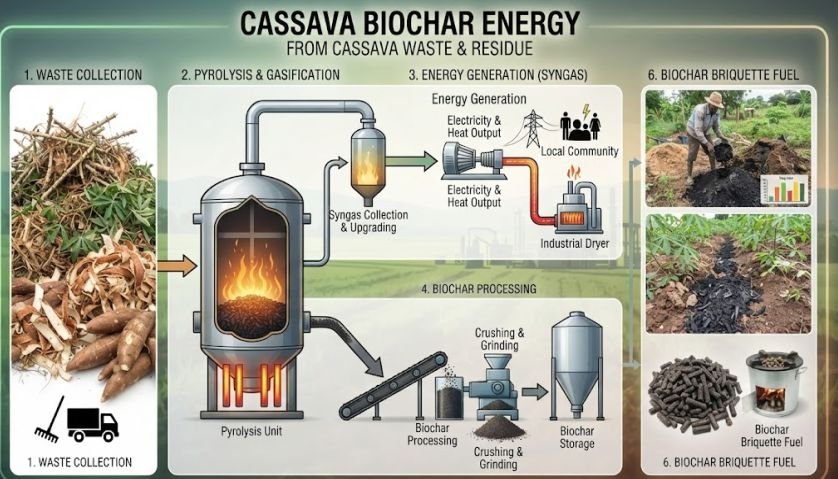
Biochar is the solid, carbon-rich residue left when biomass is heated with little oxygen, a process called pyrolysis.
Pyrolysis also releases a condensable bio-oil and a combustible gas, and those co-products are where the renewable energy comes from.
The biochar itself could be burned like charcoal, but burning it releases the stored carbon and throws away the soil benefit.
Carbon standards draw the same line, and a guide to Verra’s VM0044 notes that credited biochar must stay in a monitored sink rather than be burned.
For the wider picture of energy routes from this crop, see our comparison of cassava-based fuels and energy options.
Which Cassava Residues Make the Best Biochar
Pyrolysis needs dry, carbon-rich material, so woody stems generally beat wet peels and pulp as a starting feedstock.
A Colombian techno-economic study in Bioresource Technology Reports found cassava branches more suitable for biochar than peels.
A microwave pyrolysis study on ScienceDirect measured cassava stem at 49.5 percent carbon and 27 percent fixed carbon, confirming its value as feedstock. See a dedicated post on different cassava residues.
| Residue | Suitability | Notes |
|---|---|---|
| Stems and branches | Best | Woody and high in fixed carbon; keep enough for replanting |
| Dried peels | Good | Must be dried first; they also have value as feed and digester input |
| Dried pulp | Fair | Fine and fibrous; usually better suited to feed or digestion |
| Leaves and tops | Poor | Low mass; better left on the field as mulch |
Most of these residues arise at predictable points, which our processing methods overview maps out.
From my own farm, I keep the best stems for the next planting, and only the surplus and damaged stems would go to a kiln.
Cassava peels deserve a second thought, since they also feed livestock and digesters, as our waste-to-biogas guide for processors explains.
Pulp has its own buyers too, and our analysis of the pulp by-product trade compares those outlets.
How Pyrolysis Temperature Changes Cassava Biochar
Temperature is the main dial a producer controls, and it trades biochar quantity against stability.
The Colombian study recorded a biochar yield of 43.78 percent from cassava residues under slow pyrolysis at 300°C.
At higher temperatures, the yield falls, and a 2026 review in RSC Advances reports carbonization residues of 20 to 25 percent at 550°C.
The same review notes that slow pyrolysis at 500 to 600°C gives cassava residue biochar with up to 81.35 percent carbon.
Stability matters for carbon credits, since the VM0044 guide lists a permanence factor of 0.89 above 600°C, falling to 0.65 at 350 to 450°C.
In plain terms, hotter kilns make less biochar, but more of its carbon is counted as durably stored.
From an engineering standpoint, a small producer should pick one temperature range and hold it steady, because inconsistent batches are hard to sell or certify.
What the Soil Research Actually Shows
Biochar’s soil effects are real but more modest and site-specific than many promotional articles suggest.
A study in Biomass and Bioenergy tested biochar from cassava stems and leaves on sandy loam at 25 and 50 tons per hectare.
At 50 tons per hectare, biochar made at 500 and 600°C raised soil pH from 5.0 to 6.0.
Water-holding capacity rose by 13 and 20 percent for the 400°C and 600°C biochars, yet maize germination showed no clear change.
Note the rate: 50 tons per hectare is far more than most smallholders could ever produce or spread.
Nutrient content matters too, and cassava peelings charred at 400°C in an artisanal oven held 1.91 percent potassium and 1.14 percent nitrogen, per Scientific African.
It works best on acidic, sandy soils, which our soil requirements breakdown helps you identify.
Treat biochar as a partner to fertilizer, not a replacement, and time applications using our cassava fertilizer guide.
I have not found strong published trials showing cassava root yield gains from cassava biochar, so I would test it on a small plot first.
Carbon Storage and Carbon Credits: Promise and Paperwork
Puro.earth, which runs a leading biochar methodology, says pyrolysis can store carbon for at least 200 years.
Earning credits is another matter, because registries require documented feedstock, verified kiln conditions, lab tests, and proof the biochar reached an approved use.
In my judgment, that paperwork costs more than a single farm would earn, so credits suit pooled cooperative or factory projects.
Burning residues in the open forfeits all of this and adds to the land and air impacts of cassava growing.
Can It Pay? The Economics
Selling biochar is harder than making it, because buyers want consistent quality and most farmers have never seen the product.
The Colombian study found a slow pyrolysis plant feasible only above 3.4 tons of feedstock per hour, with biochar selling at $1,600 per ton.
That scale and price are far beyond a village kiln in Abia, where biochar is better treated as an input for your own fields.
Processors weighing a kiln against other waste investments can compare costs using our cassava enterprise business plan model.
Getting Started With a Small Kiln
A simple start uses a flame curtain kiln, an open cone or pit where a flame layer burns off gases while shielding the char beneath.
- Dry stems and peels until they snap cleanly, because wet feedstock produces smoke and poor, uneven char.
- Chop the material into similar sizes so every piece chars at the same rate.
- Light a small fire at the base and add thin layers only when the top turns gray with ash.
- Quench the finished char with water once the kiln is full, which stops it from burning away to ash.
- Mix the cooled biochar with compost or manure for a few weeks before spreading, so it arrives charged with nutrients.
Work outdoors, away from homes and dry grass, and keep water nearby, since open kilns throw sparks and heat.
Anyone planning to sell should test batches for pH and carbon, and certification schemes such as the European Biochar Certificate set quality thresholds.
Spread it before planting, alongside the soil preparation steps in our complete cassava growing guide.
Conclusion
Cassava biochar is best seen as a soil and carbon product, made from residues that would otherwise rot or burn.
Stems are the strongest feedstock, while peels and pulp may earn more as feed or digester input.
Research shows gains in soil pH and water-holding capacity, but at application rates few smallholders can reach.
Carbon credits are possible, though they suit pooled cooperative projects far better than single farms.
Try one small kiln batch this dry season, apply it to a test plot, and report your results in the comments.
Frequently Asked Questions
Which cassava residue makes the best biochar?
Cassava stems and branches work best because they are woody and high in fixed carbon. Peels also work once properly dried, though they have competing uses as feed.
Is biochar from cassava a fuel?
It can burn like charcoal, but that releases its carbon and wastes the soil benefit. The renewable energy in this process comes from the pyrolysis gases and bio-oil.
How much biochar does cassava residue produce?
One Colombian study recorded a 43.78 percent biochar yield at 300°C under slow pyrolysis. Higher temperatures give less biochar, but the carbon it holds is much more stable.
Can a small cassava farmer earn carbon credits from biochar?
It is possible but difficult, since registries demand documented feedstock, verified kiln conditions, and lab tests. Credits are far more realistic for pooled cooperatives or larger processing factories.

Chimeremeze Emeh is a tropical crop farmer and chemical engineer from Ntigha, Isiala Ngwa North LGA, Abia State, Eastern Nigeria, specializing in cassava and palm oil, with over 30 years of hands-on experience growing, harvesting, and processing cassava. He grows TMS series, TME 419, and local traditional varieties on his own farms and operates a small-scale cassava flour and starch production business through Cassava Pathway, which he founded as a CAMA-registered agribusiness in 2024. He is also the founder of Palm Oil Pathway, where he applies the same tropical farming expertise. His farms are located in Ntigha, Abia State.