Cassava growth stages determine root development, yield potential, and harvest quality. Understanding how cassava adapts to drought, soil conditions, and climate helps farmers improve productivity, reduce crop stress, and manage fields more efficiently from planting to harvest.
The stages of cassava growth influence how the crop develops, stores starch, and produces healthy roots for harvest.
From sprouting and leaf formation to tuber enlargement and maturity, each stage requires proper field management to support strong plant growth and higher yields.
Cassava is widely grown because of its ability to adapt to poor soils, drought conditions, irregular rainfall, and changing climates better than many staple crops.
This adaptability makes cassava important for food security and commercial farming across tropical regions.
Mastering the mechanics and adaptability helps farmers improve crop performance, reduce losses, and increase long-term productivity in different environments.
Table of Contents
Cassava Growth Stages Overview
Cassava, an important tropical root crop, progresses through different growth stages from planting to harvest.
Having a grip on these stages: sprouting, vegetative growth, tuber initiation, bulking, and maturation helps optimize yields and manage cultivation effectively.
Let’s take a closer look at each:
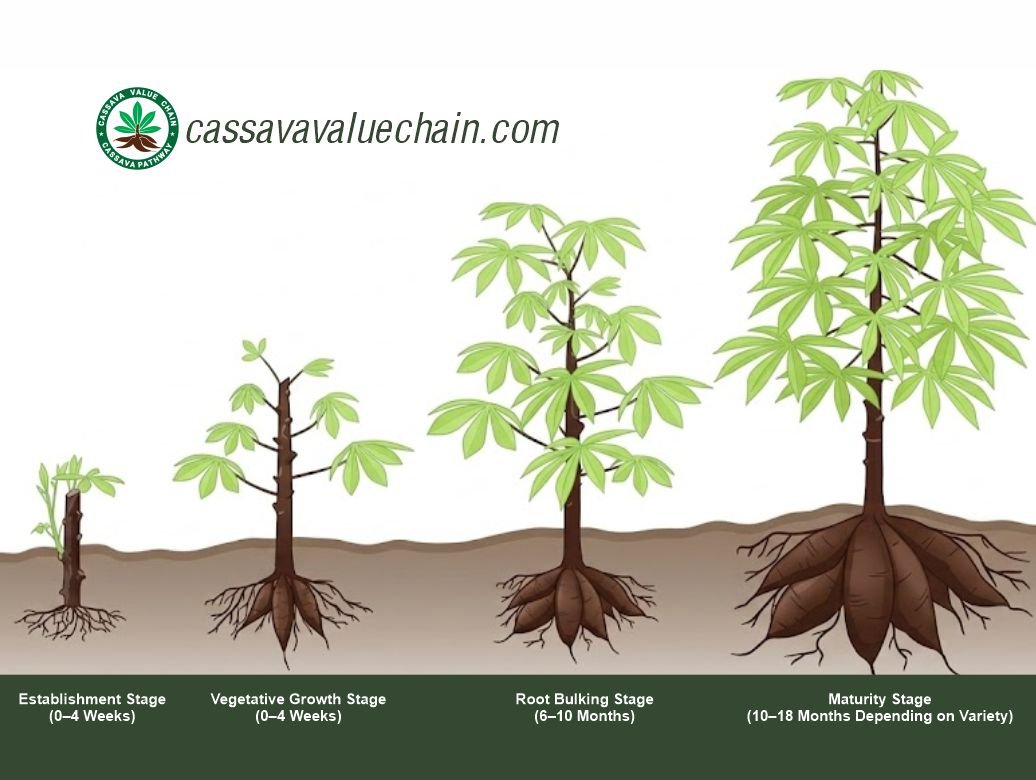
Establishment Stage (0–4 Weeks After Planting)
The establishment stage begins immediately after planting cassava stem cuttings and determines how well your crop develops in the field.
During this period, cuttings produce buds, young shoots, and feeder roots that absorb water and nutrients from the soil.
Healthy sprouting depends on fresh planting materials, proper planting depth, warm temperatures, and adequate soil moisture.
Green shoots emerge above the soil surface within days or weeks, allowing the plant to begin photosynthesis and early leaf production.
Good moisture conditions remain important at this stage because dry soil can delay sprouting, weaken root formation, and reduce plant survival.
Strong establishment supports better vegetative growth, healthier cassava plants, improved root development, and higher yields later in the growing season.
Vegetative Growth Stage (1–6 Months)
After the establishment stage comes the vegetative stage. During this vegetative growth stage, cassava plants develop rapidly above and below the soil.
Stems grow taller, branches spread outward, and leaves increase across the plant canopy.
At the same time, the root system expands deeper into the soil to absorb more water and nutrients needed for healthy growth.
Large green leaves support peak photosynthesis activity by converting sunlight into energy for plant development and future root bulking.
A wider canopy also helps suppress weeds by reducing sunlight reaching the soil surface.
Good rainfall, balanced nutrients, proper spacing, and weed control during this stage improve plant vigor and prepare the cassava crop for stronger starch accumulation and storage root formation in later growth stages.
Root Bulking Stage (6–10 Months)
During the root bulking stage, cassava plants begin forming and enlarging storage roots beneath the soil surface.
More nutrients and plant energy move toward underground root development instead of leaf and stem growth.
Storage roots gradually thicken as starch accumulates inside the tubers, increasing root weight and dry matter content.
Healthy leaves still play an important role by producing energy through photosynthesis to support starch production and root expansion.
Good soil fertility, steady moisture, and proper field management during this stage help improve tuber size, starch yield, and processing quality.
Poor nutrient supply, drought stress, or weed competition can reduce root bulking, limit starch accumulation, and lower overall cassava yield at harvest time.
Maturity Stage (10–18 Months Depending on Variety)
At the maturity stage, cassava roots reach full development with maximum starch storage inside the tubers.
This is the period when root weight, dry matter content, and processing quality are at their best for products like garri, flour, and starch extraction.
Plant growth above the soil slows down, with reduced leaf production and noticeable yellowing of older leaves as energy shifts fully into storage roots.
Stem thickening stabilizes while the plant shows fewer new shoots.
Signs of harvest readiness include large, well-formed roots, declining foliage, and crop age, depending on the cassava variety.
Harvesting at the right time improves yield, texture, and market value, while a delayed harvest may reduce starch quality and increase fiber content in the roots.
Climate Adaptability and Survival Mechanisms
Cassava performs well in different climates because of strong survival traits that support growth under stress conditions.
These natural adaptations allow it to remain productive even when rainfall, soil quality, or weather patterns are not stable.
Drought Tolerance Mechanisms
Cassava survives dry conditions through a deep root system that reaches underground moisture sources.
During prolonged drought, the plant reduces water loss by shedding leaves, lowering transpiration rates and conserving energy.
This adaptation helps cassava remain alive through extended dry seasons, allowing regrowth once rainfall returns.
The crop continues to maintain basic physiological activity even under limited water supply, making it reliable in drought-prone regions where other staple crops may fail.
Heat and Tropical Climate Adaptation
Cassava grows best in warm temperatures between 25°C and 35°C, where metabolic and photosynthesis activities remain active.
Strong sunlight supports efficient energy production, encouraging steady plant growth and root development.
The crop adapts well to humid tropical zones and also performs in semi-arid environments with moderate rainfall.
This flexibility allows cassava farming across diverse agro-ecological regions without heavy reliance on controlled environmental conditions or irrigation systems.
Survival in Harsh and Variable Conditions
Cassava thrives in poor soils, irregular rainfall, and low-input farming systems where many crops struggle to survive.
Even when stems or leaves are partially damaged by pests, drought, or storms, the plant can regenerate new shoots and continue growing.
Its low requirement for fertilizers and irrigation makes it suitable for resource-limited farming environments.
This resilience ensures consistent production in marginal lands, supporting food security in areas with unpredictable climate and limited agricultural infrastructure.
Environmental Tolerance Levels of Cassava
Cassava handles different environmental pressures better than many staple crops, which makes it suitable for farming in diverse and sometimes difficult conditions.
Its tolerance levels vary across drought, heat, soil quality, and physical damage, all of which affect field performance and yield.
Drought Tolerance
Cassava shows strong resistance to long dry periods by reducing water use and slowing down leaf activity.
Compared to cereals, it requires less moisture to stay productive.
The plant conserves water through leaf shedding during stress periods and relies on stored moisture within its roots to stay alive.
This adaptation allows cassava to survive drought spells and resume active growth once rainfall returns, making it reliable in dry farming regions.
Heat Tolerance
Cassava performs well in hot tropical environments where temperatures remain high for long periods.
Growth continues steadily under strong sunlight, with minimal heat-related stress when soil moisture is adequate.
The plant maintains photosynthesis efficiency even in intense heat, supporting root development and starch accumulation.
This makes cassava suitable for regions with prolonged sunny seasons and high daytime temperatures where other crops may struggle.
Soil Stress Tolerance
Cassava can grow in low-fertility soils where nutrient levels are poor, making it valuable for marginal farmland.
It also shows moderate tolerance to acidic soils, adapting better than many food crops.
However, performance drops in waterlogged or heavily compacted soils, which restrict root expansion and oxygen flow.
Good drainage improves root development and helps maintain steady plant growth under varying soil conditions.
Pest and Damage Recovery Tolerance
Cassava can recover from partial stem damage by producing new shoots from surviving nodes.
This resilience helps it withstand grazing pressure, storms, and some environmental stress.
Recovery strength depends on the growth stage, with younger plants more vulnerable and mature plants better able to bounce back.
Even after damage, cassava often continues root development, supporting yield stability in unpredictable field conditions.
Interconnection of Growth, Climate, and Tolerance
Cassava growth, climate response, and tolerance levels work together to shape yield results in real farming conditions.
Each growth stage depends on how well the plant handles drought, heat, soil stress, and pest pressure.
When environmental stress is low, cassava channels more energy into root bulking and starch accumulation.
During harsh conditions, survival mechanisms slow growth but protect the plant until conditions improve.
This resilience explains why cassava performs well in unstable farming environments where rainfall, soil fertility, and climate conditions vary.
Strong adaptability across all stages supports stable harvests, food security, and reliable production even under unpredictable weather patterns.
Conclusion
Cassava growth stages and environmental tolerance work together to shape yield, quality, and farm success from planting to harvest.
Each phase, from sprouting to maturity, guides how roots develop, store starch, and respond to field conditions.
Climate adaptability and stress tolerance help cassava survive drought, heat, poor soils, and damage, keeping production stable when other crops struggle.
Proper timing, field management, and awareness of these growth patterns reduce losses and improve productivity.
Cassava remains a dependable staple crop for food security and commercial farming, especially in regions with changing weather, limited resources, and unpredictable growing conditions across tropical agriculture systems.

Chimeremeze Emeh is a tropical crop farmer and chemical engineer from Ntigha, Isiala Ngwa North LGA, Abia State, Eastern Nigeria, specializing in cassava and palm oil, with over 30 years of hands-on experience growing, harvesting, and processing cassava. He grows TMS series, TME 419, and local traditional varieties on his own farms and operates a small-scale cassava flour and starch production business through Cassava Pathway, which he founded as a CAMA-registered agribusiness in 2024. He is also the founder of Palm Oil Pathway, where he applies the same tropical farming expertise. His farms are located in Ntigha, Abia State.